
Have you ever gone up or down a flight of stairs and noticed that you could not maintain a hold on the railing? Is this a compliance issue, a safety concern, or both? Some clients tell us we are splitting hairs when we come across this in our audits; but it is actually VERY EASY to catch, as safety professionals should be using handrails!!! And when we do and we have to let go because of some type of obstruction, our auditing lights and whistle should be activated. Here is what OSHA requires…
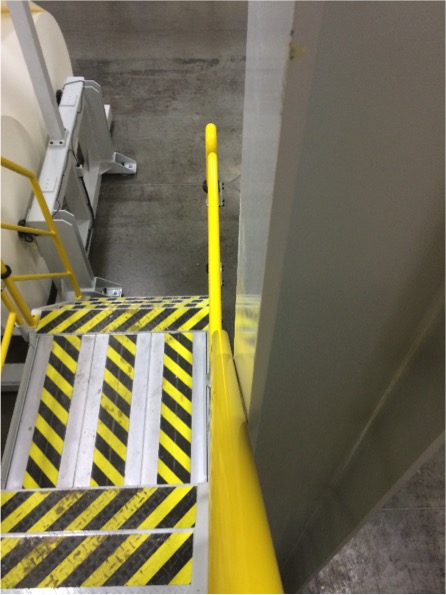
1910.23(e)(5)(i) A handrail shall consist of a lengthwise member mounted directly on a wall or partition by means of brackets attached to the lower side of the handrail so as to offer no obstruction to a smooth surface along the top and both sides of the handrail. The handrail shall be of rounded or other section that will furnish an adequate handhold for anyone grasping it to avoid falling. The ends of the handrail should be turned in to the supporting wall or otherwise arranged so as not to constitute a projection hazard.
1910.23(e)(5)(ii) The height of handrails shall be not more than 34 inches nor less than 30 inches from upper surface of handrail to surface of tread in line with face of riser or to surface of ramp.
1910.23(e)(5)(iii) The size of handrails shall be: When of hardwood, at least 2 inches in diameter; when of metal pipe, at least 1 1/2 inches in diameter. The length of brackets shall be such as will give a clearance between handrail and wall or any projection thereon of at least 3 inches. The spacing of brackets shall not exceed 8 feet.
1910.23(e)(5)(iv) The mounting of handrails shall be such that the completed structure is capable of withstanding a load of at least 200 pounds applied in any direction at any point on the rail.
1910.23(e)(6) All handrails and railings shall be provided with a clearance of not less than 3 inches between the handrail or railing and any other object.