
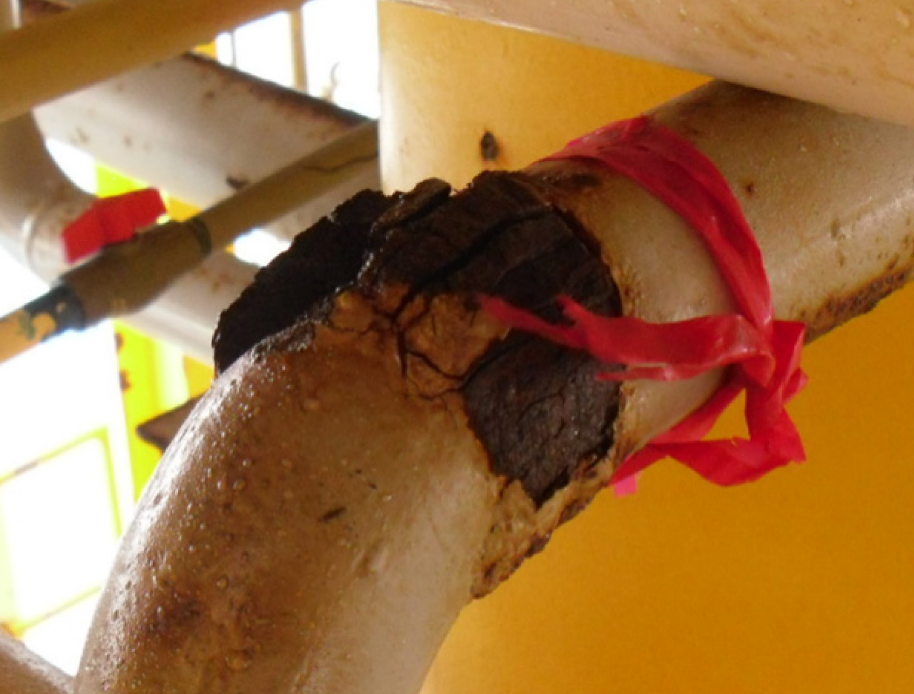
 An increased number of gas release incidents have occurred in the Gulf of Mexico Region due to leaks from cracked welds, ring gaskets, flange gaskets, inlet nozzles, pipeline risers, suction headers, pressure safety valves (PSVs), and fuel gas lines. These gas release incidents involve deficiencies in Quality Assurance and Mechanical Integrity programs and are caused by corrosion of process piping and deterioration of flanges and gaskets.
Below are details on a few recent incidents:
- A cracked weld on a compressor suction bottle triggered a gas detector alarm. Prior stabilization modifications as well as fatigue caused by the vibrations of the machinery over time may have contributed to the failure of the weld.
- A ring gasket on a test separator outlet developed a leak during well testing. The well test required the separator to operate in High Pressure mode, which had not been recently performed.
- An operator noticed water and ice forming on a fuel gas line and shut-in the facility after hearing gas leaking from the line. The insulation on the line allowed moisture to accumulate, which caused external corrosion and eventually caused a pinhole leak.
Therefore, BSEE recommends that operators and contractors consider the following:
- Ensure the design, installation, inspection, repair, testing, and maintenance of all valves, fittings, flanges, wellhead piping accessories, risers, flowline piping accessories, production manifold (headers) piping, pressure vessel piping, and pressure relief systems are included within the operator’s QAMI Program;
- Verify the QAMI program incorporates all requirements from American Petroleum Institute (API) Recommended Practice (RP) 14 E – Design/Installation of Production Platform Piping Systems and API 570 – Piping Inspection Code: In-service Inspection, Rating, Repair, and Alteration of Piping Systems;
- Confirm leak detection methods include primary protection, secondary protection, and location of safety device requirements from API 14C – Recommended Practice for Analysis, Design, Installation of Basic Surface Safety Systems for Offshore Production Platforms (7th Edition, 2001);
- Review daily pollution inspection records to ensure all gas releases that initiate equipment or process shutdown are reported to BSEE per 30 CFR 250.188(b)(2);
- Ensure personnel are trained in gas detection practices and reporting requirements;
- Exercise care when pressurizing piping that has been out of service;
- Verify that pulsation dampeners and other vibration dampening equipment are functioning properly and maintained. Bladder type dampeners may need to be periodically re-pressurized;
- Verify that compressors and other equipment that produce vibration are properly maintained. Poorly maintained or malfunctioning compressors may produce excessive vibration which may damage piping; and,
- Thoroughly investigate the root causes of leaks to identify potential management system deficiencies
CLICK HERE for the official alert from the Bureau of Safety and Environmental Enforcement (BSEE)