Several years ago I wrote an article about how a space goes through its transitions to become a non-permit required confined space. A space is not identified as a non-permit required confined space during its first evaluation; it becomes one after it has been “reclassified” using either (c)(7) or 1926.1203(g). That article caused quite a stir with my readers, but most were convinced of the rationale. But now, OSHA has a different “definition” for a “non-permit required confined space” in 1926.1202 than from how they defined in 1910.146(b) way back in the 1990’s. Coupling this article with the one I posted back in June (Does OSHA’s new PRCS in Construction allow the use of Alternative Entry and Reclassification on the same PRCS?) I tend to think OSHA knew exactly what they were doing and here’s why…
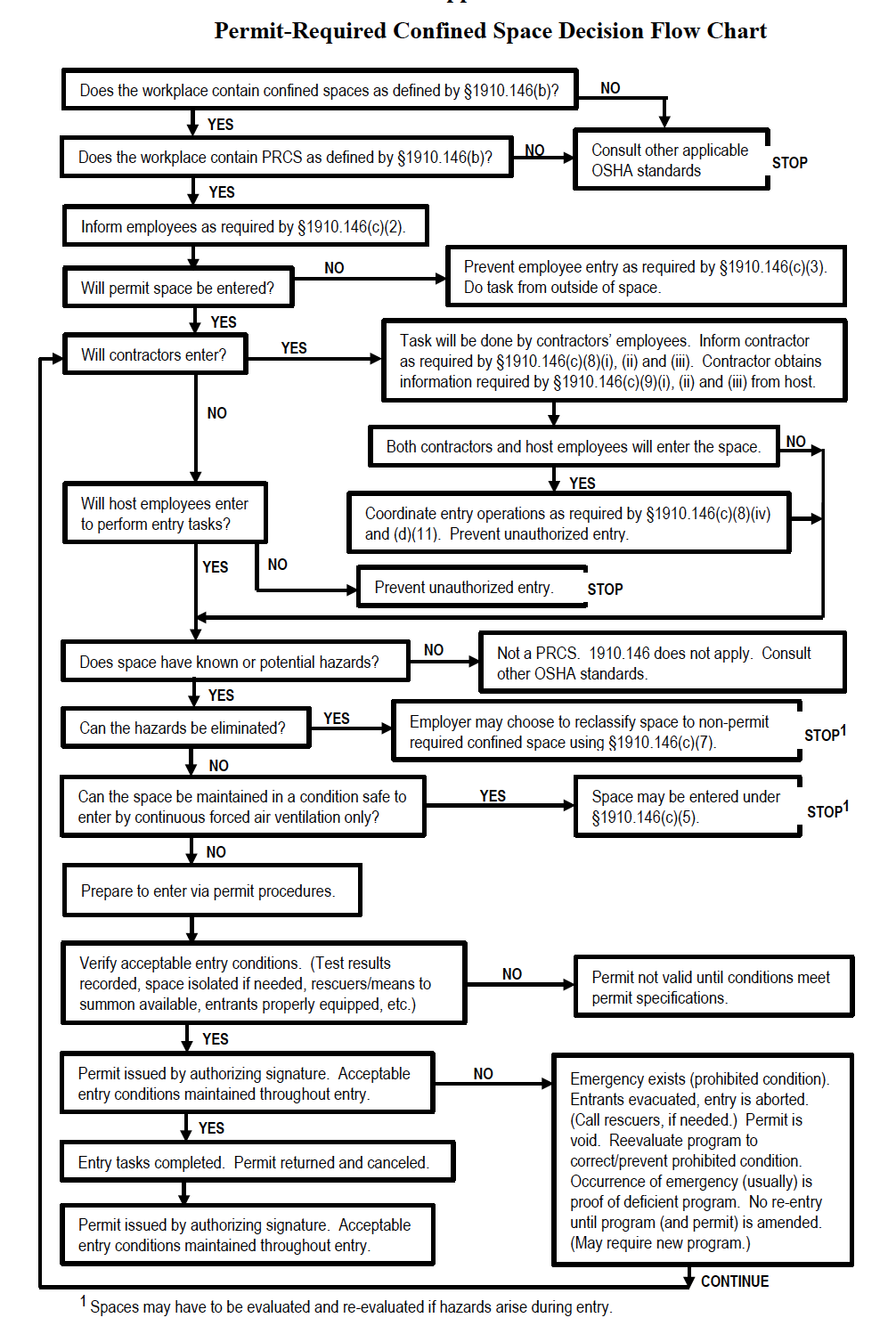
In the early days, OSHA made it clear that 1910.146(c)(5) and (c)(7) were STAND-ALONE means to enter a PRCS. There Appendix A flow chart and the cleaner version in the CPL have “STOP” at the end of each of the entry methods; a clear intent that the two (2) entry means are stand-alone. But the debate continues today… can I lock out the physical hazards using (c)(7) and then use (c)(5) forced-air ventilation to control the atmospheric hazards?
In my June article, I pointed out the very different language in the newer construction standard in which OSHA seemed to be saying that we could combine these entry methods on the same PRCS and now that we look at the difference in how they have defined a non-PRCS I am more convinced this is OSHA’s intent. Here are the different definitions:
1910.146(b) “Non-permit confined space” means a confined space that does not contain or, with respect to atmospheric hazards, have the potential to contain any hazard capable of causing death or serious physical harm.
1926.1202 Non-permit confined space means a confined space that meets the definition of a confined space but does not meet the requirements for a permit-required confined space, as defined in this subpart.
Do you see the BIG difference? In the 1910 standard, OSHA included the phrase “with respect to atmospheric hazards”, which they left out of the 1926 definition.
Couple this with the language in 1926.1203(e), I have to say, I think the “alternative” entry means AND the “reclassification” entry means can be used simultaneously on the same PRCS….
(emphasis by me)
1926.1203(e) An employer may use the alternate procedures specified in paragraph (e)(2) of this section for entering a permit space only under the conditions set forth in paragraph (e)(1) of this section.
1926.1203(e)(1) An employer whose employees enter a permit space need not comply with §§ 1926.1204 through 1206 and §§ 1926.1208 through 1211, provided that all of the following conditions are met:
1926.1203(e)(1)(i) The employer can demonstrate that ALL physical hazards in the space are eliminated or isolated through engineering controls so that the ONLY hazard posed by the permit space is an actual or potential hazardous atmosphere;
1926.1203(e)(1)(ii) The employer can demonstrate that continuous forced air ventilation alone is sufficient to maintain that permit space safe for entry, and that, in the event the ventilation system stops working, entrants can exit the space safely;
1926.1203(e)(1)(iii) The employer develops monitoring and inspection data that supports the demonstrations required by paragraphs (e)(1)(i) and (ii) of this section;
1926.1203(e)(1)(iv) If an initial entry of the permit space is necessary to obtain the data required by paragraph (e)(1)(iii) of this section, the entry is performed in compliance with §§ 1926.1204 through 1926.1211;
1926.1203(e)(1)(v) The determinations and supporting data required by paragraphs (e)(1)(i), (ii), and (iii) of this section are documented by the employer and are made available to each employee who enters the permit space under the terms of paragraph (e) of this section or to that employee’s authorized representative; and
1926.1203(e)(1)(vi) Entry into the permit space under the terms of paragraph (e)(1) of this section is performed in accordance with the requirements of paragraph (e)(2) of this section.
Note to paragraph (e)(1). See paragraph (g) of this section for reclassification of a permit space AFTER all hazards within the space have been eliminated.
So the debate will continue…