
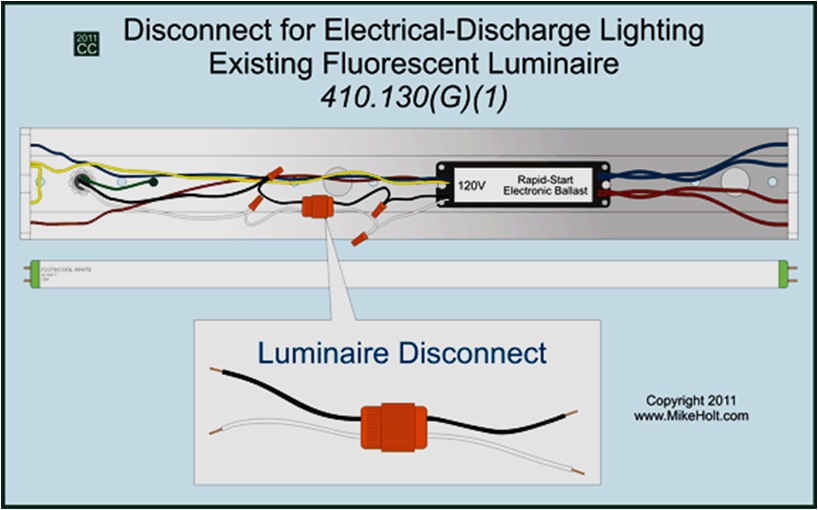
This was shared in one of the safety groups I participate in and I am not sure how I feel about this. Your thoughts/concerns? Would you let this device be used in your organization? Do you feel it replaces LOTO? Any safety people been approached by electrical workers wanting to use these? Anyone have first hand experience using these?
At first study I see these as “OK” AS LONG AS ONLY ONE WORKER is doing the work (e.g. they would have EXCLUSIVE CONTROL by the fact that they are in sight AND reach of the “isolation” device); but if this were a two-person job I would question how two people can have “exclusive control” of the same device at the same time without using locks! I would also NOT allow them to be used in situation where the single worker can NOT maintain 100% line of sight AND arms reach of these devices. Not sure of a scenario where this would be the case, but if they came across it, LOTO would be REQUIRED. Here is what the NEC states:
ARTICLE 410 Luminaires, Lampholders, and Lamps
XII. Special Provisions for Electric-Discharge Lighting Systems of 1000 Volts or Less
410.130 General.
G Disconnecting Means.
1 General.
In indoor locations other than dwellings and associated accessory structures, fluorescent luminaires that utilize double-ended lamps and contain ballast(s) that can be serviced in place shall have a disconnecting means either internal or external to each luminaire. For existing installed luminaires without disconnecting means, at the time a ballast is replaced, a disconnecting means shall be installed. The line side terminals of the disconnecting means shall be guarded.
Exception No. 1: A disconnecting means shall not be required for luminaires installed in hazardous (classified) location(s).
Exception No. 2: A disconnecting means shall not be required for emergency illumination required in 700.16.
Exception No. 3: For cord-and-plug-connected luminaires, an accessible separable connector or an accessible plug and receptacle shall be permitted to serve as the disconnecting means.
Exception No. 4: A disconnecting means shall not be required in industrial establishments with restricted public access where conditions of maintenance and supervision ensure that only qualified persons service the installation by written procedures.
Exception No. 5: Where more than one luminaire is installed and supplied by other than a multiwire branch circuit, a disconnecting means shall not be required for every luminaire when the design of the installation includes disconnecting means, such that the illuminated space cannot be left in total darkness.
National Electrical Code 2011, Section 410.130(G)(1)
Benefits of Ballast Disconnects
Ballast disconnects, now mandated by the NEC, easily justify their cost. The first and foremost consideration is, of course, increased safety (I do not agree with the statement that these “increase safety” – How?). However, another benefit is that the use of ballast disconnects can shorten the downtime required to properly change a ballast. In some cases, changing out a ballast may include:
- Lockout/tagout to prevent shock hazard to the electrician.
- Roping off the work area to prevent any conceivable injury to other workers, such as falling tools.
- Changing the ballast while the circuit feeding the luminaire is energized has been a standard practice where there’s no local disconnect. But it’s an unsafe practice to work with energized conductors. Even if the worker does not sustain a fatal shock, a subsequent fall off a ladder can cause death or injury.
- With ballast disconnects installed, you don’t need lockout/tagout or the use of PPE, and that shortens your task list, which can result in an increase of overall productivity. Ultimately, any safety innovation that will help make sure that you come home in one piece at night is certainly well worth the bother and expense.
With ballast disconnects installed, you don’t need lockout/tagout or the use of PPE, and that shortens your task list, which can result in an increase of overall productivity.
Ultimately, any safety innovation that will help make sure that you come home in one piece at night is certainly well worth the bother and expense.
Please post comments – be professional, but I want some honest opinions.
Bryan