
Earlier this year I wrote about the EPA Safety Alert regarding having high expectations of an Excess Flow Valve being a reliable safeguard to stop an uncontrolled flow of a HHC/EHS. This article is another example of how these valves should NOT be considered a safeguard and most certainly should NOT be the sole layer of protection for excess flow from a leaking hose/pipe. About 3:45 a.m. on July 14, 2001, at a chemical plant in Riverview, Michigan, a pipe attached to a fitting on the unloading line of a railroad tank car fractured and separated, causing the release of methyl mercaptan, a poisonous and flammable gas. About 4:09 a.m., shortly after the Fire Department chief arrived on the scene, the methyl mercaptan ignited, engulfing the tank car in flames and sending a fireball about 200 feet into the air. Here is the incident break down…
Fire damage to cargo transfer hoses on an adjacent tank car resulted in the release of chlorine, a poisonous gas that is also an oxidizer. The fire was extinguished about 9:30 a.m. Three plant employees were killed in the accident. There were several other injuries; most of the injured were treated for respiratory symptoms and released. About 2,000 residents were evacuated from their homes for about 10 hours. Two tank cars, railroad track, and plant equipment (including hoses and fittings) were damaged in the fire.
The National Transportation Safety Board determines that the probable cause of the accident involving the release of methyl mercaptan from the tank car at the plant in was a fractured cargo transfer pipe that resulted from
- the failure of the plant to adequately inspect and maintain its cargo transfer equipment, and
- inadequate Federal oversight of unloading operations involving hazardous materials.
Contributing to the accident was the plant’s reliance on a tank car excess flow valve to close in the event of a leak from cargo transfer equipment and the company’s failure to require appropriate safety equipment for employees involved in tank car loading and unloading operations.
As a result of its investigation of the accident, the National Transportation Safety Board identified the following safety issues:
- The adequacy of the plant’s procedures for unloading tank cars containing hazardous materials.
- The adequacy of Federal regulations and oversight for cargo transfer operations involving bulk containers transporting hazardous materials.
- As a result of its investigation of this accident, the Safety Board makes safety recommendations to the U.S. Department of Transportation, the Federal Railroad Administration, the Environmental Protection Agency, and the Occupational Safety and Health Administration.
Unloading Apparatus Information
The first component of plant’s unloading apparatus consisted of a 1-foot-long, 1-inch-diameter steel pipe with a 2- to 1-inch reducer threaded onto one end and a four-bolt flange threaded onto the other. In preparation for product transfer, the reducer end of the pipe was passed through an access hole on the side of a tank car dome, and the reducer was threaded onto the tank car’s unloading valve. The 1-inch pipe was the one that, in this accident, failed and separated, releasing the methyl mercaptan.
Additional cargo unloading components were then attached to the 4-bolt flange.
These components included a pressure gauge, a 90-degree elbow, a gate valve, two T-fittings, several lengths of 1-inch pipe, and a flexible hose that attached to the plant process piping. (See figure 4.) The total weight of the unloading apparatus was about 53 pounds. With the exception of the downstream end of the flexible hose, which was attached to the plant piping, the unloading apparatus was supported only by the reducer and the 1-inch pipe mounted in the tank car unloading valve.
Damage
Visible damage to methyl mercaptan tank car UTLX 900558 consisted of fire damage to the jacket, wheels, axles, bearings, brake components, and safety appliances. The fire affected approximately 90 percent of the car. The visible damage to chlorine tank car DCTX 27444 consisted of fire damage to the jacket and running components on the left side (facing the B-end) of the car.
Figure 4. Overhead view of the unloading apparatus.
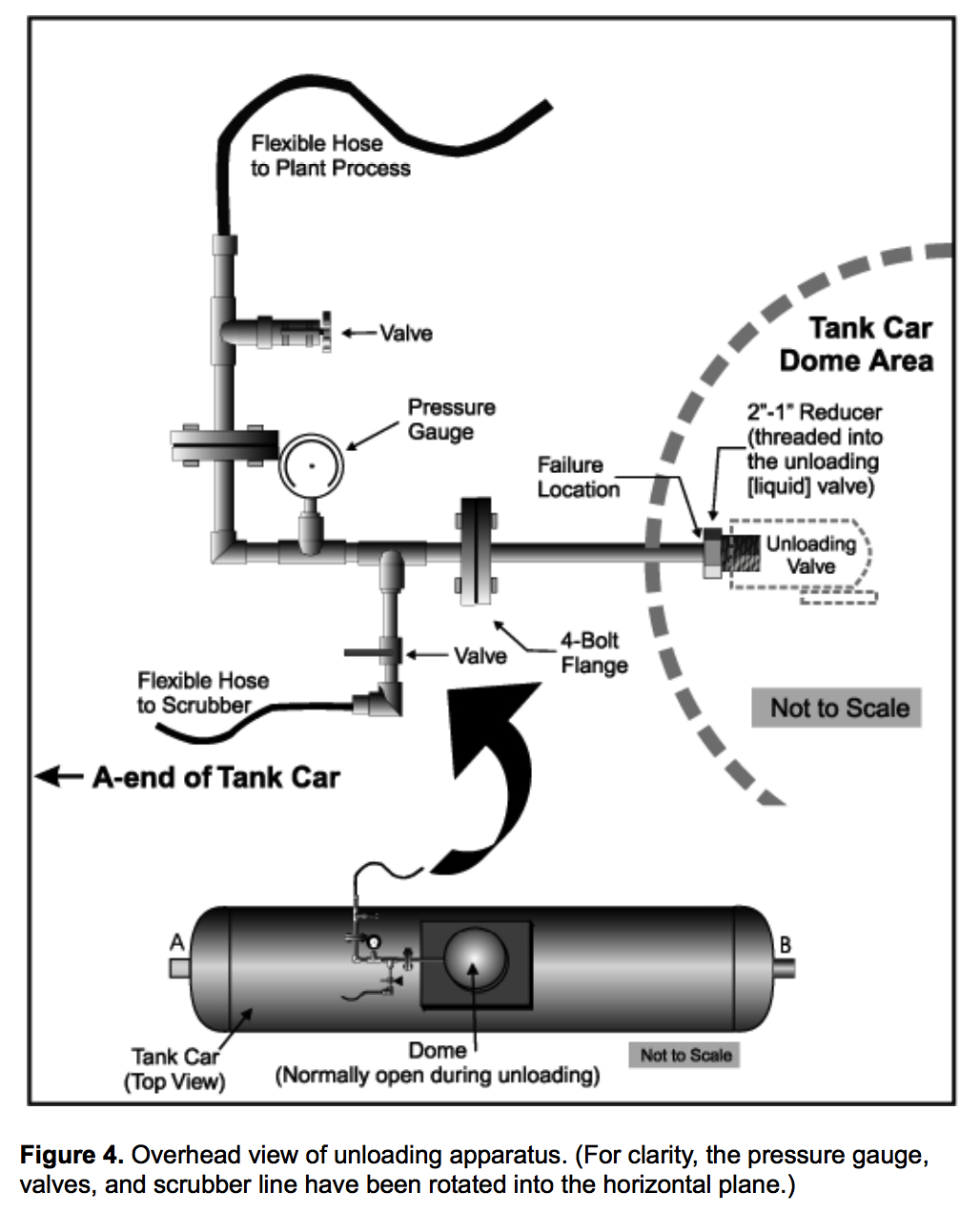
(For clarity, the pressure gauge, valves, and scrubber line have been rotated into the horizontal plane.)
This side was facing tank car UTLX 900558. As noted earlier, a 1-inch-diameter steel pipe in the unloading apparatus of UTLX 900558 was separated at the point the pipe threads exited a 2- to 1-inch reducer installed in the tank car’s unloading valve. The flexible hoses attached to the unloading apparatus on both tank cars were melted and partially consumed by the fire.
Damage to the plant was limited to fire exposure on the methyl mercaptan unloading station, which resulted in melting or damaging most of the non-ferric fittings, gauges, and other apparatus; fire exposure and warping of the track under the methyl mercaptan tank car; and scorching of track ties and nearby wooden planking.
Reliance on the Tank Car’s Excess Flow Valve
Both the EPA and OSHA required the plant to develop and document safety plans for the facility that included safeguards intended to reduce the risk and consequences of catastrophic releases of hazardous materials. The plant’s risk management plan (mandated by the EPA) and process hazard analysis (mandated by OSHA and EPA) included an accident scenario that involved the failure of a flexible hose on the unloading apparatus for a methyl mercaptan tank car – a scenario similar to this accident. Under both plans, the plant indicated that the release of methyl mercaptan would be stopped by the automatic closure of the tank car’s excess flow valve. Further, the plant’s risk management plans explicitly noted that excess flow valves on the tank car would activate in the event of a pipeline or unloading hose rupture. However, when the transfer pipe failed on July 14, 2001, the excess flow valve on the tank car did not close and stop the release of the methyl mercaptan.
Calculations made by Safety Board engineers and parties to the investigation indicated that the flow rate of methyl mercaptan through the broken transfer piping was insufficient to cause the excess flow valve to close. Excess flow valves are designed to close and stop the release of product from the tank car in the event a tank car valve or fitting is broken or sheared off during transit. Attaching a cargo transfer apparatus to a tank car can change product release rates and flow rate characteristics and can prevent the excess flow valve from closing in the event of an emergency. As noted by the Chlorine Institute in its Chlorine Manual and by the Safety Board in its investigation of a July 30, 1983, accident at the Formosa Plastics plant in Baton Rouge, Louisiana tank car excess flow valves are not designed to act as an emergency shutoff device during cargo transfer.
Therefore, the Safety Board concludes that reliance on tank car excess flow valves to stop leaks during tank car cargo transfer operations is inappropriate. To determine whether reliance upon tank car excess flow valves as safety mechanisms during transfer operations is restricted to this plant or is a broader problem, Safety Board investigators interviewed a sampling of domestic chemical companies. Interviews with personnel responsible for company safety plans revealed that six of nine companies (67%) surveyed rely on tank car excess flow valves as a method of stopping or limiting a leak in the transfer equipment. Only one company reported having remotely operated shutoff valves on the unloading piping just outside the tank car dome. (The other two companies did not respond to the Safety Board’s inquiry.) Although the Safety Board’s sampling was limited, the results suggest that the inappropriate use of tank car excess flow valves may be a widespread practice in the chemical industry. To address this issue, the Safety Board believes that the FRA should issue a hazardous materials bulletin to warn excess flow valves cannot be relied upon to stop leaks that occur during those operations (CLICK HERE for the FRA Advisory). The Safety Board further believes that the EPA should notify all facilities that are required to submit risk management plans to the EPA that tank car excess flow valves cannot be relied upon to stop leaks that occur during tank car loading and unloading operations and that those companies that have included reliance on such valves in their risk management plans should instead identify and implement other measures that will stop the uncontrolled release of product in the event of a transfer line failure during tank car loading or unloading.