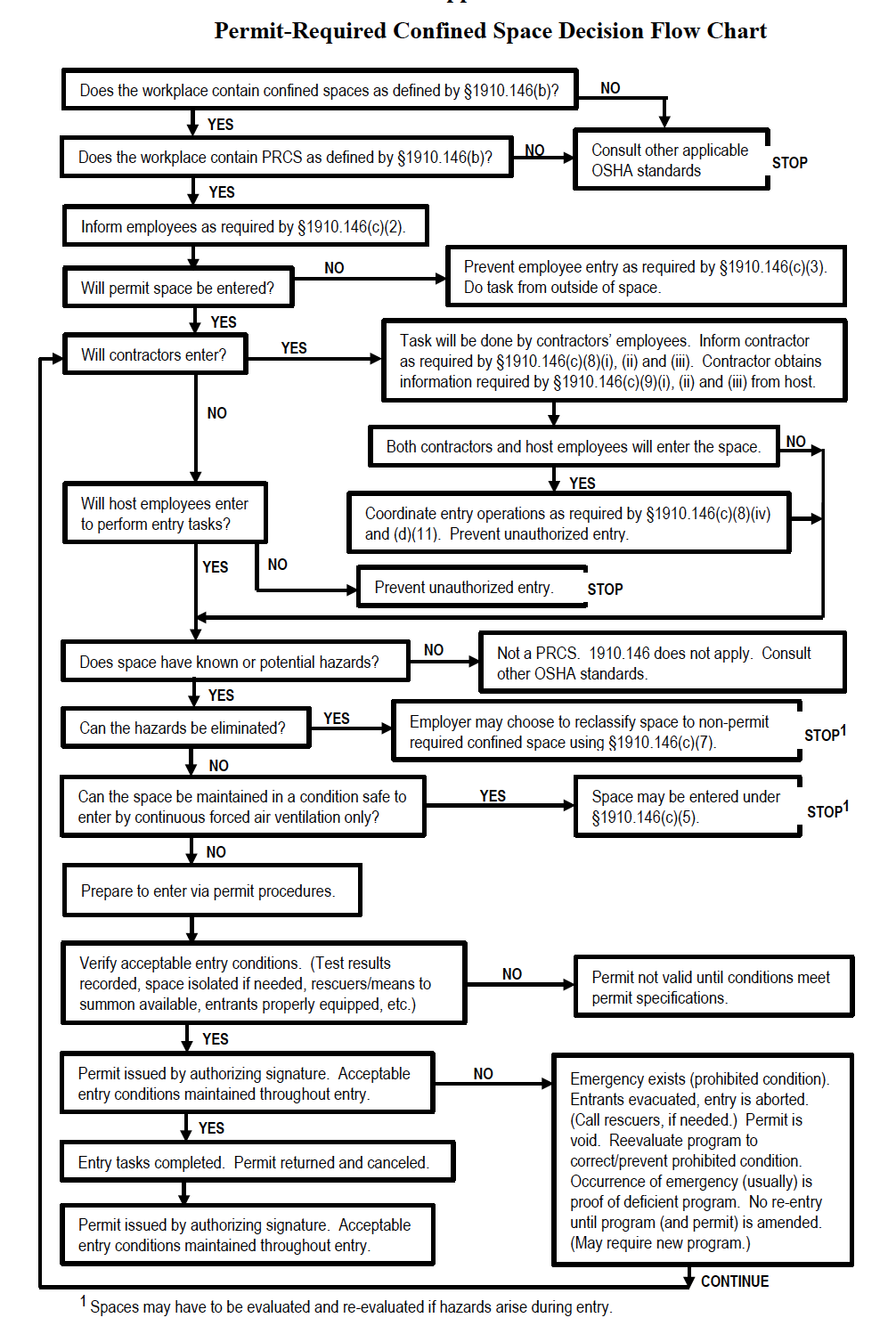
A couple of weeks I posed this question, and I figured there is NOT a consensus among the safety community (including OSHA) as to whether (c)(5) AND (c)(7) can be used on the same PRCS at the same time. My position is NO, they can not be; but I am only one voice in the debate, and many excellent safety professionals have spoken up and said YES. I know it is not clear if we read all the OSHA materials (LOIs, CPL, and Preamble), and in fact, some of the written statements by OSHA do make it appear that both (c)(5) AND (c)(7) can be used on the same PRCS at the same time. But since I do not believe OSHA intended this, I am going to attempt to make the argument that (c)(5) AND (c)(7) are NOT to be used on the same PRCS at the same time.
I first turn to OSHA’s CPL 2.100 – Application of the Permit-Required Confined Spaces (PRCS) Standard, 29 CFR 1910.146. In this CPL’s Appendix A, we can see the flowchart OSHA has provided their CSHOs in how the standard is to be applied. This flowchart makes it clear that (c)(5) and (c)(7) are separate and stand-alone methods based on the hazards of the PRCS. This is significant… in the flow chart, there are three (3) “STOPS,” two of which are associated with (c)(5) and (c)(7). To me, had OSHA intended (c)(5) and (c)(7) to be used together in the same space, they would have connected these sections RATHER THAN applying a STOP function within their flow chart.
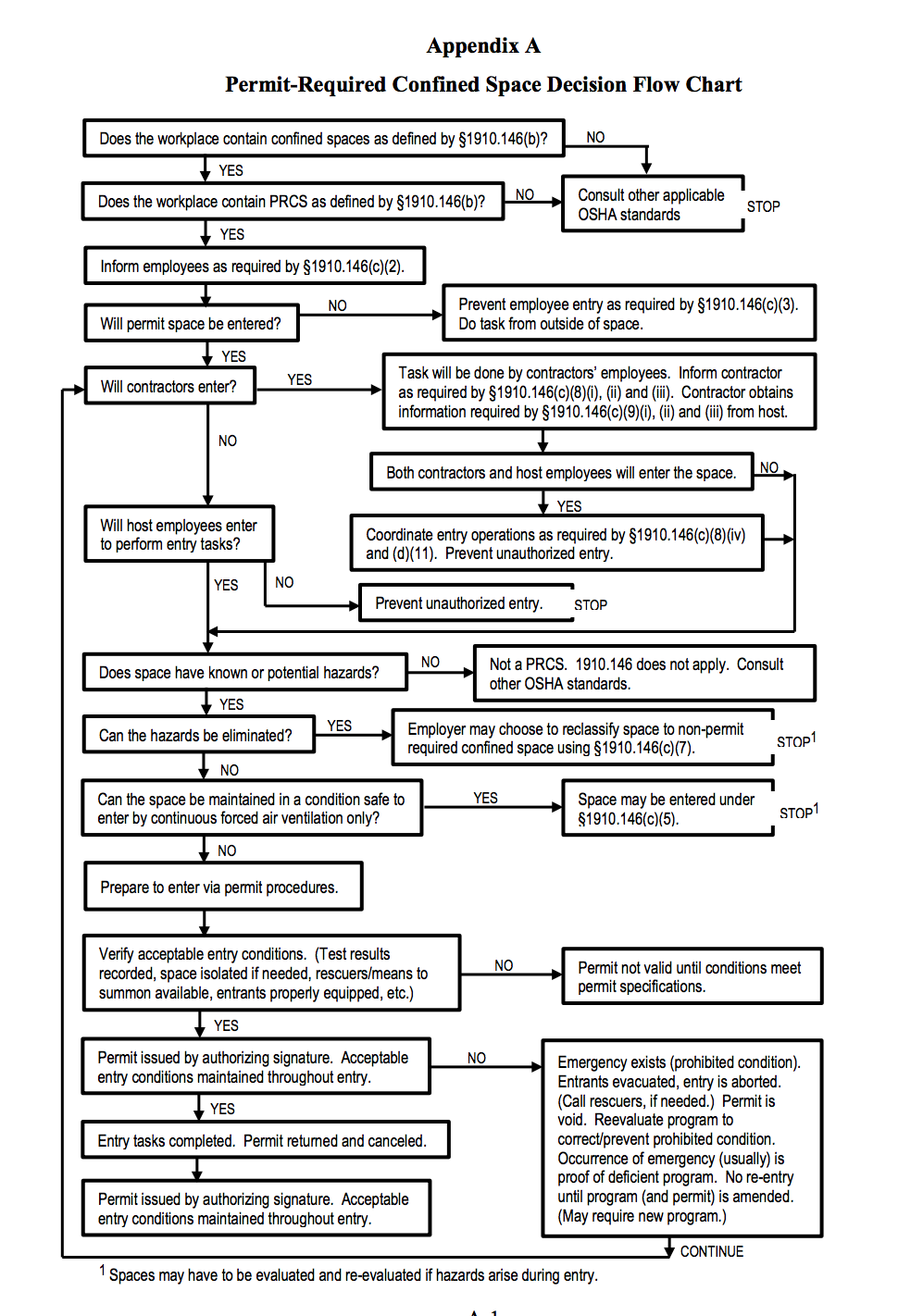
From the PRCS Preamble…
The basic performance-oriented nature of the permit space standard forces employers to develop whatever procedures are necessary to eliminate OR control hazards in permit-required confined spaces. Spaces posing the least risk (above the threshold set by the definition of permit-required confined space) will necessitate the fewest procedures to ensure safe entry. Spaces containing severe or multiple hazards will require more detailed and comprehensive procedures. Lastly, confined spaces not posing the minimum risk set by the definition of a permit-required confined space require the least amount of effort to render them safe for employees; such spaces need neither attendants nor permits(11).
Then, later on, OSHA makes this statement, making it sound as if both (c)(5) and (c)(7) can be used together…
The first condition, set out in paragraph (c)(5)(i)(A) of the final rule, is that the employer MUST be able to demonstrate that the ONLY hazard posed by the permit space is an actual or potential hazardous atmosphere. The procedures required under paragraph (c)(5)(ii) are ONLY appropriate for atmospheric hazards, and the spaces for which these procedures can be used pose ONLY this type of hazard. If the space poses other hazards as well, either all the hazards must be eliminated, under paragraph (c)(7) of the final rule, or the space may only be entered following the full permit space procedures set out in paragraphs (d) through (k).
Then in the next paragraph, they state…
Paragraph (c)(5)(i)(B) indicates clearly that an employer who relies on continuous forced air ventilation to maintain spaces safe for entry must be able to establish that other measures are not needed to protect entrants.
Then OSHA talks about using (c)(7) and says this…
This paragraph applies ONLY to permit spaces containing NO actual or potential atmospheric hazards. OSHA expects that this provision will apply primarily to spaces containing hazardous energy sources OR containing engulfment hazards. The control of hazardous energy sources is addressed by existing section 1910.147, The control of hazardous energy sources (lockout/tagout).
Now I turn to a 1995 OSHA Memo in which OSHA’s Directorate of Compliance Programs says NO WAY…
October 12, 1995
MEMORANDUM FOR: LINDA R. ANKU, REGIONAL ADMINISTRATOR
FROM: JOHN B. MILES, JR., DIRECTOR, DIRECTORATE OF COMPLIANCE PROGRAMS
SUBJECT: COMPLIANCE POLICY CONCERNING 29 CFR 1910.146(c)(5)
This is in response to your letter request for formal guidance regarding the application of 29 CFR 1910.146(c)(5). Although the telephone conversation between our respective staff is recalled, the original memorandum could not be found. Please accept our apology for the delay.
Your letter presented two scenarios and discussed why the Region believes that they should permit a deviation from the standard. The two scenarios presented are being repeated below so that this response imparting OSHA compliance policy will be a stand alone document and not be misinterpreted.
Can an employer choose the option of following paragraph (c)(5) of 1910.146 under the following circumstances?
1. There is another hazard [(beyond atmospheric) emphasis added], such as moving machinery, in the permit-required confined space, that can and will be “eliminated” (as that word is used in the standard) before and during the time entry is made into the permit space.
2. There is a hazardous atmosphere in the permit-required confined space that can and will be controlled by the continuous ventilation during entry into the permit space.
The answer to circumstance no. 1 continues to be NO. The answer to no. 2 is YES, if all the conditions associated with applying the alternate entry procedures of (c)(5) for the permit space(s) are met.
Both the standard and the preamble make it clear that it is not acceptable to use the alternative procedure in paragraph (c)(5) where the classification of a space as a permit space is based on the presence of hazards other than atmospheric in the space. Specifically, paragraph (c)(5)(I)(A) states that the procedure may only be used where the employer “can demonstrate that the only hazard posed by the permit space is an actual or potential hazardous atmosphere.” No mention is made of “eliminating” non-atmospheric hazards to make the space eligible for the application of the (c)(5) procedure.
The discussion of the alternative procedure on page 4488 of the preamble contains the following statement: “If the space poses other [than atmospheric] hazards as well, either all the hazards must be eliminated under paragraph (c)(7) of the final rule, or the space may only be entered following the full permit space procedures set out in paragraphs (d) through (k).” No mention is made of using a combination of the (c)(5) and (c)(7) procedures, or of eliminating non-atmospheric hazards in the space to establish eligibility for the (c)(5) procedure.
The intent of the standard was to protect confined space entrants from harm. The use of a permit system, entailing the preparation of a written permit, is prescribed by the standard for most permit space entry situations. The system is flexible and designed to cover a multitude of spaces and hazards. While the system may be cumbersome for a certain few types of spaces and hazards, it provides the greatest degree of protection for the majority of entries into permit spaces. In condition No. 1 an employer would, in essence, be partially applying parts of paragraph (c)(7) for all the non-atmospheric hazardous conditions to gain further relief through the use of the (c)(5) procedures. Were we to allow entry into spaces that had mechanical hazards without the safeguards of permit-space entry we would undermine a major purpose of the standard. We note also that there is no suggestion of a procedure for such entry that would be comparable to the monitoring requirement in (c)(5). To administratively modify their intent now would be rulemaking without public notice.
From an enforceability position, should we accept a hybrid alternate entry procedure as DeMinimis, the agency would be hard pressed to cite in situation with a “condoned alternate procedure” when an employer failed to address all the permit space hazards, nor could we cite 5(a)(1).
In relatively straight forward and uncomplicated situations, a case might be made that the use of a “elimination/(c)(5) hybrid procedure” is feasible and might not compromise the safety of an entrant. However, the Agency’s recognition and approval of a procedure not provided for in the standard would sow further confusion in the regulated community and could have disastrous consequences for entrants in abused or misapplied, especially for situations where multiple hazards are present.
We believe that accepting the combination of (c)(5) and certain elements of (c)(7) as technically equal to (c)(5) is not in the best interest of a permit space entrant or the uniform application of the standard. Therefore, the agency’s official position in this regard, is not to use its DeMinimis Policy to provide compliance relief from the 1910.146 standard for this “elimination/(c)(5) procedure” outlined in circumstance No. 1.
We note, however, that if the non-atmospheric hazards were permanently eliminated, the alternate procedures could subsequently be applied since the only remaining hazard would be atmospheric.
If you have further questions on this response please contact Mr. Don Kallstrom in the Office of General Industry Compliance Assistance (202) 219-8031. Again please accept our apology for the delay.