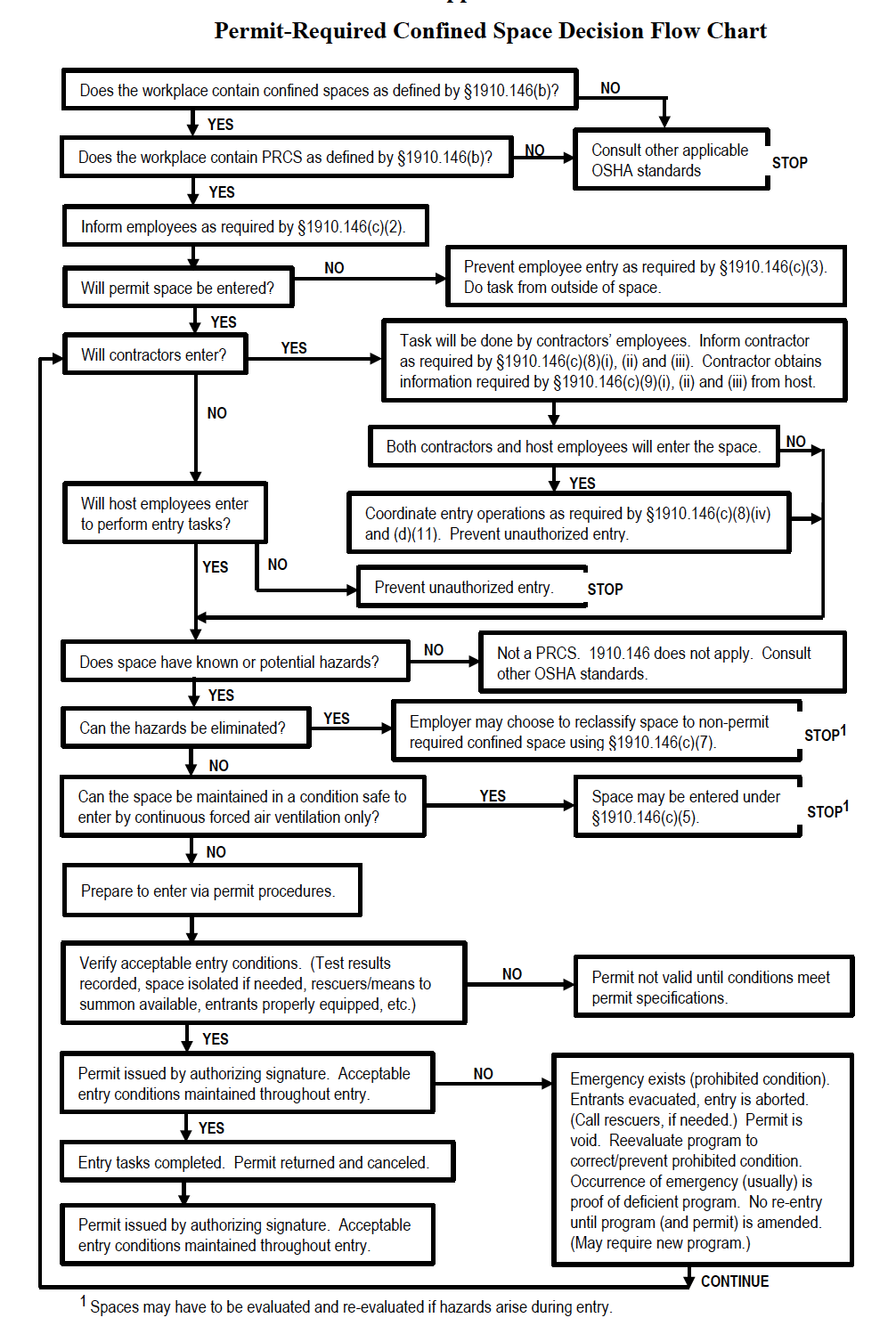
As we know, 1910.146 gives employers three (3) methods to enter Permit-Required Confined Spaces:
1) Full permitted entry following (d)-(k),
2) alternative entry methods prescribed in (c)(5), and
3) reclassification of the PRCS to a non-permit space by following (c)(7).
However, in the past year or so, we have come across another method… using BOTH (c)(5) AND (c)(7) in the same space at the same time. Questions:
1) Is this compliant with 1910.146?
2) Is this safe?
Is this compliant with 1910.146?
After a half dozen phone calls and still awaiting two returned phone calls with OSHA CSHO(s) and Management personnel, I would say even OSHA is not sure if this practice is compliant. Three (3) area offices have stated it is OK, one (1) has said no, and I await some unofficial ruling from higher up the food chain. But what say you?
Scenario:
I have a PRCS. The space is permit-required because it has the following hazards:
- flammable atmosphere
- oxygen deficient atmosphere from Nitrogen purge/blanket
- Liquid engulfment w/ Chemical contact hazards (HF Acid)
- agitator at the bottom and mid-way in space
- screw-type conveyor in the bottom of the space
Does 1910.146(c)(7) allow for me to:
1) use LOTO to eliminate the HF Acid hazard with DB&B, Disconnect/Misalignment, or Blinding/Blanking
2) use LOTO to eliminate the agitator(s) hazard
3) use LOTO to eliminate the screw conveyor
4) use DB&B, Disconnect/Misalignment, or Blinding/Blanking to isolate the flammable liquid pipes and nitrogen flow into the PRCS
Then… Once I have eliminated (a requirement under (c)(7)) the physical hazards via proper energy isolation methods, can I then turn to (c)(5) since the only hazard left is an “atmospheric hazard” AND by using forced air ventilation PROPERLY to control the hazardous atmosphere(s) enter this space WITHOUT an entry permit and all that goes with the permit (atm testing, attendants, rescue, etc.)?
In other words, Does 1910.146 allow an employer to use (c)(7) and (c)(5) at the same time on the same PRCS, which has BOTH atmospheric hazards AND physical hazards?
What say you?
NOTE: For those who are not quite sure, here is some info to consider:
Using 1910.146(c)(5) as your entry method into a Permit-Required Confined Space
Using 1910.146(c)(7) as your entry method into a Permit-Required Confined Space
Next month we will discuss the question: Is this practice safe?