
In the past several years the use of NFPA’s 704 “Diamond” as a means for secondary labeling has seen much scrutiny; however, even OSHA has stated that this label can be used as an in-house secondary label under the GHS labeling requirements. (SAFTENG members can see my earlier articles on this topic in the OSHA Compliance Section). But the use of the “Diamond” comes with some basic requirements which we can find in NFPA 704. For example, should we accept a “colorless” diamond when our program cites colors, our training materials cites colors, as well as our HAZCOM educational postings throughout the facility show colors. Do the colors matter? Is this label “compliant” with your written program, training, and postings?
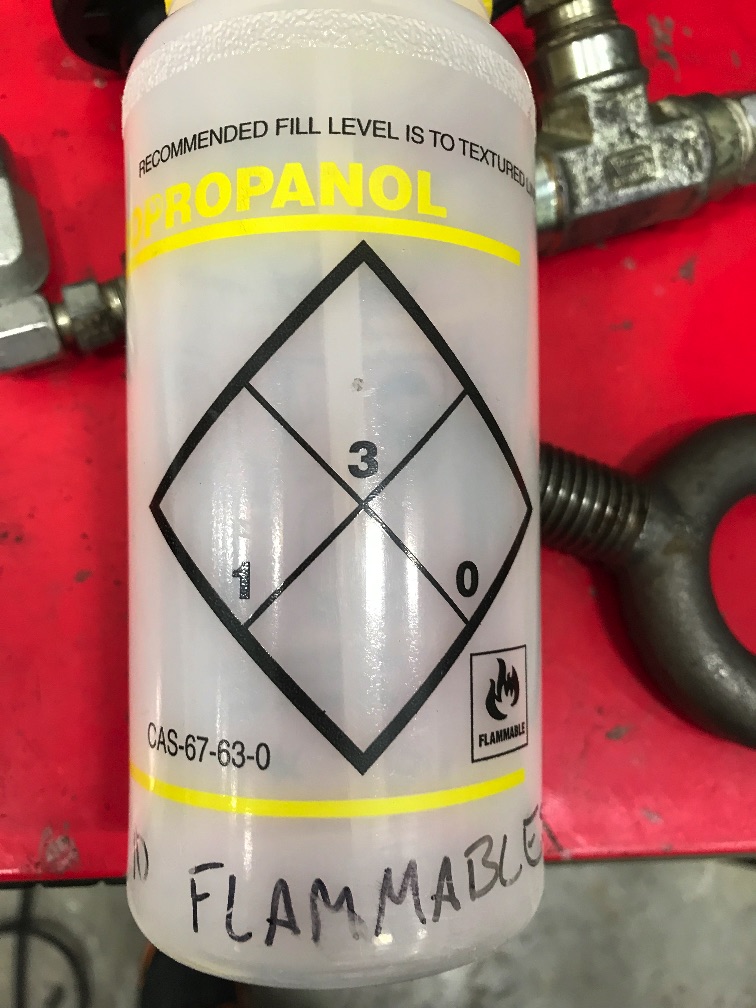
Let’s be real – the color may not be a major problem IF the employees can state what the sections at 12 o’clock, 3 o’clock, 6 o’clock and 9 o’clock represent. In fact, it is not that unusual (unfortunately) to find personnel who can not state the sections even when they are color coded, but that is simply a training issue – not a code issue.
Let’s see what NFPA says about the use of their “Diamond”…
4.1.4* Each rating shall be located in a square-on-point field (commonly referred to as a diamond), each of which is assigned a color as follows:
(1) Blue for health hazard
(2) Red for flammability hazard
(3) Yellow for instability hazard
NOTE: A.4.1.4 No specific color shade is recommended, but the blue, red, and yellow used must provide adequate contrast so that the rating numbers are easily identified. Many environmental conditions can affect the stability of the colors.
4.1.5 Alternatively, the square-on-point field shall be permitted to be any convenient contrasting color and the numbers themselves shall be permitted to be colored. (See Figure 9.1(a) through Figure 9.1(c) for examples of the spatial arrangements.)
4.1.6 The fourth quadrant, at the six o’clock position, shall be reserved for indicating special hazards and shall be in accordance with Chapter 8. No special color is associated with this quadrant.
SO I make the argument that the container shown above is NOT compliant, based on the label being used is the NFPA Diamond and the standard that goes with this label (NFPA 704) requires the quadrants to be color coded and they are not. But as I stated above, if the employees could cite the hazards represented by the quadrants based on their location within the label, I would not push the issue. But if the workers could not state that Fire is at 12 o’clock, Reactivity is at 3 o’clock, “special” is at 6 o’clock and health is at 9 o’clock, then by all means the label is NOT effective.
Just imagine if all the NFPA diamonds were NOT color coded – what would the local FD say about this? And finally, over my career I have seen the diamond applied as a “square” and I have seen them applied upside down as well. It was easy for us to recognize these defects, but what would the workers, contractors and responders thinks of this?