
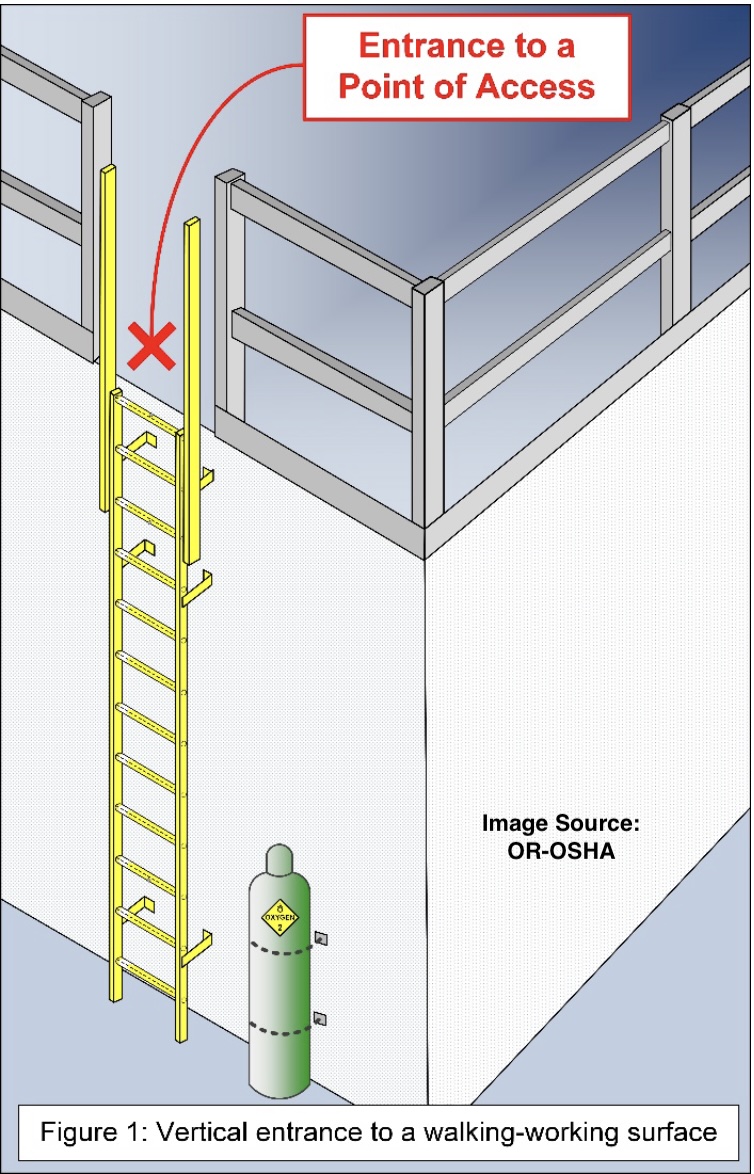
The simple answer is yes. Federal OSHA requires either a self-closing swing gate or an offset barrier at the point of access where a fixed ladder meets the unprotected edge of a walking-working surface. While the regulatory text in Subpart D sometimes causes confusion by referring to these access points as “holes,” OSHA consistently enforces the gate requirement at perimeter edges to maintain continuous fall protection.
When a fixed ladder provides access to an elevated surface that is 4 feet or more above a lower level, the perimeter of that surface requires a standard guardrail system under §1910.28(b)(1)(i). The entrance to the ladder creates a necessary break in that perimeter guardrail.
To protect that break, OSHA applies the requirements for ladderway access points:
§1910.28(b)(3)(iv) mandates that employees must be protected by a guardrail system on all exposed sides of a ladderway platform, “except at the entrance to the hole, where a self-closing gate or an offset must be used”.
§1910.29(b)(13) dictates the design criteria for that guardrail system opening, requiring the use of a self-closing gate or an offset to prevent accidental falls.
A common compliance trap involves arguing that a ladder attached to the outside edge of a roof or mezzanine is not technically a “ladderway platform hole,” and therefore does not require a gate.
OSHA has historically and consistently rejected this defense. The agency’s stance was explicitly detailed in a well-known 2009 directive (the Fairfax Memorandum), which guided enforcement prior to the 2017 Subpart D update and established the logic used in the current rule. The directive clarified that the fall protection standard applies to ladders that extend to another working surface “even if the ladder attaches to the edge of the working surface or the platform, since the opening at the ladder access point is also a floor opening”.
Ultimately, if the perimeter guardrail stops to allow a worker to step off a ladder, that gap must be closed.
If a swing gate is used instead of an offset barrier, it must function as an equivalent piece of the guardrail system. Under §1910.29(b)(13)(i), it must meet the following criteria:
Self-Closing: The gate must return to the closed position automatically. The 2017 rule update effectively banned the use of safety chains, drop bars, or single-bar gates at ladderways, as these rely on the worker to manually secure them.

Swing Direction: It must slide or swing away from the hole or edge. A worker leaning against the gate from the platform side must not be able to push it outward over the ladderway.

Equivalent Protection: The gate must have a top rail (at 42 inches, ± 3 inches) and a midrail, and it must withstand the same 200-lb downward/outward force as the rest of the standard guardrail system.
NOTE: OR-OSHA takes a different approach in its 2024 LOI on the matter. Basically, no swing gate is required, unless a worker is actually working in the area and needs fall protection to aid in preventing them from falling through the opening. CLICK HERE to see their LOI