In the past several weeks I have received inquiries regarding NFPA 704, 4.2.3.2 so I figured I should put it in writing so that others can understand this single clause which apparently has become a “whipping boy” for a particular hazardous material. The quick answer is YES, but apparently, there is some confusion on why NFPA 704, 4.2.3.2 permits this. This is what it says:
4.2.3.2* It shall be anticipated that different physical forms of the material or conditions of storage and use could result in different ratings being assigned to the same material.
*Due to the large number of variables, the requirements and guidance presented in this standard are general in nature and are limited to the most important and common factors. For example, although ash point is the primary criterion for assigning the flammability rating, other criteria could be of equal importance. For example, autoignition temperature, flammability limits, and susceptibility of a container to failure due to fire exposure also should be considered. For instability, the emphasis is on the ease by which an energy releasing reaction is triggered. These factors should all be considered when calling on one’s judgment during the assignment of ratings.
In reality, the same material may have different ratings based on where it is in the process. For example:
Diesel fuel normally carries an NFPA Flammability rating of a 2 when it is stored in an atmospheric storage tank. But the diesel fuel is actually a feedstock in a manufacturing process in which the diesel fuel is heated up ABOVE it boiling point.
When diesel fuel is handled ABOVE its boiling point it’s flammable characteristics change considerably and thus process vessels where this is occurring may need to have a different NFPA flammability rating than what is seen on the atmospheric storage tank holding the diesel fuel.
This is what 4.2.3.2 was meant to allow… we can INCREASE the rating of the hazardous material based on its current state of storage and use. But there is one way we could DECREASE our rating; it is not seen often, but I have come across it…
A flammable liquid with a flashpoint of around 65F that is stored in a refrigerated atmospheric storage tank with the liquid at a temperature of 50F. This situation could allow the NFPA flammability rating to be REDUCED based on these storage conditions (e.g. below its FP); however, with this type of storage comes additional signage/labeling on the container/tank to inform responders that the tank is “refrigerated” so that they are aware of what could happen in a FIRE SCENARIO. The refrigeration is designed to chill the flammable liquid under “Standard Temperature and Pressure” (STP) conditions. When this tank is involved in a pool fire, it will quickly loose its ability to maintain the flammable liquid below its flash point and thus the tank will begin to behave just like a non-refrigerated atmospheric storage tank holding a flammable liquid – AND RESPONDERS MUST UNDERSTAND THIS!
We must also understand any hazards that may be presented by the “refrigerant” used to refrigerate this tank. In the cases I have seen, chilled water was used in coils that wrapped around the tank; however, this facility was seriously considering using some of their anhydrous ammonia to “chill” the tank as it would be more efficient AND they needed more chilled water for their processing and did not want to spend the $ to increase the chilled water system capabilities. This would be a HUGE MOC, but to stay focused on our topic at hand, this would require some serious upgrades to the container/tank labeling to inform personnel/responders that the tank now has NH3 in its coils.
To wrap this up, YES – NFPA 704 allows us to change our hazard rating values based on the conditions of storage and use. But this change is based on the “conditions of storage and use” as I discussed above AND not based on the fact you think the manufacturer or the SDS is wrong. We MUST use the SDS values to assign our NFPA 704 ratings when using the NFPA 704 Diamond as our means to label our containers/tanks.
FOLLOW-UP (11/12/2017)
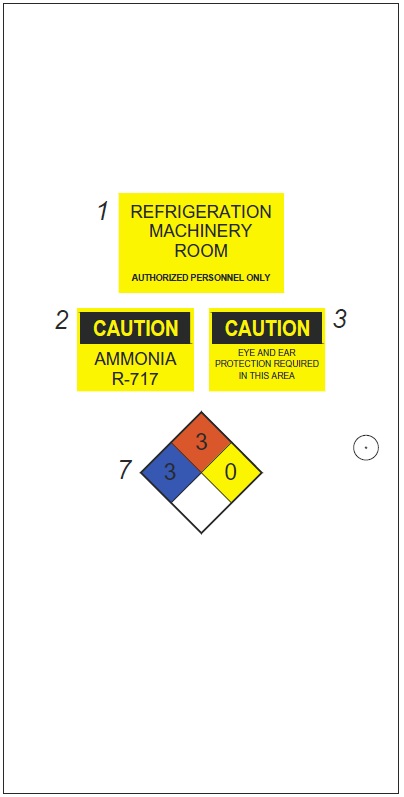
One of my Ammonia refrigeration clients reminded me of a really nice real-world example of a hazardous material having a different NFPA 704 rating. Anhydrous Ammonia (NH3) flammability rating is rated based on the location of where it is found. NH3 is classified as a non-flammable gas based on its LEL of 16% (e.g. >13%) and its flammable range (e.g. <12 percentage points). Outside it is difficult to ignite due to these properties; however, in an enclosed space NH3 can reach its LEL and thus should be managed as a flammable gas. Hence in 2008 the International Institute of Ammonia Refrigeration (IIAR) issued an addendum to their ANSI/IIAR 2- Equipment, Design, and Installation of Closed-Circuit Ammonia Mechanical Refrigerating Systems in which they required NFPA 704 diamonds “outside” to have a flammable rating of “1” and NFPA 704 diamonds on machinery room doors (e.g. inside) to have a flammable rating of “3”. Then in 2014 they included the following in Appendix J…
(emphasis added by me)
Appendix J. (Informative) Machine Room Signs
J.7. NFPA 704 – Ammonia Fire Diamond
Color: Black text, white, blue, red, and yellow background
1. Warning for INDOOR ammonia refrigeration equipment: 3-3-0.
This includes all entrances to a machinery room.
2. Warning for OUTDOOR ammonia refrigeration equipment: 3-1-0.
This is for equipment located ENTIRELY OUTDOORS.
The following example of the principal and auxiliary machinery room doors are provided for reference only.