
Whenever I facilitate a PHA for a client who is serious about the exercise, I always create a visual on a white board so the team can methodically discuss ALL the safeguards/barriers/controls that are present to PREVENT-PROTECT-MITIGATE the event being studied. It looks like this:
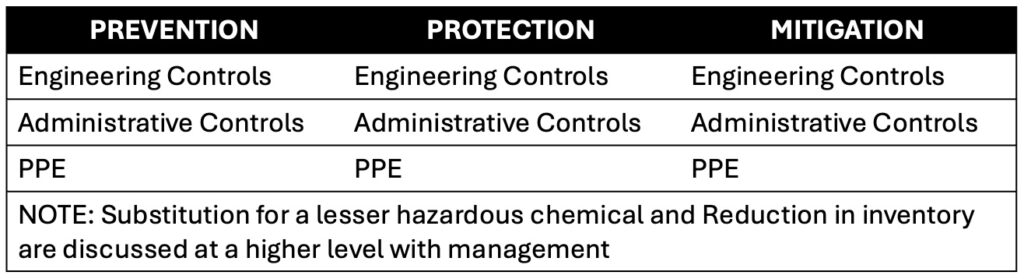
This effort is intended to force the PHA team to identify their actual layers of protection, using the hierarchy of controls methodology. And when we are speaking in terms of the engineering controls, we break these controls down into two (2) subcategories: 1) Passive and 2) Active Engineering Controls.
We define these as follows:
Passive Engineering Controls involve equipment that does not require physical actuation or power in order to perform the intended function (i.e., dike wall acting as a Secondary Containment in the Protection Layer) .

Active Engineering Controls involve equipment that does requires physical actuation and/or some means of power to function.
Keep in mind that we have to be cautious in where we lay claim to the control(s). A PREVENTION control is literally in place to PREVENT the event from happening. A PROTECTION control is for when the event happens (i.e., LOPC), and we are looking at measures that PROTECT ASSETS (i.e., people and process), and the MITIGATION controls are how we LESSEN the consequences of the event.
For example, I like to specifically call out my PPM Layers in my Safeguards Column so the team is very clear where we want the resources applied. This is an eye-opening experience when they see they are heavy on the Mitigation and very light on the actual PREVENTION.
And for SOPs… when someone wants to call out an SOP/Training as a Safeguard for a specific scenario, make damn sure that SOP actually covers the “deviation” and provides the operator(s) the means to AVOID or CORRECT the deviation. If not, then we should create a recommendation to address this sceanrio in the SOP and retrain personnel on the revised SOP.