
I have an on going debate with a new food client on their “spiral freezers” being a Permit-Required Confined Space(s). In my professional opinion, a spiral freezer, at least all the ones I have been around, are without a doubt a PRCS. This company, including their brand manufacturer, are claiming they are not – based on the fact that the manufacturer claims they have “designed” their spiral freezer to be occupied. This is INSANE to even be having this discussion, but to be still having it in 2019 is just sad and folks these people, especially the manufacturer, who apparently has been telling all of their customers their freezers are not a CS (or PRCS), are mad as hell, but I am not budging. In this article, I will explain how/why a spiral freezer is without a doubt a PRCS. I have found a lot of images and videos of spiral freezers and these images and videos are NOT of the brand this “former client” is using, but their design(s) that make these spaces a PRCS are almost identical. So let’s jump right in (all pun intended)…
Here is a nice video showing all sides of a spiral freezer which does a nice job showing its size, entry portals, etc. This is NOT the brand the client had, just a nice video that shows a spiral freezer very similar to the size and design of the clients.
So the argument is that the inside of this spiral freezer is designed for “continuous employee occupancy”. OSHA’s definition of a CS is: (emphasis by me)
“Confined space” means a space that:
-
- Is large enough and so configured that an employee can bodily enter and perform assigned work; and
- Has limited or restricted means for entry or exit (for example, tanks, vessels, silos, storage bins, hoppers, vaults, and pits are spaces that may have limited means of entry.); and
- Is not DESIGNED FOR CONTINUOUS EMPLOYEE OCCUPANCY.
So after watching that video or hands-on experience with spiral freezers, does anyone actually believe a spiral FREEZER is designed for “CONTINUOUS EMPLOYEE OCCUPANCY”? Who designs a structure for people to continuously occupy that has temperatures of -40F? Also, notice that once inside the freezer that the belts, chains, gears are NOT individually guarded – the freezer’s outside walls are intended to be guarding of these mechanical hazards, but once inside there is a serious exposure to a serious hazard.
The fact that the manufacturer has increased the size of their entry/exit portals to allow for “easier access” does not change the fact that they still represent limited or restricted means for entry or exit; however, the space is large enough and so configured that an employee can bodily enter and perform assigned work. So without question (although there seems to be some who disagree) this is a confined space.
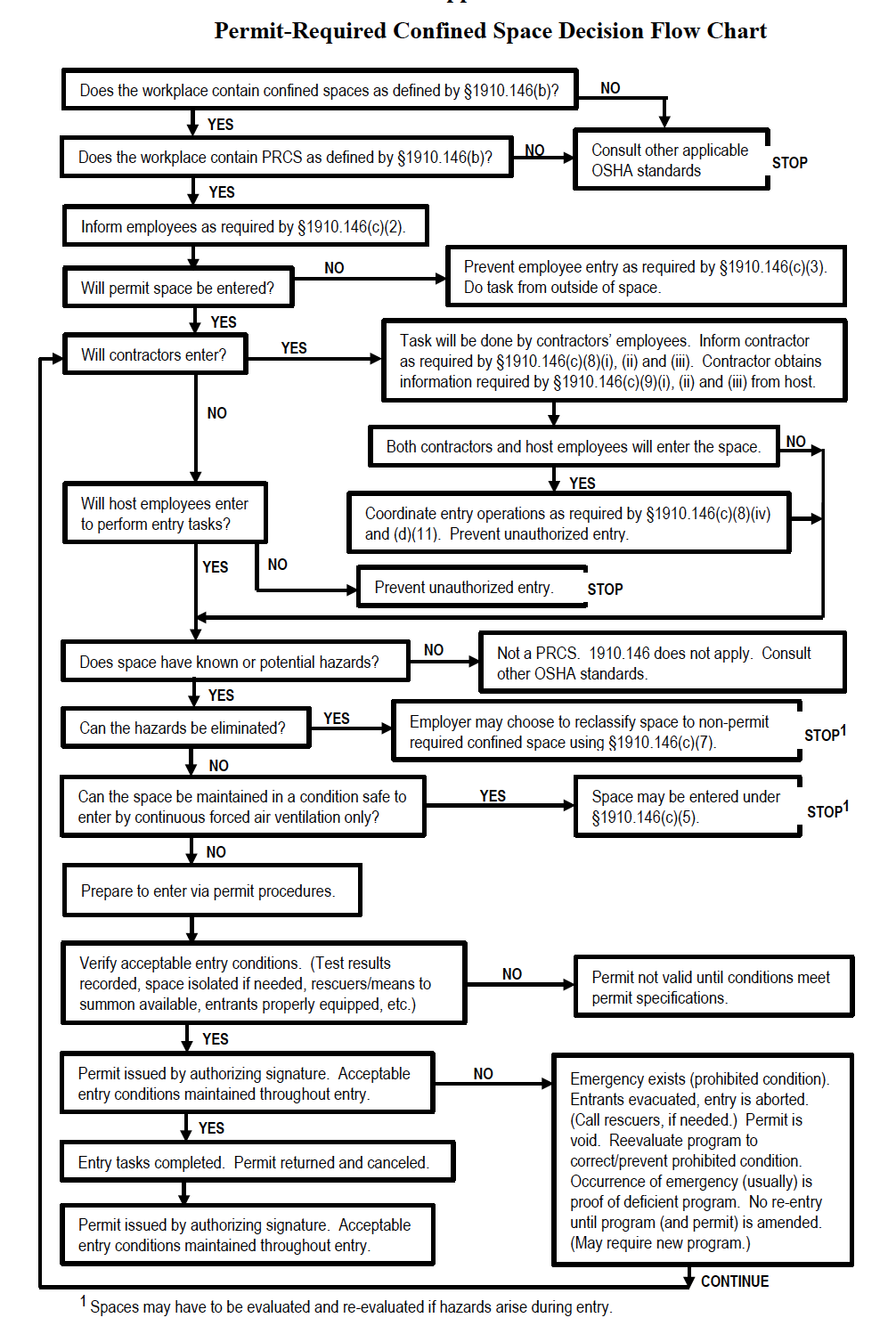
I even go further and say it is a Permit-Required Confined Space (PRCS) simply because of the “mechanical hazards” (e.g. unguarded belts, chains, gears, in-going body points). Now, this freezer MAY qualify for “reclassification” using (c)(7), but that is a debate for another day (e.g. would we have to evacuate the refrigerant from within the piping/tubing inside the space to reclassify to a non-PRCS). But the decision to declare this space a PRCS is quite straight forward for me… what say you?
From OSHA’s PRCS Preamble…
OSHA determined in the rulemaking process that there are three (3) circumstances
1) mobility-limiting size and configuration,
2) limited means of access and egress, and
3) unsuitability for continuous employee occupancy)
that are common to all confined spaces.
Those are the elements that OSHA included in their definition of “confined space”. OSHA recognizes that the hazard element that differentiates permit spaces from confined spaces may vary in its nature, so the Agency set out several ways in which a confined space could qualify as a permit space. Thus, a permit space is a confined space that has certain characteristics that make it hazardous for employees to enter WITHOUT taking special precautions.
Proposed paragraph (b)(23)(iii) stated, as the third criterion, that a space had to be NOT designed for continuous employee occupancy in order to be considered a permit-required confined space. Some commenters expressed concern regarding the use of the phrase “continuous occupancy” in this proposed paragraph. Some of them argued that many spaces are not designed for continuous employee occupancy but should not be considered as confined spaces. They suggested rewording the proposed definition to “an enclosure with a primary function” other than “human occupancy.” (The suggested language is essentially identical to language in the ANSI Z117.1 1989 definition of a confined space.) OSHA notes that the criterion “not designed for continuous human occupancy” is but one (1) of the necessary three (3) criteria required for a space to be designated a confined space. Thus, there may be any number of spaces that are not designed for “continuous human occupancy”, but that cannot be considered to be confined spaces (or, subsequently, permit-required confined spaces) under OSHA’s definitions because they do not meet BOTH of the other two criteria set forth in the confined space definition. OSHA determined that the suggested language from the ANSI standard is not appropriate. The ANSI language focuses on what the “primary function” of the space is, whereas OSHA’s definition focuses on what the space is designed for. If the space is truly designed for human occupancy, then the primary function of the space is irrelevant. For example, a vented telecommunications vault is typically designed for continuous human occupancy — the ventilation for the vault ensures the presence of a normal atmosphere for an occupant to breathe, and the working dimensions of the space are large enough to allow an adult to work and move around while erect. It could be argued, however, that the “primary function” of the vault is to house telecommunications equipment. Although the distinction between the “primary function” and the “design” of a space may seem inconsequential, OSHA believes that the final definition properly places the focus on the design of the space, which is the key to whether a human can occupy the space under normal operating conditions.
Another commenter stated that OSHA should eliminate “continuous” from the definition because its manholes and vaults — to the extent they are covered — are designed for employee entry and occupancy in order to service telephone cables.” OSHA has not accepted this recommendation. One of the characteristics of a confined space is that it is not designed for humans to enter and work for prolonged periods without any additional consideration for safety and health. With respect to manholes and unvented vaults, the Agency notes that atmospheric testing and portable mechanical ventilation are among the recognized procedures that must be undertaken (as required by §1910.268(o)) before employees can safely enter these spaces. Therefore, the final definition of confined space retains the proposed phrase “continuous human occupancy”.
OSHA notes that the meaning of proposed paragraph (b)(23)(iii) has been a factor in general duty clause (section 5(a)(1)) enforcement actions brought by the Agency. For example, General Dynamics Land Systems Division (General Dynamics) contested a citation for a willful violation of section 5(a)(1) for failure to protect employees from confined space hazards. The employer referenced the proposed language to contend that an M1 tank is not a (permit-required) confined space because the assembled tank is intended for continuous employee occupancy. The Occupational Safety and Health Review Commission (OSHRC) held in General Dynamics Land Systems Div. (15 OSHRC 1275, September 11, 1991) that the classification of a space would be based on its condition at the time employees would enter, not on the ultimate use of the space. The OSHRC determined that assembled tanks posed a recognized hazard (freon exposure) and that it was feasible to abate the hazard. Therefore, the OSHRC held that OSHA properly cited General Dynamics for failure to implement a permit space program when employees were assigned to enter assembled M1 tanks in which freon was being used. Additionally, the Agency notes that the preamble of the NPRM (54 FR at 24097) stated some products are considered permit spaces while they are being built, and entries by workers are required as part of the manufacturing process.” This language reflects OSHAs recognition that there are spaces (such as assembled M1 tanks) that may be permit spaces during fabrication, because hazards might be introduced at that time and because they are not designed for continuous occupancy until their manufacture has been completed. However, after they are completed and put to use, the hazards created by the manufacturing process are not present, and they are then designed and intended for continuous occupancy. Thus, they would not be permit spaces in actual use.

