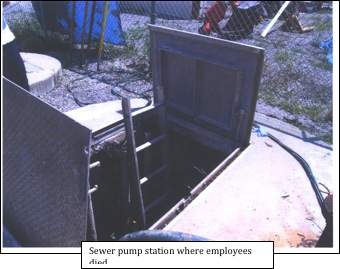
Two water and sewage treatment plant operators, one a 49-year-old and the other a 21-year-old, died when they entered a permit-required-confined space and could not exit safely. Three employees and one supervisor were assigned to replace a bracket on a pump inside an underground pump station. The pump station measured nine feet in diameter by 15-25 feet in depth. The supervisor entered the pump station earlier in the day to determine what repairs were needed. They all three returned to the shop to get the proper parts. When they returned to the pump station, the supervisor once again entered the station to replace the bracket. While in the permit-required-confined space, he experienced physical problems and could not climb the ladder to exit the space. The other victim then entered the space to assist the supervisor. He experienced similar problems and could not exit. Both victims fell into and beneath the liquid sewage and drowned. The third employee did not attempt entry. No atmospheric conditions were identified that could have overcome both employees, but that remains a possibility. During the investigation, violations of TOSHA standards unrelated to the fatalities were also discovered.
TOSHA Citation(s) as Originally Issued
Citation 1
|
Item 1 1910.22(c) |
Covers and/or guardrails were not provided to protect personnel from the hazards of open pits, tanks, vats, ditches, etc., in that covers or rails were not provided around the basins at the waste water treatment facility. |
|
Item 2 1910.23(c)(1) |
Every open-sided floor or platform 4 feet or more above adjacent floor or ground level was not guarded by a standard railing or fall arrest system on all open sides of the opening on top of the pump stations. |
|
Item 3a 1910.146(c)(1) |
The employer did not evaluate the workplace to determine if any spaces are permit-required confined spaces. |
|
Item 3b 1910.146(c)(2) |
When the workplace contained permit spaces, the employer did not inform exposed employees, by posting danger signs or by any other equally effective means, of the existence and location of and the danger posed by the permit spaces. |
|
Item 3c 1910.146(c)(4) |
When the employer decided that its employees would enter permit spaces, the employer did not develop and implement a written permit space program that complies with this section and make the written program available for inspection by employees. |
|
Item 4a 1910.146(d)(1) |
The employer did not implement the measures necessary to prevent unauthorized entry. |
|
Item 4b 1910.146(d)(2) |
The employer did not identify and evaluate the hazards of permit spaces before employees enter them. |
|
Item 4c 1910.146(d)(3)(i) |
The employer did not develop and implement the means, procedures, and practices necessary for safe permit space entry operations, including, but not limited to, specifying acceptable entry conditions. |
|
Item 4d 1910.146(d)(3)(ii) |
The employer did not develop and implement the means, procedures, and practices necessary for safe permit space entry operations including, but not limited to, providing each authorized entrant with the opportunity to observe any monitoring or testing of permit spaces. |
|
Item 4e 1910.146(d)(3)(vi) |
The employer did not develop and implement the means, procedures, and practices necessary for safe permit space entry operations, including, but not limited to, verifying that conditions in the permit space was acceptable for entry throughout the duration of an authorized entry. |
|
Item 4f 1910.146(d)(4)(i) |
The employer did not provide testing and monitoring equipment at no cost to employees, maintain that equipment properly, and ensure that employees use that equipment properly. |
|
Item 4g 1910.146(d)(4)(viii) |
The employer did not provide rescue and emergency equipment. |
|
Item 4h 1910.146(d)(5)(i) |
The employer did not evaluate permit space conditions and test conditions in the permit space to determine if acceptable entry conditions exist before entry was authorized to begin and entry conditions were not continuously monitored in the areas where authorized entrants were working. |
|
Item 4i 1910.146(d)(5)(ii) |
The employer did not test or monitor the permit space as necessary to determine if acceptable entry conditions were being maintained during the course of entry operations. |
|
Item 4j 1910.146(d)(5)(iii) |
The employer did not evaluate permit space conditions and when testing for atmospheric hazards test first for oxygen, then for combustible gases and vapors, and then for toxic gases and vapors. |
|
Item 4k 1910.146(d)(5)(iv) |
The employer did not evaluate permit space conditions and provide each authorized entrant an opportunity to observe the pre-entry and any subsequent testing or monitoring of permit spaces. |
|
Item 4l 1910.146(d)(5)(vi) |
The employer did not evaluate permit space conditions and immediately provide each authorized entrant with the results of any testing conducted. |
|
Item 4m 1910.146(d)(6) |
The employer did not provide at least one attendant outside the permit space into which entry is authorized for the duration of entry operations. |
|
Item 4n 1910.146(d)(8) |
The employer did not designate the persons who are to have active roles (as, for example, authorized entrants, attendants, entry supervisors, or persons who test or monitor the atmosphere in a permit space) in entry operations, identify the duties of each such employee, and provide each such employee with the training required by paragraph (g) of this section. |
|
Item 4o 1910.146(d)(10) |
The employer did not develop and implement a system for the preparation, issuance, use, and cancellation of entry permits. |
|
Item 4p 1910.146(d)(12) |
The employer did not develop and implement procedures (such as closing off a permit space and canceling the permit) necessary for concluding the entry after entry operations have been completed. |
|
Item 5 1910.146(e)(1) |
Before entry was authorized, the employer did not document the completion of measures required by paragraph (d)(3) of this section by preparing an entry permit. |
|
Item 6a 1910.146(g)(1) |
The employer did not provide training so that all employees whose work is regulated by this section acquire the understanding, knowledge, and skills necessary for the safe performance of the duties assigned under this section. |
|
Item 6b 1910.146(h)(1) |
The employer did not ensure that all authorized entrants knew the hazards that may be faced during entry, including information on the mode, signs or symptoms, and consequences of the exposure. |
|
Item 6c 1910.146(i)(1) |
The employer did not ensure that each attendant knew the hazards that may be faced during entry, including information on the mode, signs or symptoms, and consequences of the exposure. |
|
Item 6d 1910.146(j)(1) |
The employer did not ensure that each entry supervisor knew the hazards that may be faced during entry, including information on the mode, signs or symptoms, and consequences of the exposure. |
|
Item 7a 1910.146(k)(2)(ii) |
The employer whose employees have been designated to provide permit space rescue and emergency services did not train affected employees to perform assigned rescue duties and ensure that such employees successfully complete the training required to establish proficiency as an authorized entrant, as provided by paragraphs (g) and (h) of this section. |
|
Item 7b 1910.146(K)(2)(iii) |
The employer did not train affected employees in basic first-aid and cardiopulmonary resuscitation (CPR) and ensure that at least one member of the rescue team or service holding a current certification in first aid and CPR is available. |
|
Item 7c 1910.146(k)(2)(iv) |
The employer did not ensure that affected employees practice making permit space rescues at least once every 12 months. |
|
Item 7d 1910.146(k)(3) |
To facilitate non-entry rescue, retrieval systems or methods were not used whenever an authorized entrant enters a permit space, unless the retrieval equipment would increase the overall risk of entry or would not contribute to the rescue of the entrant. |
|
Item 7e 1910.146(k)(3)(ii) |
A mechanical device was not available to retrieve personnel from vertical type permit spaces more than 5 feet (1.52 m) deep. |
|
Item 8a 1910.147(c)(1) |
The employer did not establish a program consisting of energy control procedures, employee training, and periodic inspections to ensure that before any employee performs any servicing or maintenance on a machine or equipment where the unexpected energizing, startup or release of stored energy could occur and cause injury, the machine or equipment would be isolated from the energy source and rendered inoperative. |
|
Item 8b 1910.147(c)(4)(i) |
Procedures were not developed, documented and utilized for the control of potentially hazardous energy when employees were engaged in the activities covered by this section. |
|
Item 8c 1910.147(c)(5)(i) |
Locks, tags, chains, wedges, key blocks, adapter pins, self-locking fasteners, or other hardware was not provided by the employer for isolating, securing or blocking of machines or equipment from energy sources. |
|
Item 9a 1910.303(b)(1)(i) |
Electric equipment was not free from recognized hazards that are likely to cause death or serious physical harm to employees. |
|
Item 9b 1910.303(c)(3)(i) |
Conductors were not spliced or joined with splicing devices identified for the use or by brazing, welding, or soldering with a fusible metal or alloy. |
|
Item 9c 1910.303(f)(2) |
Each service, feeder, and branch circuit, at its disconnecting means or overcurrent device, was not legibly marked to indicate its purpose, unless located and arranged so the purpose is evident. |
|
Item 9d 1910.304(g)(5) |
The path to ground from circuits, equipment, and enclosures was not permanent, continuous, and effective. |
|
Item 9e 1910.305(a)(2)(v)(C) |
No branch-circuit conductor may be laid on the floor. |
|
Item 9g 1910.305(b)(1)(i) |
Conductors entering cutout boxes, cabinets, or fittings were not protected from abrasion and openings through which conductors enter were not effectively closed. |
|
Item 9h 1910.305(j)(2)(v) |
A receptacle installed outdoors in a location protected from the weather or in other damp locations did not have an enclosure for the receptacle that is weatherproof when the receptacle is covered. |
|
Item 10a 1910.333(a) |
Safety-related work practices were not employed to prevent electric shock or other injuries resulting from either direct or indirect electrical contacts when work is performed near or on equipment or circuits which are or may be energized. |
|
Item 10b 1910.333(b)(2) |
While any employee is exposed to contact with parts of fixed electric equipment or circuits which have been deenergized, the circuits energizing the parts were not locked out or tagged or both in accordance with the requirements of this paragraph. |
|
Item 10c 1910.333(c)(2) |
Only qualified persons may work on electric circuit parts or equipment that have not been deenergized under the procedures of paragraph (b) of this section and such persons were not capable of working safely on energized circuits and were not familiar with the proper use of special precautionary techniques, personal protective equipment, insulating and shielding materials, and insulated tools. |
|
Item 10d 1910.305(g)(1)(i) |
Flexible cords and cables were not approved for conditions of use and location. |
|
Item 11a 1910.1200(e)(1) |
The employer did not develop, implement, and maintain at each workplace, a written hazard communication program which at least describes how the criteria specified in paragraphs (f), (g), and (h) of this section for labels and other forms of warning, material safety data sheets, and employee information and training will be met. |
|
Item 11b 1910.1200(g)(8) |
The employer did not maintain in the workplace copies of the required material safety data sheets for each hazardous chemical, and did not ensure that they were readily accessible during each work shift to employees when they are in their work area(s). |
|
Item 11c 1910.1200(h)(1) |
The employer did not provide employees with effective information and training on hazardous chemicals in their work area at the time of their initial assignment and whenever a new physical or health hazard the employees have not previously been trained about was introduced into their work area. |
Citation 2
|
Item 1 1910.22(a)(8)(ii) |
Every floor hole into which persons can accidentally walk was not guarded by a floor hole cover of standard strength and construction. |
|
Item 2 1910.24(b) |
Fixed stairs were not provided for access from one structure level to another where operations necessitate regular travel between levels and for access to operating platforms at any equipment which required attention routinely during operations. |