
In November 2015, an operator at an explosives manufacturing plant was tasked with transferring aluminium grit atomised powder (aluminium powder) from a flexible intermediate bulk container (IBC) outside the plant to the hopper inside the plant. Using a pneumatically-driven vacuum suction pump and transfer pipe work (which incorporated five metres of PVC piping) the operator successfully transferred part of the powder from the IBC. When the hopper began to empty the operator resumed transferring product. Just after repositioning the suction pipe inside the IBC, he heard a loud explosion that sounded like a cartridge of explosives detonating, and felt the pipe shake violently in his hand. The operator ran inside the plant to find that the vacuum pump and chamber were on fire and had been blown off the hopper. There were spot fires of burning product. The operator used an extinguisher to put out the fires. There were no injuries. There was charring on the inside of both the vacuum chamber and transfer pipe work but not inside the hopper. It appears a dust explosion was triggered by a static discharge inside the vacuum chamber creating a flash-back through the transfer piping.
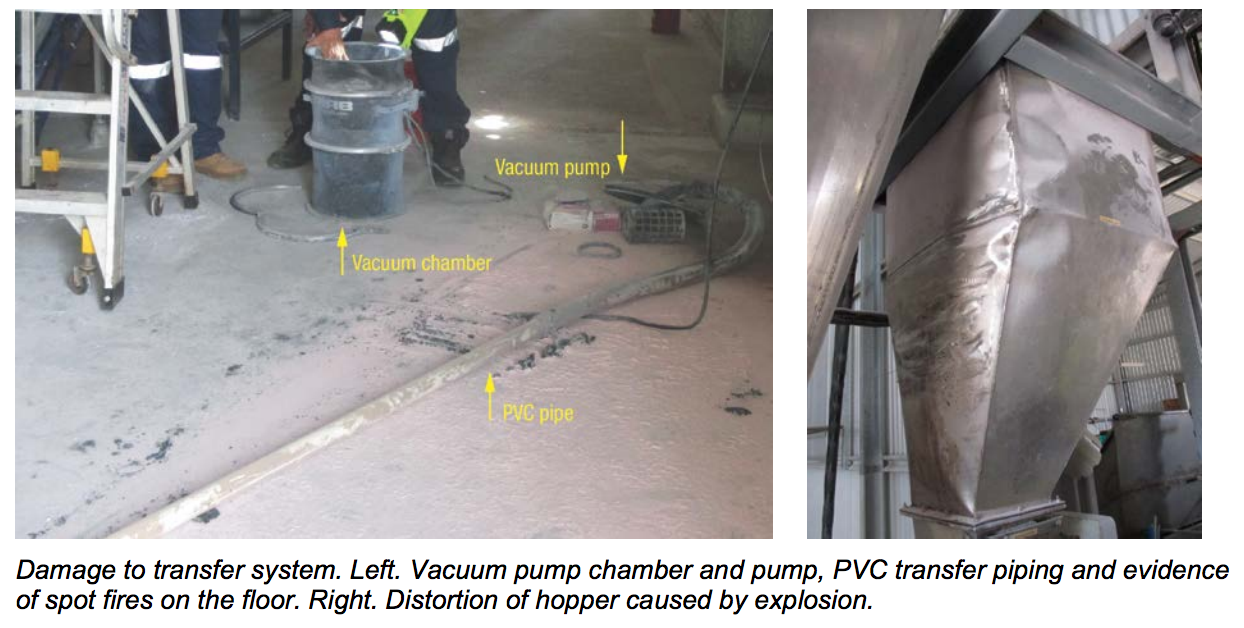
Direct factors
- The aluminium powder contained fines, which has the potential to form an explosive dust atmosphere.
Note: The material safety data sheet (MSDS) warned that the product could form explosive dust atmospheres.
- The inner and outer chambers of the pneumatically-driven vacuum pump were not effectively bonded and only one chamber was earthed. This allowed for the build-up of static electricity (a potential ignition source).
- Non-conductive PVC piping had been incorporated within the conductive transfer piping. The transfer piping was not earthed which allowed for the build-up of static electricity.
Contributory factors
- The relative humidity was exceptionally low, allowing for static charge to accumulate.
- The grade and quality of the aluminium granules (e.g. size and percentages of fines) was unknown.
- Workers were unaware of a standard operating procedure (SOP), including the MSDS, for safely transferring aluminium powder.
- Electrical continuity for all equipment could not be confirmed.
- The earthing point on the flexible IBC was not used and the bag was sitting on a wooden pallet which insulated it from the ground.
Actions required
Where aluminium powder is used, the following actions are recommended to prevent dust explosions.
Product specifications
Particle shape (e.g. flake, atomised) and particle size distribution (i.e. proportion less than 420 microns in size) determines the propensity to create an explosive dust atmosphere.
Information to determine whether the product meets specifications can be obtained by:
- requesting certificates of analysis
- undertaking independent analysis to confirm particle size distribution.
Plant design, construction and modifications
- Changes to plant and transfer piping that differ from the original plant specification constitute a design change. Before changes are made they should be carefully considered using a change management approach.
- Reduce the potential to generate a static charge by:
- selecting a suitable low-energy transfer system for product (e.g. avoid high-energy pneumatic systems where possible)
- using conductive material to assist in the dissipation of static charge (e.g. avoid non-conductive materials such as PVC)
- effectively bonding and earthing plant and transfer piping.
Training and safe systems of work
- Workers should:
- be provided with SOPs
- be trained in the safe use of plant and equipment
- have an understanding of the mechanisms that lead to dust explosions.
Click Here for the Safety Alert