Organizational weaknesses are vulnerabilities, flaws, and defects in controls (engineered, administrative, cultural, and oversight controls). Searching for and eliminating latent organizational weaknesses eliminates factors contributing to significant events.
A systematic diagnostic approach for discovering recurring individual or workgroup performance problems provides another means of identifying organizational weaknesses. Managers and supervisors need a tool that helps them understand a performance discrepancy and why it is happening. With the aid of the Behavior Engineering Model (BEM), performance analysis helps define the performance gap by contrasting current performance with desired performance and systematically identifying the factors that contribute to the performance gap. Once valid reasons for the performance gap are understood, the manager or supervisor can develop more effective and efficient corrective actions. I have shared the SAFTENG sample Performance Gap Analysis form in other posts to help analyze and solve human performance problems. Starting with a known performance problem, the user(s) searches for answers to questions that help determine the performance discrepancy and select potential corrective actions.
Value the Prevention of Error
People’s beliefs and attitudes toward hazards and error traps affect their adherence to high standards. Suppose error-free performance (avoiding active errors) is not held up as an important value or is not expected for daily work. In that case, people may adopt unsafe practices to get their work done, possibly placing themselves, others, or the facility at risk of an event. Consistently maintaining high standards communicates the value of error prevention. By clinging to high standards regardless of the perceived risk, adherence to expectations will become the norm.
Positive attitudes about error prevention depend greatly on what is rewarded and which behaviors are reinforced. It is easier to change behavior when positive attitudes exist. Positive values and attitudes follow behaviors that consistently result in success for the individual. Values and attitudes don’t need to precede behavior, but it is preferable. The most effective way to communicate values is to act in accordance with them while reinforcing people when they apply them.
The following leader behaviors convey the values of the organization in order of influence:
- what managers pay attention to, measure, and control;
- reactions to an accident, event, or crisis;
- allocation of resources;
- deliberate attempts to coach or role model;
- criteria for allocation of rewards and punishment, and
- criteria for selection, advancement, and termination
People will adopt safe behaviors if those in positions of responsibility and influence react appropriately, with integrity, and with stated values.
BEHAVIOR ENGINEERING MODEL (BEM)
BEM is an organized structure for identifying potential factors that impact job site performance and analyzing the organizational contributors to those factors. Job-site conditions that affect behavior can be categorized into two types of variables:
(1) the environment and
(2) the individual
Environmental factors include conditions external to the individual; individual factors include internal conditions generally under the person’s control. However, some aspects of human nature, such as stress, instinctive reflexes, and mental biases, are not always controllable.
Job-site conditions set the occasion for behavior—opportunity to act—including those factors that make action achievable or realizable. And conditions that tend to reinforce the act—willingness to act—are shaped by matching the individual’s motives with the incentives associated with the job or task. These categories attempt to describe the “stimulus-response” components of human behavior.
Strategically, environmental factors provide the greatest leverage in terms of potential for improving human performance. Leverage and cost are important factors to consider when determining corrective actions. Think back to the Anatomy of an Event. It is estimated that 85% or more of the causes of facility events originate in the organization’s processes and culture. Changes in environmental factors offer greater impact at less expense on performance improvement than changes at the individual level. For example, if the causes of a performance problem point to individual factors (motives, capacity/readiness, and knowledge and skills), implementing corrective actions would have less immediate influence, and the cost of generating the desired improvement will likely be greater.
The BEM can serve as an analysis tool for evaluating human error and related performance problems, providing a framework for exposing the real root causes that originate within the organization. The BEM contains many good and bad factors influencing human performance, including error precursors. The BEM is included here to show that error precursors, like other job-site conditions, result from organizational processes and values. In each case, one or more aspects of the organization that establish a job-site condition or error precursor can be identified. For instance, an individual’s level of knowledge is likely an outcome of the organization’s training program, or the human resources selection process may have overlooked the required abilities necessary for the task at hand.
CREATE A JUST CULTURE
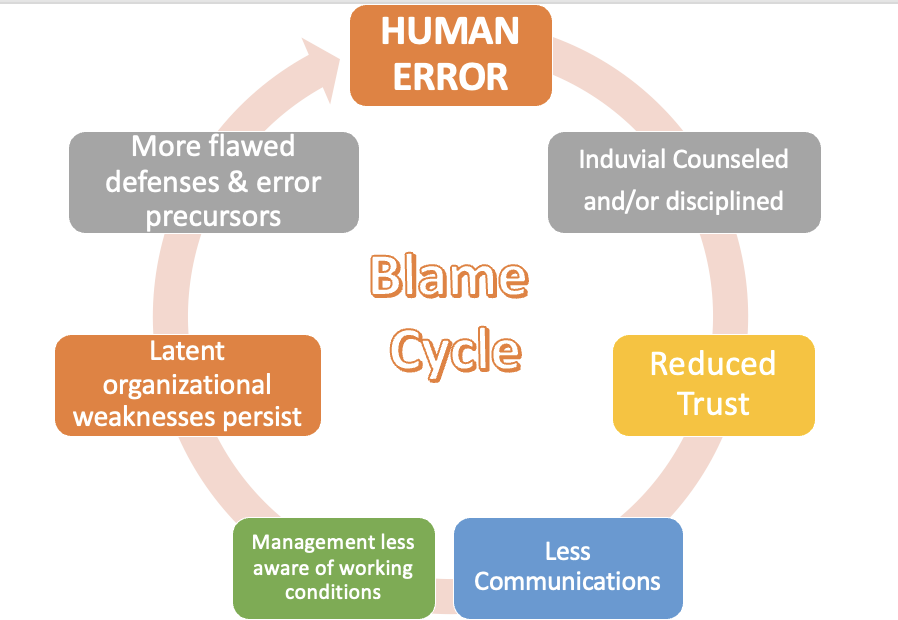
The Blame Cycle
The “blame cycle” depicted below is urged on by the belief that human error occurs because people are not properly motivated. In reality, no matter how motivated an individual is, active errors will continue occasionally. Events will continue as long as event investigations stop prematurely at the active human error. The true causes (typically organizational weaknesses) will not be discovered—will remain latent or hidden—and errors and events will persist.

The Culpability Decision Tree
The logic diagram below is a proven management tool intended to help determine the culpability level of an individual in response to events or near misses triggered by human error. When used in conjunction with the organization’s accountability policy, the tool supports the fair and consistent application of disciplinary outcomes across all departments and work groups. The tool is an adaptation of Dr. James Reason’s Culpability Decision Tree in his book, Managing the Risks of Organizational Accidents, which provides a further in-depth description of the use of the diagram.

Start with the assumption that the actions under scrutiny have contributed to an accident or a serious near-miss in which a bad outcome was only just averted. In an organizational accident, there are likely to be a number of different unsafe acts. The decision tree should be applied separately to each of them. The concern is with individual unsafe acts committed by either a single person or different people at various points in the accident sequence. Because of the subjectivity of the questions, the Decision Tree should be used by a small team or committee vs. a single manager or supervisor.
The questions of the inquiry relate primarily to intention.
Unintended actions define slips and lapses, generally the least blameworthy of errors.
Unintended consequences cover mistakes and violations.
The decision tree usually treats the various error types in the same way, except with regard to the question of the violation.
Start at the top left box on the logic diagram. The numbers below relate to the boxes left to right
Were the actions as intended? The key questions relate primarily to intention. Suppose both the actions and the consequences were intended. In that case, we are likely to be in the realm of criminal behavior, which is probably beyond the organization’s scope to deal with internally. Unintended actions define slips and lapses—generally the least blameworthy of errors—while unintended consequences cover mistakes and violations.
1. Knowingly violating expectations?
If the individual knowingly violated expectations at that time, the resulting error is more culpable since it should have been realized that violating increases both the likelihood of making an error and the chances of resulting in bad consequences. Violations involve a conscious decision on the part of the perpetrator to break or bend the rules (except when noncompliance has become a largely automatic way of working). Although the actions may be deliberate, the possible bad consequences are not—in contrast to sabotage, in which both the act and the consequences are intended. Most violations will be non-malevolent in terms of intent; therefore, the degree to which they are blameworthy will depend largely on the quality and availability of the relevant procedures.
Procedures are not always appropriate for a particular situation. Where this is judged to be the case (perhaps by a “jury’” of the perpetrator’s peers), the problem lies more with the system than with the individual. But, when good procedures are readily accessible but deliberately violated, the question arises as to whether the behavior was reckless in the legal sense of the term. Such actions are more culpable than “necessary” violations—the non-compliant actions necessary to get the job done when the relevant procedures are wrong, inappropriate, or unworkable.
2. Passes the substitution test?
The “substitution test,” or something similar, is used to help judge the culpability of organizationally induced violations. Could some well-motivated, equally competent, and similarly qualified individuals make the same error under those or similar circumstances? If the answer provided by a jury of peers is “yes,” then the error is probably blameless. If the answer is “no,” we must consider whether there were any system-induced deficiencies in the person’s training, selection, or experience. If such latent conditions are not identified, then the possibility of a negligent error has to be considered. The unsafe act was likely a largely blameless system-induced error if they were found.
3. History of performance problems?
Remember that people vary widely and consistently in their liability to everyday slips and lapses. Some individuals, for example, are considerably more absentminded than others. Suppose the person in question has a previous history of unsafe acts. In that case, it does not necessarily bear upon the culpability of the error committed on this particular occasion. Still, it does indicate the necessity for corrective training or even career counseling along the lines of “Don’t you think you would be doing everyone a favor if you considered taking on some other job within the company?” Although absentmindedness has nothing to do with ability or intelligence, but it is not a desirable trait in a pilot, a control room operator, a physician, or the like.
The line between acceptable and unacceptable behavior is clearer when the logic diagram is used. An intentional act to cause harm (lower left) is wholly unacceptable and should receive severe sanctions, possibly administered by the courts rather than the organization. Knowingly violating workable expectations likely suggests reckless violation, a condition that warrants sanctions. The remaining categories should be considered blameless unless they involve aggravating factors not considered here. Experience suggests that most unsafe acts—perhaps 90% or more—fall into the blameless category.
Sources: OSHA/NIOSH/DOE