
When do I need a Confined Space rescue team?
I get this question almost monthly, and it worries me that so many facilities struggle with such a critical analysis. It is not easy, but it could be a matter of life or death, and deserves some explanation. In this post, I will walk us through the rationale of entry-style rescue vs. non-entry-style rescue and when each one would be REQUIRED. I am using 29 CFR 1910.146(k) as the foundation for my analysis. Remember that 1910.146 is the very least we have to do, and there is MUCH ROOM for improvement within 1910.146, so let’s not look at this post as the absolute, but rather as the minimum we have to do.
Here is the flow for PRCS Rescue requirements:
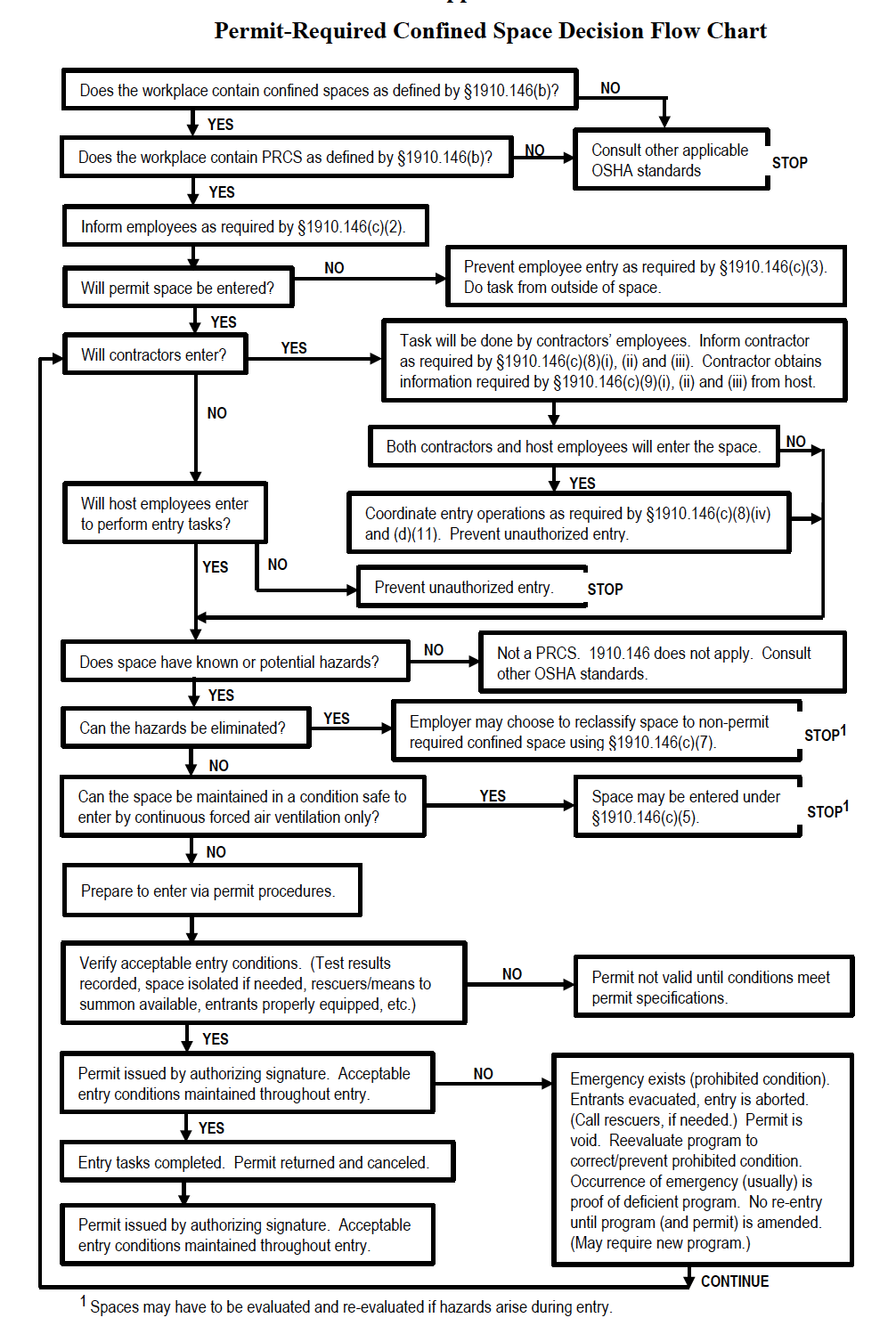
1) ALL entries into a Permit-Required Confined Space (PRCS) MUST include non-entry rescue capabilities. This means that each entrant will have on a 5-point harness (OSHA allows other harnesses); that harness will be attached to a Life-line/Tag-line/Rescue Rope that is attached at the center of the entrant’s back near shoulder level or above the entrant’s head so that the entrants profile will be small enough for the successful rescue of the entrant through a small diameter opening (e.g., manway). The other end of the lifeline will be attached to a FIXED point outside the space, or better yet, to a mechanical device. Now, if the entry is over 5′ down, then this non-entry rescue “setup” MUST include a mechanical device that would provide at least a 4:1 mechanical advantage (OSHA does not specifically call out a 4:1 advantage) so that the attendant can “winch” the entrant out of the space. If a 4:1 mechanical advantage is not provided and the attendant cannot begin rescue because the entrant weighs 250 pounds and is down 50′, and the attendant is a 90-pound 17-year-old female summer intern, you are screwed! EVEN WORSE, you’ll have to get your black suit cleaned for the FUNERAL of your entrant!!!!
2) There are TWO (2) exceptions for when non-entry rescue requirements may not be required (keep in mind that using this exception will kick in even more burdensome requirements for entry rescue!):
- The retrieval equipment would INCREASE THE OVERALL RISK of entry, OR
- It would not contribute to the rescue of the entrant.
These exceptions have an EXTREMELY HIGH THRESHOLD to pass. In my 25 years of working around confined spaces and being involved/overseeing literally thousands of entries, I have maybe used this exception once or twice.
3) If a facility has PRCSs where this non-entry rescue setup can not be used because it will:
- INCREASE THE OVERALL RISK of entry, OR
- it would not contribute to the rescue of the entrant, OR
- multiple entrants and not all entrants can be attached to the mechanical device
Then the entry will need to have in place “entry style rescue capabilities”. This means a properly trained, staffed, and equipped rescue team must be on hand to provide rescue services. I will discuss the timing for these services in #4 below. Some examples of this type of space where this rescue service may be needed are:
- baffled tanks, where the entrant has to climb over the baffles to access a particular area of the tank
- a space that requires the entrant has to change elevation once inside the space
- a space with false walls that the entrant has to maneuver around
One simple test that I like to ask myself when evaluating a space or an actual entry is, “could I winch this entrant out of the space by myself?” If the answer is NO or maybe yes, but I would kill them in doing so (e.g., pulling their unconscious body over a baffle and letting it fall 10′ to the other side), then ENTRY STYLE RESCUE SERVICES are REQUIRED.
4) OK, so we have decided we need to have entry-style rescue services provided. How do we define “provided”? Can I use my 24-hour environmental clean-up response contractor since they told me they do rescue services? I already have them approved in my SPCC plan, and they are an approved contractor in our Purchase Order system. Well, there is a bit more to the decision-making. We have to evaluate a prospective rescue service’s ability, in terms of proficiency with rescue-related tasks and equipment, to function appropriately while rescuing entrants from the particular permit space or types of permit spaces identified in our site evaluation. We also have to evaluate a prospective rescuer’s ability to respond to a rescue summons in a timely manner, considering the hazard(s) identified. In 1910.146(k), OSHA posted a “NOTE” that says…
What will be considered timely will vary according to the specific hazards involved in each entry. For example, §1910.134, Respiratory Protection, requires that employers provide a standby person or persons capable of immediate action to rescue employee(s) wearing respiratory protection while in work areas defined as IDLH atmospheres.
In 1998 OSHA revised the PRCS standard and included Appendix F as a tool to help facilities evaluate prospective rescue services, both their rescue teams and off-site rescue teams. Although Appendix F is a “Non-Mandatory” appendix, OSHA will use it when they evaluate your rescue service during their inspection! In Appendix F, OSHA provides some insight into what they mean when using the term “timely”…
For example, if entry is to be made into an IDLH atmosphere or into a space that can quickly develop an IDLH atmosphere (if ventilation fails or for other reasons), the rescue team or service would need to stand by at the permitted space. On the other hand, if the danger to entrants is restricted to mechanical hazards that would cause injuries (e.g., broken bones, abrasions), a response time of 10 or 15 minutes might be adequate.

