
It may be a sutle suggestion to most, but it is a SCREAMING recommendation to those who struggle daily to get their process safety efforts embedded within their management group. Too often process safety is delegated to a “one-person” team. If there is a full-time environmental or safety professional on site, then RMP/PSM is almost always dealt to them and unfortunately TOO MANY managers still feel that PSM/RMP is the job of the safety professional or safety department. This month, EPA Region X’s RMP Newsletter provides an example of what a “management system” required by the RMP rule could look like. Take notice as to what EPA’s example is telling us!
Here is the EPA Region X Management System example:
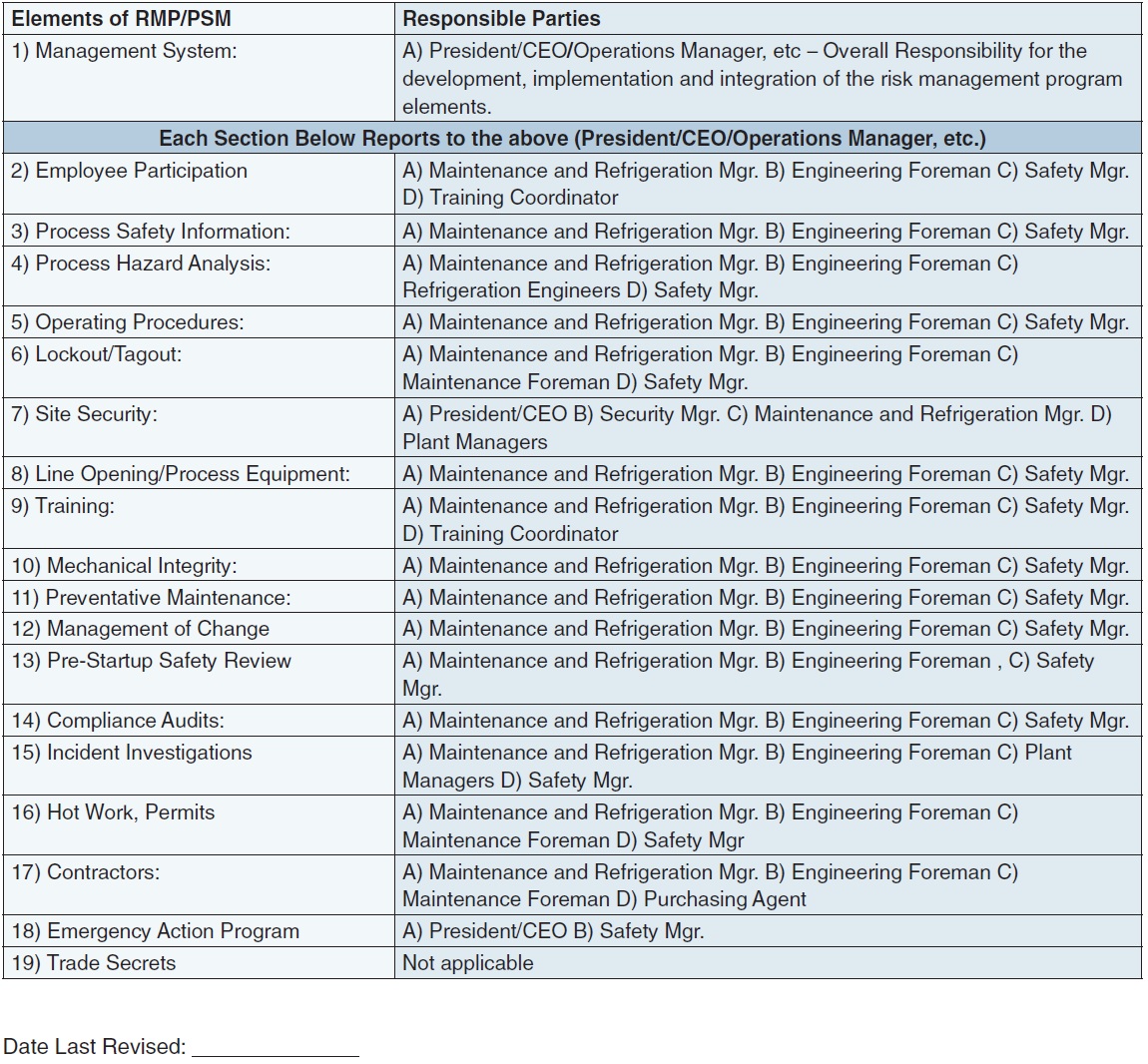
After careful review of the example two things become clear: 1) yes the example is from an refrigeration process, but 2) did you notice who is responsible for the DAY-TO-DAY actions within the process safety management system? Better yet, did you notice where the safety professional lies in the scheme of the DAY-TO-DAY RMP management?
One should notice that those managers most directly responsible for operating the process and maintaining the process have the heaviest involvement in the DAY-TO-DAY functions and decision making. Also, notice that the safety professional has responsibility, but that in none of the 19 line items in the EPA example is the safety manager the one PRIMARILY responsible for the implementation of the element! To me, the underlying message needs to be shouted from the highest mountain, as this misunderstanding of process safety MANAGEMENT is our road block to gain as much ground in the next 20 years as we did in the first 20 years.
Take contractors for example, it is still very common to find the safety professional buried up to their eyeballs with contractor evaluations, contractor training, issuing permits, auditing, and enforcing the safety work practices. A mature and well managed contractor safety program will be managed by the engineering/maintenance manager, seeing how the vast majority of the contractor work on the covered process will most likely be through this manager. I was fortunate, most of plant managers understood “management systems” and laid a very simple law down… You hire – You are responsible for them; from their evaluation to the enforcement of the plant safety rules with them. The plant manager made it easy on me, if I caught them violating plant safety rules, I was to shut down the job, remove the workers from the hazards, and call a Board of Review (e.g. Investigation to identify the failures that allowed the hazards to be present). It was very painfully the first six months, but once everyone realized I was not their personal contractor trainer and all contractor evaluations were not emergencies, the program actually began to make everyone’s life much easier – include the lives of our contractors.
As long as process safety is viewed as the role of the safety professional or safety department, we are DOOMED TO FAIL. We MUST BE INVOLVED on a daily basis, but we are there to aid in the management process and not be a one person/one department act. There is just NO WAY that anyone person, regardless of education, years of experience, and/or level of passion and desire, that can successfully manage a process safety management system on their own and be highly successful. First no one person can excel in ALL ASPECT of process safety. There is just too much information and data that has to be harnessed for one person to consume and fully understand; much less time to actually implement it all.
So take one thing away from this EPA example… process safety is a TEAM APPROACH with the right skills aligned with the needs of the process. When this approach is taken, we have seen much success. Unfortunately we see the other side of that coin in the news weekly, either from OSHA/EPA news releases with the latest six figure citation or the news telling us about the most recent explosion or chemical release.
Lastly for those who want to blow this off with the position that “EPA has never run a chemical process, much less ever run a process safety management system… so they have no idea what they are talking about”, be very careful with that type of attitude and NEVER LOOSE SIGHT of one basic fact… They wrote the rule! Even in the early years all the way back to 1999, EPA has always stated that they would accept an organizational chart with the responsibilities for RMP identified by assignment to the management group. This new layout is just a bit more fancy, but it is still focusing the responsibility for RMP on the management team and NOT A SINGLE INDIVIDUAL or department!
FYI… here is the guidance from EPA Guidance Documents on the RMP “Management System”
CHAPTER 5: MANAGEMENT SYSTEM
5.1 GENERAL INFORMATION (§68.15)
If you have at least one Program 2 or Program 3 process (see Chapter 2 for guidance on determining the Program levels of your processes), the management system provision in § 68.15 requires you to:
- Develop a management system to oversee the implementation of the risk management program elements;
- Designate a qualified person or position with the overall responsibility for the development, implementation, and integration of the risk management program elements; and
- Document the names of people or positions and define the lines of authority through an organizational chart or other similar document, if you assign responsibility for implementing individual requirements of the risk management program to people or positions other than the person or position with overall responsibility for the risk management program.
ABOUT THE MANAGEMENT SYSTEM PROVISION
Management commitment to process safety is a critical element of any facility’s risk management program. Since the program requires ongoing implementation of accident prevention and emergency response measures, management commitment does not end when the risk management plan is submitted to EPA. For process safety to be a constant priority, facility personnel must remain committed to every element of the risk management program.
By satisfying the requirements of this provision, you are ensuring that:
- The risk management program elements are integrated and implemented on an ongoing basis; and
- All groups within a source understand the lines of responsibility and communication.
5.2 HOW TO MEET THE MANAGEMENT SYSTEM REQUIREMENTS
Sources covered by this rule are diverse, so you are in the best position to decide how to appropriately implement the risk management program elements at your facility. Therefore, the rule provides considerable flexibility in complying with its program requirements.
WHAT DOES THIS MEAN FOR ME AS A SMALL FACILITY?
As a small facility that must comply with this provision, you most likely have one or two Program 2 or 3 processes. To begin, you may identify either the qualified person or position with overall responsibility for implementing the risk management program elements at your facility. As a small facility, it may make sense and be practical to identify the name of the qualified person, rather than the position. Recognize that the only element of your management system that you must report in the RMP is the name of the qualified person or position with overall responsibility. Further, changes to this data element in your RMP do not trigger a special update of your RMP (although such changes must be reflected in RMP updates submitted for other reasons – see Chapter 9 for more information on RMP updates).
Identification of a qualified individual or position with overall responsibility may be all you need to do if the person or position named directly oversees the employees operating and maintaining the processes. You must define the lines of authority with an organizational chart or similar document only if you choose to assign responsibility for specific elements of the risk management program to persons or positions other than the person with overall responsibility. For a small facility, with few employees, it is likely that you will meet the requirements of this provision by identifying the one person or position with the overall responsibility of implementing the risk management program elements. If this is the case, you need not develop an organizational chart.
Even if you meet the requirements of this section by naming a single person or position, it is important to recognize that the person or position assigned the responsibility of overseeing implementation must have the ability and resources to ensure that your facility and employees carry out the risk management program, particularly the prevention elements, on an continuing basis. Key to the effectiveness of the rule is integrated management of the program elements.
WHAT DOES THIS MEAN FOR ME AS A MEDIUM OR LARGE FACILITY?
As a medium or large facility you may have more personnel turnover than smaller sites. For this reason, it may make more sense at your facility to identify a position, rather than the name of the specific person, with overall responsibility for the risk management program elements. Remember that the only element of your management system that you must report in the RMP is the name of the qualified person or position with overall responsibility. Also note that changes to this data element in your RMP do not require you to update your RMP.
As a relatively large or complex facility, you may choose to identify several people or positions to supervise the implementation of the various elements of the program; therefore, you must define the lines of authority through an organizational chart or similar document. Further, most large facilities already have likely developed and maintained some type of documentation defining positions and responsibilities. Any internal documents you currently have should be the starting point for defining the lines of authority at your facility. You may find that you can simply use or update current documents to satisfy this part of the management system provision. Exhibit 5-1 provides a sample of another type of documentation you may use in addition to or as a replacement for an organization chart.
Defining the lines of authority and roles and responsibilities of staff that oversee the risk management program elements will help to:
- Ensure effective communication about process changes between divisions;
- Clarify the roles and responsibilities related to process safety issues at your facility;
- Avoid problems or conflicts among the various people responsible for implementing elements of the risk management program;
- Avoid confusion and allow those responsible for implementation to work together as a team; and
- Ensure that the program elements are integrated into an ongoing approach to identifying hazards and managing risks.
Remember that all of the positions you identify in your documentation will report their progress to the person with overall responsibility for the program. However, nothing in the risk management program rule prohibits you from satisfying the management provision by assigning process safety committees with management responsibility, provided that an organizational chart or similar document identifies the names or positions and lines of authority.