As we have discussed before, the EPA broke down its RMP rule into three (3) programs, and each program has criteria that will place the process in one of the three. However, the one criterion that confuses some businesses is how the EPA used the North American Industry Classification System (NAICS) to qualify a process for Program 3. Here is what the RMP rules state.
(d) Program 3 eligibility requirements. A covered process is subject to Program 3 if the process does not meet the requirements of paragraph (b) of this section, and if either of the following conditions is met:
(1) The process is in NAICS code 32211, 32411, 32511, 325181, 325188, 325192, 325199, 325211, 325311, or 32532; or
(2) The process is subject to the OSHA process safety management standard, 29 CFR 1910.119.
Here is a breakdown of those NAICS codes in (1) above:
NAICS code 32211 – Pulp Mills
NAICS code 32411 – Petroleum Refineries
NAICS code 32511 – Petrochemical manufacturing
NAICS code 325181 – Alkalies and Chlorine Manufacturing
NAICS code 325188 – All Other Basic Inorganic Chemical Manufacturing
NAICS code 325192 – Cyclic Crude and Intermediate Manufacturing
NAICS code 325199 – Other Basic Organic Chemical Manufacturing
NAICS code 325211 – Plastics Material and Resin Manufacturing
NAICS code 325311 – Nitrogenous Fertilizer Manufacturing
NAICS code 32532 – Pesticide and Other Agricultural Chemical Manufacturing
This means that if your process exceeds the threshold of an RMP chemical, is NOT eligible for Program 1, falls into one of these ten (10) NAICS codes, or is already covered under OSHA’s PSM, then the process is a Program 3 RMP.
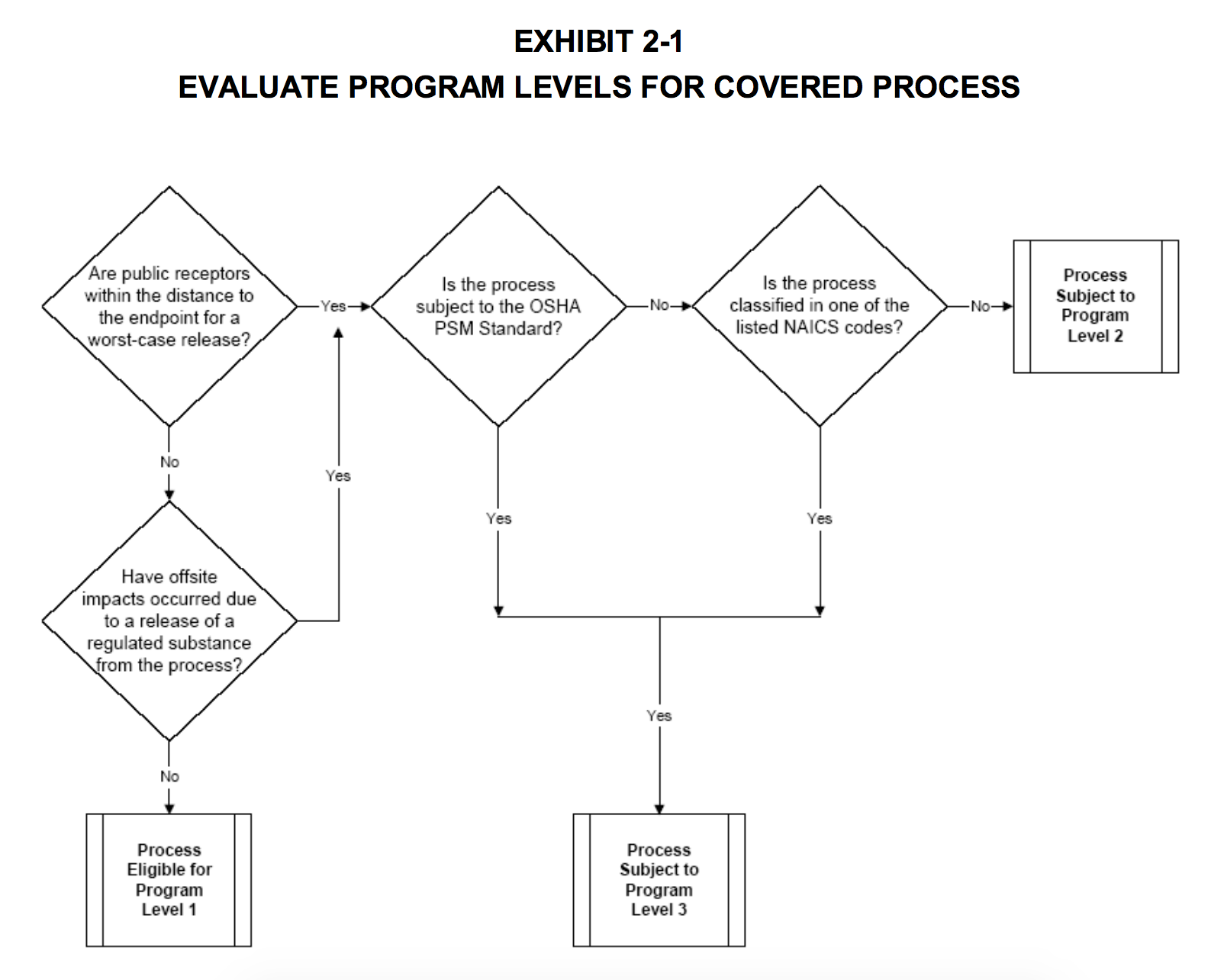
BUT I would like to remind everyone that if the process is eligible for Program 1 then all of this is a mute point! We start our program(s) level assessment with Program 1, then we move to Program 3, and then if the process does NOT qualify for Program 1 or 3, it falls into Program 2. And yes, a process covered by OSHA’s PSM standard can indeed be a Program 1 RMP! If you don’t believe me, and many don’t on this matter, look at the EPA Guidance Documents.
EPA’s Flow Chart explains how processes qualify for the three (3) programs…

If the flow chart and the actual standard are not enough to convince you, here is some more from EPA: (emphasis added by me)
KEY POINTS TO REMEM BER
In determining program level(s) for your process(es), keep in mind the following:
(1) Each process is assigned to a program level, which indicates the risk management measures necessary to comply with this regulation for that
process, not the facility as a whole. The eligibility of one process for a program level does not influence the eligibility of other covered processes
for other program levels.
(2) Any process that meets the criteria for Program 1 can be assigned to Program 1, even if it is subject to OSHA PSM or is in one of the NAICS codes listed for Program 3.
(3) Program 2 is the default program level. There are no “standard criteria” for Program 2. Any process that does not meet the applicability criteria for
either Program 1 or 3 is subject to the requirements for Program 2.
(4) Only one Program level can apply to a process. If a process consists of multiple production or operating units or storage vessels, the highest
Program level that applies to any segment of the process applies to all parts.
Here is one of EPA’s Q&A (emphasis added by me)
Q. If my state administers the OSHA program under a delegation from the federal OSHA, does that mean that my processes that are subject to OSHA PSM under the state rules are in Program 3?
A. Yes, as long as the process does not qualify for Program 1. Any process subject to PSM, under federal or state rules, is considered to be in Program 3 unless it qualifies for Program 1.
For those who wish to read this directly from the EPA’s CHAPTER 2: APPLICABILITY OF PROGRAM LEVELS