
If you are an RMP site and have updated your RMP Submittal in the past couple of years you may have noticed a slight discrepancy in some of the data. In fact, the EPA guidance documents are also out-of-date with the ERPG-2 level for Ammonia still is being shown as 200 ppm. I am not sure about the many other Extremely Hazardous Substances (EHS), but I work with many Ammonia facilities, doing their RMPs and/or helping them with their RMP WCS and ARS. Here is the issue at hand…
PLEASE NOTE: I have linked to many external documents in this article to aid those trying to follow my path and so that everyone can see what I am seeing. I would greatly appreaciate any help or feedback concerning this article; so if you know something on this matter please feel free to comment publically in the comment section below or e-mail me privately.
The American Industrial Hygiene Association (AIHA) maintains and publishes the the Emergency Response Planning Guides (ERPG), which EPA used to establish the end points for both the Worst Case Release Scenario (WCS) and Alternative Release Scenario (ARS). Specifically EPA used the ERPG-2 levels. The old ERPG-2 for ammonia was 200 ppm (pdf, p. 4), the new ERPG-2 for Ammonia was revised in 2011 and is now 150 ppm (pdf); which means that with a lower ppm, the distances from the modeling will be farther if properly reflected in the RMP Comp Modeling.
I know the RMP Comp Model was updated in 2009, as stated in the FAQs, but I have been unable to determine if it has been updated since 2011 (when the ERPG-2 for NH3 was revised). The EPA guidance documents still reflect the ERPG-2 of 200 ppm, but this may be a paper work issue and not impacting the actual modeling done via RMP Comp.
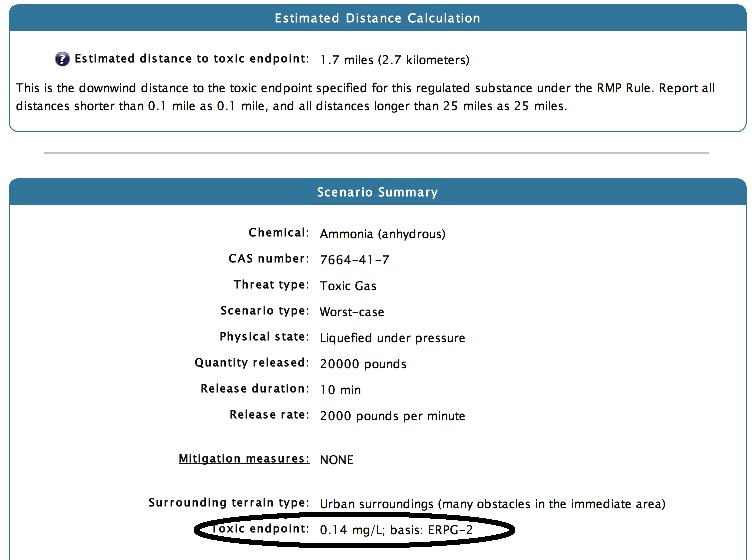
What does this mean to us? Not really sure. If EPA is not complying with it’s own directive, to use the ERPG-2 for Ammonia, then I am not sure what they can say to us for using their modeling software that they may have not updated. I can tell you this, I am advising my clients that when they have to update their submittals, to revise the text in the Executive Summaries where some have quoted the ERPG-2 level of 200 ppm (0.14 mg/L). At least they are attempting to use the right end point data, even if EPA has not updated their RMP*Comp modeling software.
Here is a screen shot of the RMP* Comp on-line version using NH3 in a WCS of 20,000 pounds. I have circled the ERPG-2 statement from within the software.
UPDATE on 1/11/13: An “unofficial” response from the EPA RMP Program Office…
“… The endpoint concentrations for each chemical in the regulation are fixed, unless a regulatory change is made. The anhydrous ammonia ERPG-2 has changed to 150ppm, but the RMP regulation uses 200ppm, as originally set. We can’t make any changes to the toxic endpoint values used in RMP*Comp and the OCA Guidance without a rule change.”
So just keep using the 200 ppm for the end-point, as it is more favorable to the facility anyway. I can certainly understand EPA’s position on the matter.