
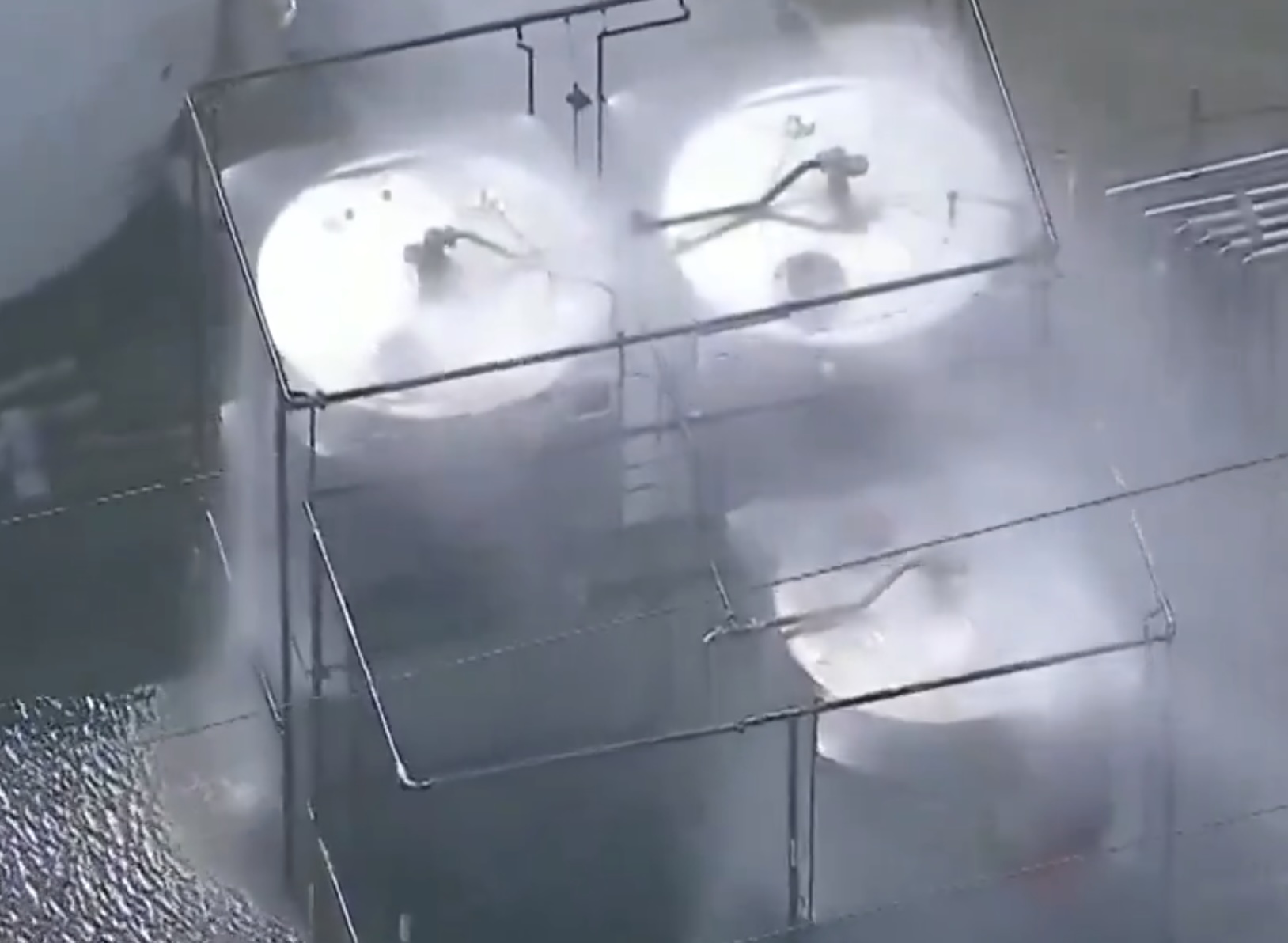
OSHA, IFC, and NFPA have “separation distance” requirements for flammable liquid storage tanks. These requirements have been around longer than I have been dealing with hazardous materials and process safety, and yet we always come across some wildly out of “compliance” arrangements of these flammable liquid tanks. using OSHA’s Flammable Liquid Standard 1910.106 we can get a visual of this requirement: (emphasis by me)
1910.106(b)(2)(ii)(a) The distance between any two flammable liquid storage tanks shall not be less than 3 feet.
1910.106(b)(2)(ii)(b) Except as provided in paragraph (b)(2)(ii)(c) of this section, the distance between any two adjacent tanks shall not be less than one-sixth the sum of their diameters. When the diameter of one tank is less than one-half the diameter of the adjacent tank, the distance between the two tanks shall not be less than one-half the diameter of the smaller tank.
Let’s discuss WHY the codes/standards require this spacing.
Its entire purpose is to prevent cascading failure (the “domino effect”) during an incident. When one tank catches fire, it radiates intense heat to its surroundings. If an adjacent tank is too close, that radiant heat will cause it to exceed its safe operating temperature—potentially leading to a tank rupture, a pool fire, or a BLEVE.
Here is the breakdown of the two (2) scenarios the code covers:
The “General Case” (Similar Sized Tanks)
"The distance between any two adjacent tanks shall not be less than one-sixth (1/6th) the sum of their diameters."
This rule applies when the tanks are roughly comparable in size. By using a fraction of the sum of their diameters, the standard ensures that as the tanks get larger (and thus have more fuel and more surface area to radiate heat), the required safety gap increases proportionally.
If you have two tanks, both with a diameter (D) of 60 feet:
- Sum of diameters = 60 + 60 = 120 feet.
- Minimum separation = 1/6 × 120 = 20 feet
The “Small Tank/Large Tank” Exception
"When the diameter of one tank is LESS THAN one-half the diameter of the adjacent tank, the distance between the two tanks SHALL NOT BE LESS THAN one-half (1/2) the diameter of the smaller tank."
This rule is designed for situations where a small vessel is placed next to a much larger one. If you applied the “one-sixth the sum” rule here, the calculated gap might be so small that the small tank would be entirely engulfed by the large tank’s flame zone during a fire.
If you have a large tank (100-foot diameter) next to a small tank (20-foot diameter):
- Since 20 is less than half of 100, you use this exception.
- Minimum separation = 1/2 × (small diameter) = 1/2 × 20 = 10 feet
These distances are not just suggestions; they are the “fire-break” that allows your emergency response teams to actually work.
- If tanks are spaced according to these rules, it leaves enough room for firefighters to maneuver portable ground monitors and hoses to provide exposure protection (as seen in the first photo you shared).
- These distances are calculated based on the radiant heat flux of a typical flammable liquid fire. If the tanks are closer than this, you cannot rely on water cooling to save the “uninvolved” tank—the heat intensity will simply be too high for the water to dissipate effectively.
If you are performing a site assessment, any tank found with less than these required clearances is a non-compliant condition that must be immediately addressed by either upgrading the fire suppression system (e.g., adding automated water spray curtains or high-intensity fireproofing) or by modifying the tank layout.
May 2026 Update:
This weekend, we watched the MMA event in Garden Grove, CA. MMA is classified as an “unstable flammable liquid” and will fall under: (emphasis by me)
1910.106(b)(2)(ii)(d) Where unstable flammable liquids are stored, the distance between such tanks SHALL NOT BE LESS THAN one-half (1/2) the sum of their diameters.
Now I do not have the exact measurements, so I can not say one way or the other that those tanks were adequately spaced. But we can discuss hypotheticals to demonstrate what the code/standard requires. Let’s say the two larger tanks shown in the screenshot of drone video from OCFA are 10′ in diameter.
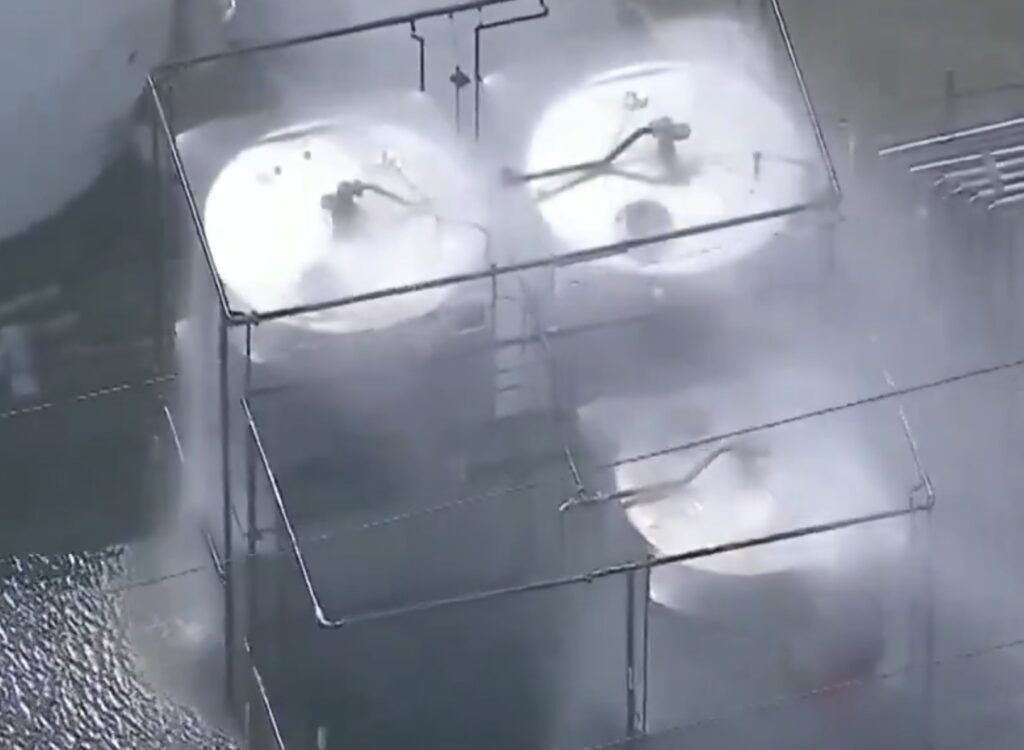
Minimum separation = 1/2 × (10′) = 5 feet seperation distance
I’ll let you be the judge if these tanks look to be 5′ or more apart from each other.