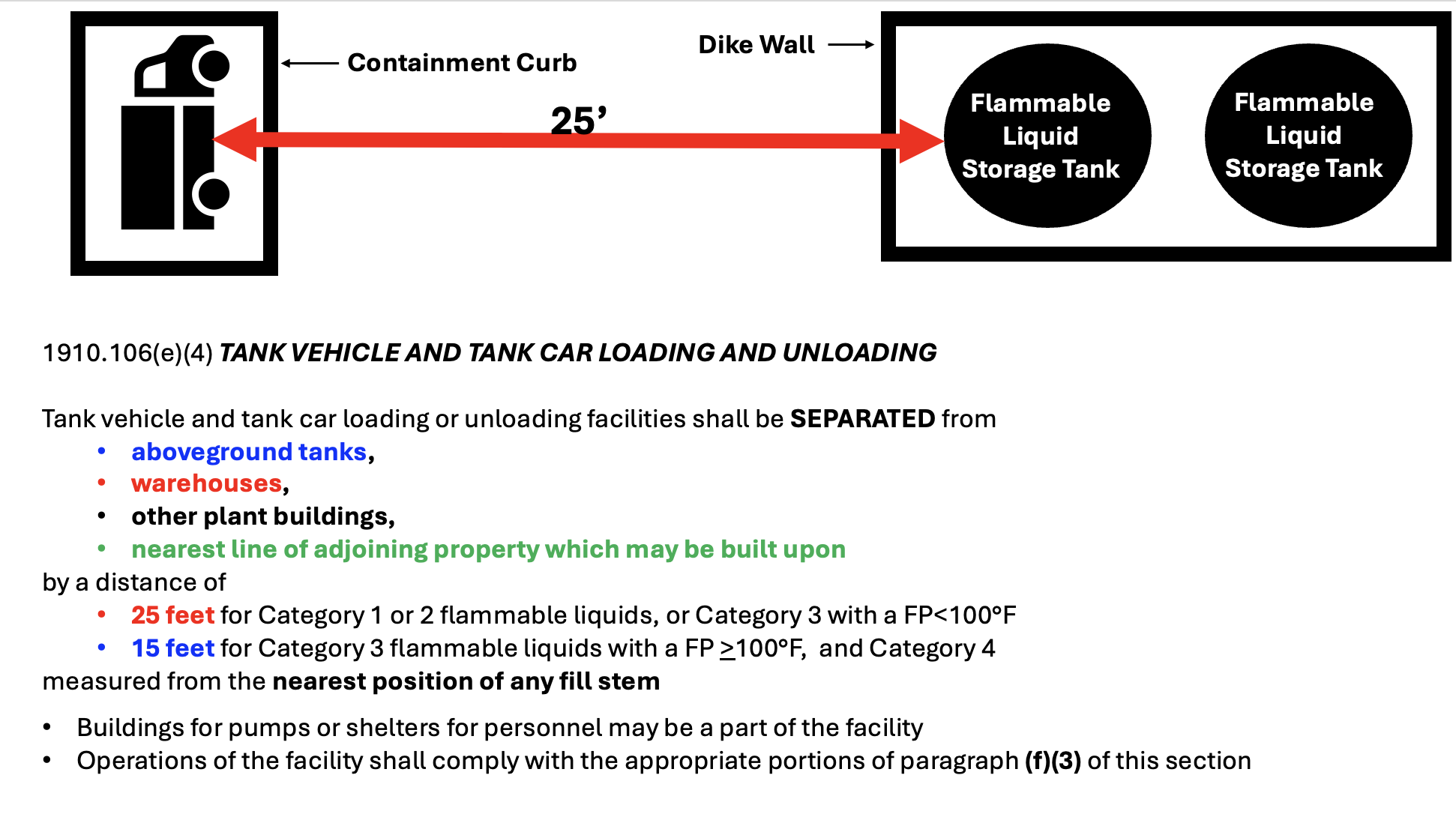
In some cases, we can actually put specific measurements in our “facility siting” analysis. Take, for example, an old but often missed distance between the tank truck/railcar and the closest aboveground tank.
(emphasis by me)
|
1910.106(e)(4) Tank vehicle and tank car loading and unloading.
1910.106(e)(4)(i) Tank vehicle and tank car loading or unloading facilities shall be separated from aboveground tanks, warehouses, other plant buildings or nearest line of adjoining property which may be built upon by a distance of 25 feet for Category 1 or 2 flammable liquids, or Category 3 flammable liquids with a flashpoint below 100 °F, and 15 feet for Category 3 flammable liquids with a flashpoint at or above 100 °F and Category 4 flammable liquids, measured from the nearest position of any fill stem. Buildings for pumps or shelters for personnel may be a part of the facility. Operations of the facility shall comply with the appropriate portions of paragraph (f)(3) of this section.
|
Here is what this looks like:
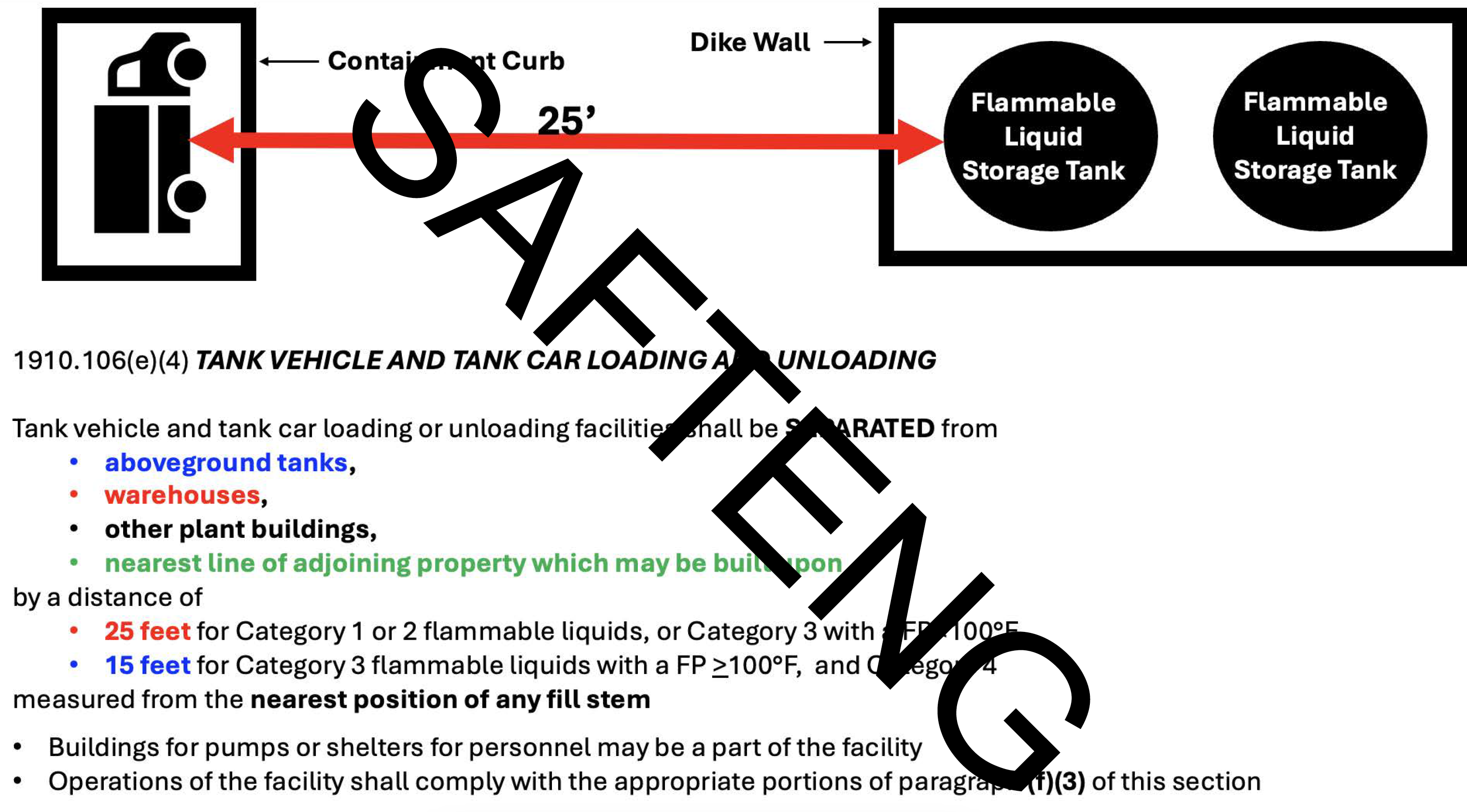
SAFTENG Members can download the full image without watermark and the analysis of NFPA 30 as it applies to these requirements…
NFPA 30, 2024 allows for an exception to these distances…
|
Chapter 28 Bulk Loading and Unloading Facilities for Tank Cars and Tank Vehicles 28.1 Scope. This chapter shall apply to operations involving the loading or unloading of tank cars and tank vehicles. … 28.4 Location of Loading and Unloading Facilities 28.4.2* These distances shall be permitted to be reduced if there is suitable protection for exposures.
… A.28.4.2 Use of fixed fire protection systems, dikes, fire-rated barriers, or a combination of any of these can provide suitable protection from exposures. |
It should be noted that using a truck unloading containment basin is one of these “suitable protections.” But for the containment basin to be practical, it would still need some distance from the tank(s). The INTENT of these distance requirements is to protect the bulk tanks from the highest risks – BULK UNLOADING. We can use DISTANCE or BARRIER as our “suitable protection for exposures,” but having our truck unloading secondary containment basin right next to the above-ground tanks does not permit adequate distance.