
Falls, Permit-Required Confined Spaces, and Reclassifying the space

Our behind the scenes debate continues and now a number of clients have joined in with their take on the matter. The fundamental part of our debate has come down to two (2) positions:

  1. does a fall inside or into a Confined Space make that CS a Permit-Required Confined Space?
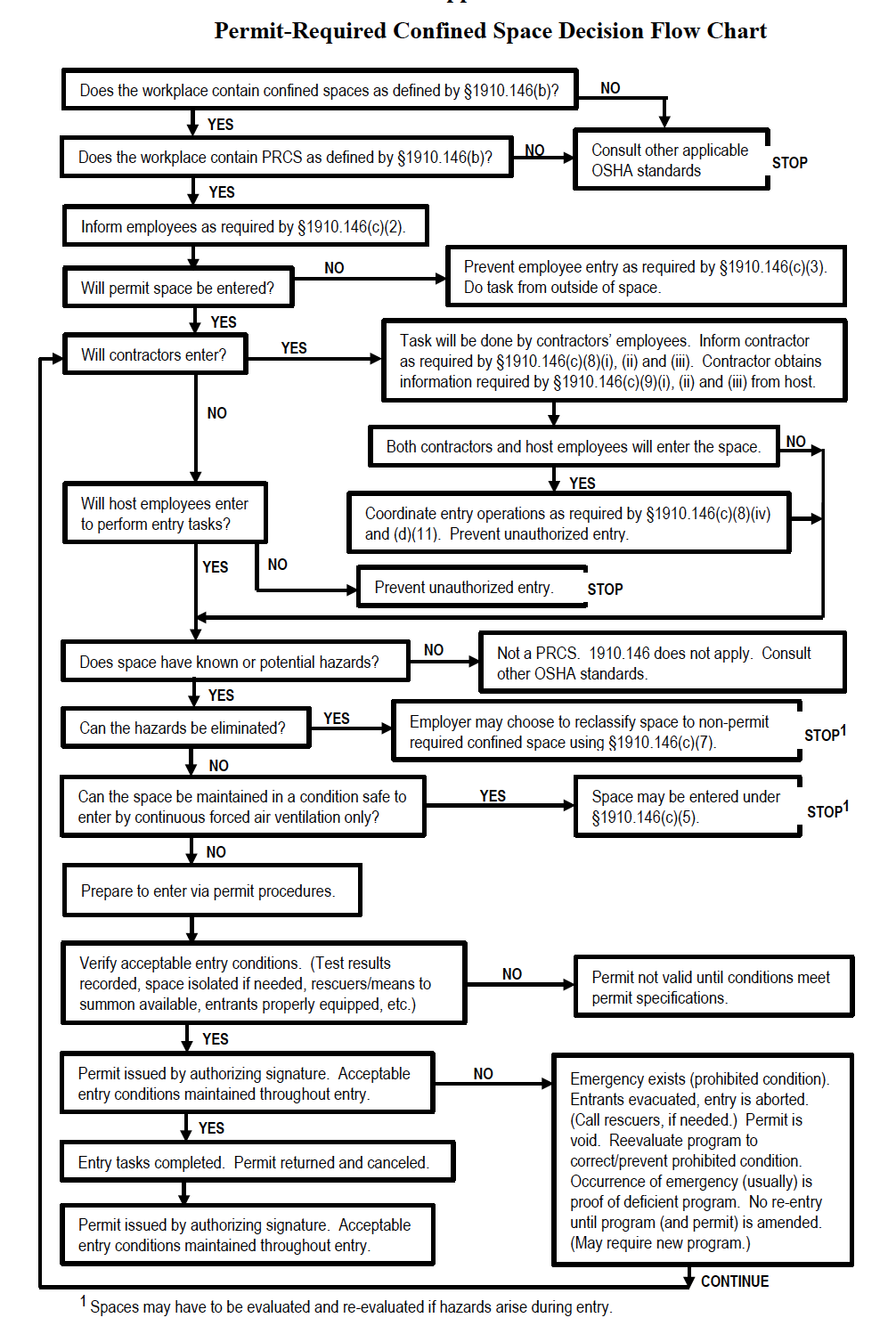
  2. if you said yes to #1, then can the space be “reclassified” under 1910.146(c)(7) or 1926.1203(g)?

As I have ALWAYS said, we MUST manage the fall hazard, but it is NOT the type of hazard OSHA is talking about when they state “Contains any other recognized serious safety or health hazard”. And I am in NO WAY saying “fall hazards” are NOT a recognized hazard nor that they are not a serious hazard; just that this type of hazard is NOT part of determining whether a CS becomes a PRCS.

If you have an in-house rescue team that is properly staffed, equipped, and trained and you wish to enter every one of your CS as a permitted-entry then by all means I am NOT trying to stop you – heck I commend you for taking that approach. I just ask that you realize you are in a very small minority of facilities that have this luxury.  Thus OSHA gave employers three (3) acceptable means to enter a PRCS and over the years the “reclassification” method has gained momentum once employers realized what PRCS rescue really required!  And please don’t think that entry using the reclassification method is taking short-cuts.  It is actually more safe and takes more time and resources than doing a permitted-entry.

I have made my position clear for years, but to restate it – a fall inside or into a CS does not make that CS a PRCS. I base my position on a 1999 OSHA Memorandum which asked:
“Would a pit, which meets the definition as a confined space, also meet the definition of a permit-required confined space, if the only hazard is a potential fall from 21 feet while descending on a ladder within the pit?”

OSHA’s response to the Assistant Regional Administrator, Technical Support Region V stated:

Specific fall protection requirements were not included in the PRCS standard. Fall protection and ladder safety requirements are addressed in Walking-Working Surfaces, 29 CFR 1910, Subpart D and the General Duty Clause of the Occupational Safety and Health Act. Therefore, if the described potential fall hazard is the exclusive hazard within this pit, a permit program would not be required.

1999 OSHA Memorandum

I know what it is like to have my very own in-house ERT and PRCS rescue was a way-of-life for ERT members.  Heck, we were better trained and equipped than the community FD; such that the FD would call us for help! But it was after BFGoodrich sold their chemical business to a bank in the early 2000’s and the cuts began to budgets, personnel, etc. While we were under the BFG umbrella we were NOT allowed to reclassify to a non-permit status; although 90% of our entries were prepared and conducted under conditions that made the space a non-PRCS – we still issued an entry permit (vs. a reclassification certificate) and verified rescue team was available. It was after the sale and we lost hundreds of employees to layoff’s and training budgets were slashed as to when I was asked about reclassification by some managers who had used the practice at their previous facilities. In a union plant, when layoff’s occurred it is always the youngest/newest employees who go first and guess who makes up the bulk of a plant ERT? So after going from an 85-100 member ERT to about 25-30 members, much discussion with Corporate S&H and my management team we decided that we would begin entering spaces as Non-PRCS (i.e. .146(c)(7)) when that method was “without question” available. This plant was a “batch plant” and almost all of our reactors/process vessels were 2-3 floors high and the entry portals (i.e. man-ways) were almost always on top of the vessel. Some vessels would have a side man-way at the bottom, but the vast majority had one (1) man-way at the top.

So we would spend a half day (sometimes longer) flushing and rinsing the space, draining the space, then isolating every line/pipe/hose/tube/duct to and from the space with one of the three (3) isolation means OSHA recognizes:

  1. blanking or blinding
  2. misaligning or removing sections of lines, pipes, or ducts
  3. double block and bleed

We also used the traditional energy isolation device/methods on the agitator, auger, sweep arms, etc. within the space. Thus we have now ELIMINATED the hazards that made that space a PRCS.

In our original evaluation, we did NOT list falling 30′ as one of the hazards that made the CS a PRCS, so when it came time to ELIMINATE the PRCS hazards that made the CS a PRCS, falls was not on the list. But we recognized falls as a serious hazard AND we ALWAYS managed the fall hazard(s) with the proper personal fall arrest systems.

In all the arguments I have received telling me that I am “dead wrong” (don’t think they meant the pun) I began to question my position, but then it dawned on me…

If we viewed a fall into or within a PRCS as a hazard that prevented me from reclassifying the space to a non-PRCS then the vast majority of PRCSs (and I would argue not just my experience but most of your spaces) within my nearly 30 years of entering PRCSs would not have been eligible for reclassification simply because we entered through the top entry portal and the vessel was taller than XX feet. Then I began to ask myself, how far would the fall have to be before it was a “recognized serious safety or health hazard”? 4 feet? 6 feet? How about a fall at the same level due to a slick/wet floor?

As OSHA stated in their 1999 Memorandum, if the potential fall hazard is the only hazard within this pit (i.e. space), a permit program would not be required. Now some read this memo as to say if the only hazard the space presents then the standard would not apply, but if there are other hazards then the fall hazard would negate any reclassification???? I am sorry, but that is NOT what OSHA meant – call them and ask. The memo was trying to make it clear that a pit may contain other hazards, just not a fall, and that the other hazards would have to be considered as well; however, a fall into or inside the pit alone would NOT make the pit a PRCS.

Scroll to Top