
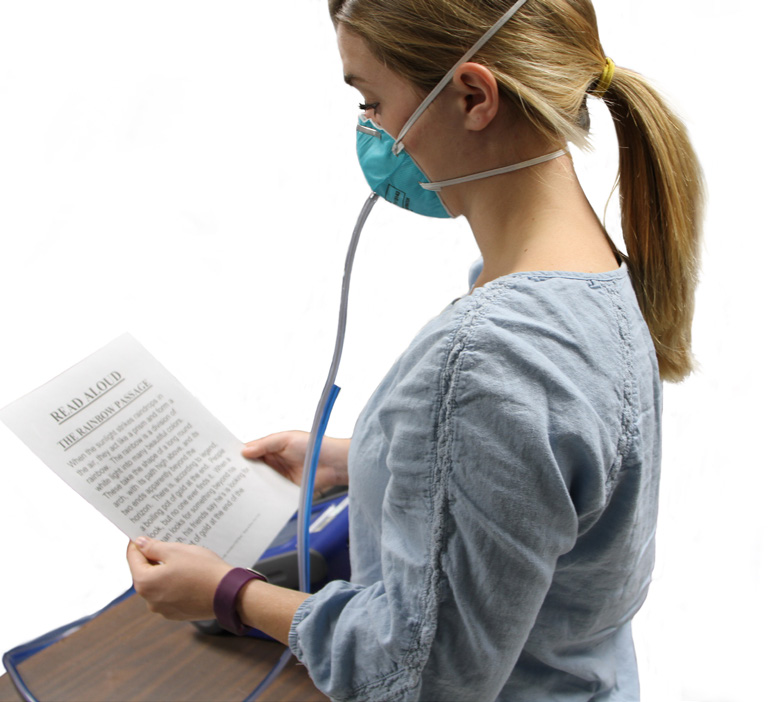
 Over 3 million United States employees, in approximately 1.3 million workplaces, are required to wear respiratory protection. The Occupational Safety and Health Administration (OSHA) (29 CFR 1910.134) requires an annual respirator fit test to confirm the fit of any respirator that forms a tight seal on the wearer’s face before it is used in the workplace. This ensures that users are receiving the expected level of protection by minimizing any contaminant leakage into the facepiece. The following are some frequently asked questions about respiratory protection and fit testing.
What is a Respirator Fit Test?
A fit test is conducted to verify that a respirator is both comfortable and correctly fits the user. Fit test methods are classified as either qualitative or quantitative. A qualitative fit test is a pass/fail test that relies on the individual’s sensory detection of a test agent, such as taste, smell, or an involuntary cough (a reaction to irritant smoke). A quantitative fit test uses an instrument to measure the effectiveness of the respirator numerically. The benefits of a fit test include better protection for the employee and verification that the employee is wearing a correctly-fitting model and size of respirator.1 Higher than expected levels of exposure to a contaminant may occur if the respirator has a poor face seal against the user’s skin, which can result in leakage.
How Often Must Fit Testing Be Conducted?
In addition to fit testing upon initially selecting a model of respirator, OSHA requires that fit testing be conducted annually, and repeated “whenever an employee reports, or the employer or the physician or other licensed health care professional makes visual observations of changes in the employee’s physical condition that could affect respirator fit (e.g., facial scarring, dental changes, cosmetic surgery, or an obvious change in body weight).” 2
The appropriate length of time between respirator fit tests has been a point of debate and discussion for many years due to its use of workplace time and resources, especially in reference to the commonly-used filtering facepiece respirator (FFR).3 In response to these concerns, NIOSH completed a study that confirmed the necessity of the current OSHA respirator fit the testing requirement, both annually and when physical changes have occurred.2
Once I am Fit Tested, Can I use any Brand/Make/Model Respirator as Long as it is the Same Size?
A successful fit test only qualifies an employee to use the specific brand/make/model and size of respirator that he or she wore during that test. Respirator sizing is not standardized across models or brands. For example, a medium in one model may not offer the same fit as a different manufacturer’s medium model.
Can I Have Facial Hair and still be Fit Tested to Wear a Tight-Fitting Respirator?
The OSHA respirator standard prohibits tight-fitting respirators to be worn by workers who have facial hair that comes between the sealing surface of the facepiece and the face of the wearer. Facial hair that lies along the sealing area of a respirator, such as beards, sideburns, or some mustaches, will interfere with respirators that rely on a tight facepiece seal to achieve maximum protection.
Research tells us that the presence of facial hair under the sealing surface causes 20 to 1000 times more leakage compared to clean-shaven individuals.4 Gases, vapors, and particles in the air will take the path of least resistance and bypass the part of the respirator that captures or filters hazards out. A common misconception is that human hair can act as a crude filter to capture any particles that are in the airstream between the sealing surface and the user’s skin. However, while human hair appears to be very thin to the naked eye, hair is much larger than the particles inhaled. Facial hair is not dense enough, and the individual strands are too large to capture particles as an air filter does; nor will a beard trap gases and vapors like the carbon bed in a respirator cartridge. Therefore, the vast majority of particles, gases, and vapors follow the air stream right through the facial hair and into the respiratory tract of the wearer. In fact, some studies have shown that even a day or two of stubble can begin to reduce protection.
Do Powered Air-Purifying Respirators (PAPRs) Require Fit Testing?
The answer to this question depends on the type of facepiece that the respirator has. Any facepieces that form a tight seal to the wearer’s face, e.g., half-masks and full facepieces, must be fit tested. Loose-fitting PAPRs, in which the hood or helmet is designed to form only a partial seal with the wearer’s face or hoods which seal loosely around the wearer’s neck or shoulders, do not require fit testing.
Where can I Find More Information?
This information and more is available on the NIOSH Respirator Trusted-Source webpage.
CLICK HERE for the official NIOSH pdf
This document is in the public domain and may be freely copied or reprinted.
DOI: https://doi.org/10.26616/NIOSHPUB2018129
DHHS (NIOSH) Publication No. 2018-129
References
1. Duling MG, Lawrence RB, Slaven JE, Coffey CC [2007]. Simulated workplace protection factors for half-facepiece respiratory protective devices. J Occup Environ Hyg. 4(6):420-431.
2. OSHA [1998]. Respiratory Protection. 29 CFR 1910.134. Final rule. Fed Regist 63:1152-1300.
3. Zhuang Z, Bergman MS, Brochu E, Palmiero AJ, Niezgoda G, He X, Roberge RJ, Shaffer RE [2016]. Temporal changes in filtering-facepiece respirator fit. J Occup Environ Hyg. 13(4), pp.265-274.
4. Stobbe TJ, daRoza RA, Watkins MA [1988]. Facial hair and respirator fit: a review of the literature. Am. Ind Hyg Assoc J. 49(4):199-204.