
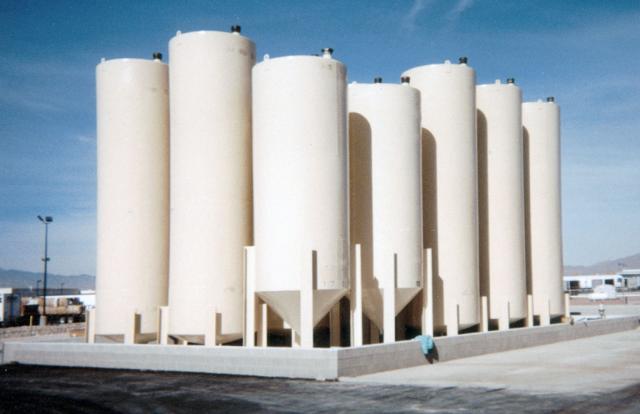
 Over the past year or so we have come across several situations where facilities have replaced their flammable liquid storage tanks, which some are used as a “waste tank”. These “waste tanks” fall under EPA’s RCRA rule and apparently these tanks have to be “fully inspected” on a set frequency and when tanks sit directly on their foundation this causes some issues with a “full RCRA inspection”. So it seems that there may be a concerted effort to install new flammable waste tanks, as well as other flammable tanks, on legs so that the bottom of the tank can be visually inspected with ease. Now I am no RCRA expert, but this explanation does make sense; and I have contacted two other businesses where we have seen this and they too stated the same reasons. But each facility viewed these new tanks as a “Replacement in Kind” since the tanks were the same size, same materials of construction, same operations, same nozzle arrangement(s), etc. EXCEPT these new tanks are installed on legs, which CHANGES things considerably and an MOC should have been done. Here’s why…
OSHA Flammable Liquids Standard
1910.106(b)(5)(ii) “Fire resistance.” Steel supports or exposed piling shall be protected by materials having a fire resistance rating of not less than 2 hours, except that steel saddles need not be protected if less than 12 inches high at their lowest point. Water spray protection or its equivalent may be used in lieu of fire-resistive materials to protect supports.
NFPA 30
22.5.2.3 Where tanks storing Class I, Class II, or Class IIIA liquids are supported above their foundations, tank supports shall be of concrete, masonry, or protected steel.
Exception: Single wood timber supports (not cribbing), laid horizontally, shall be permitted to be used for outside aboveground tanks if not more than 12 in. (300 mm) high at their lowest point.
22.5.2.4 Steel support structures or exposed piling for tanks storing Class I, Class II, or Class IIIA liquids shall be protected by materials having a fire resistance rating of not less than 2 hours.
Exception No. 1: Steel saddles do not need to be protected if less than 12 in. (300 mm) high at their lowest point.
Exception No. 2: At the discretion of the authority having jurisdiction, water spray protection in accordance with NFPA 15, Standard for Water Spray Fixed Systems for Fire Protection, or NFPA 13, Standard for the Installation of Sprinkler Systems, is permitted to be used.
International Fire Code – Chapter 57 – Flammable and Combustible Liquids
5704.2.9.2.3 Fire protection of supports. Supports or pilings for above-ground tanks storing Class I, II or IIIA liquids elevated more than 12 inches (305 mm) above grade shall have a fire-resistance rating of not less than 2 hours in accordance with the fire exposure criteria specified in ASTM E 1529.
Exceptions:
1. Structural supports tested as part of a protected above-ground tank in accordance with UL 2085.
2. Stationary tanks located outside of buildings when protected by an approved water-spray system designed in accordance with Chapter 9 and NFPA 15.
3. Stationary tanks located inside of buildings equipped throughout with an approved automatic sprinkler system designed in accordance with Section 903.3.1.1.
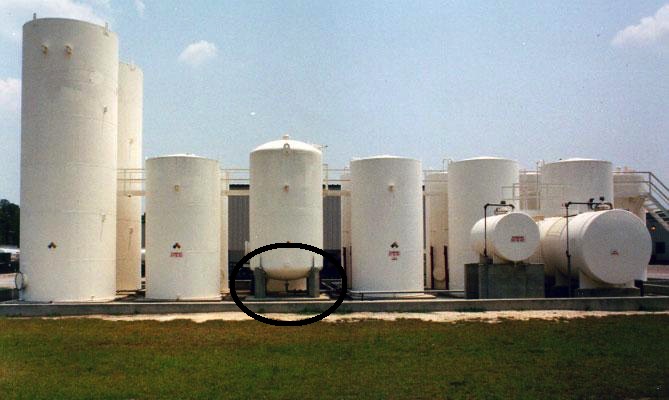
As we see in the photo below, the vertical tanks are elevated by steel supports vs. sitting directly on their foundations. These tank legs MUST be protected from a pool fire scenario with fire proofing rated for 2-hours. The photo at the bottom of the page shows insulated legs.
To show the contrast between insulated steel supports and uninsulated steel we can look to a CSB investigation photo:
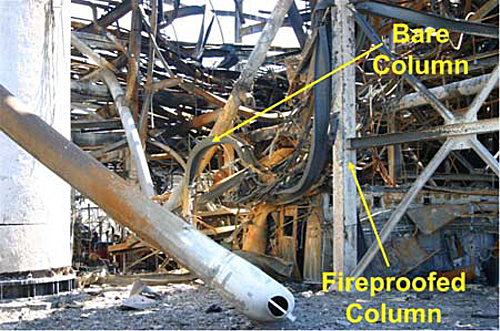
These fire proofing requirements are intended to protect the integrity of the tank supports in the event of a pool fire. Metal can fail MUCH FASTER than most would ever think when exposed to the type of heat generated by a pool fire.
It should also be noted that the IFC also REQUIRES that any pipe supports that can be exposed to a fire ALSO be protected for two (2) hours. So any pipe supports that are within the secondary containment or even within a couple of feet of the containment will need some type of protection.
5703.6.8 Piping supports.
Piping systems shall be substantially supported and protected against physical damage and excessive stresses arising from settlement, vibration, expansion, contraction or exposure to fire. The supports shall be protected against exposure to fire by one of the following:
1. Draining liquid away from the piping system at a minimum slope of not less than 1 percent.
2. Providing protection with a fire-resistance rating of not less than 2 hours.
3. Other approved methods.
So as we can see, a tank that is replaced and installed on stell supports vs. sitting directly on its foundation brings about a SIGNIFICANT change in protection requirements. Thus this “change” is NOT a RIK and an MOC would have been needed to ensure the proper protection is provided.