 Our friends to the North have once again outdone themselves with an Emergency Response Task Force that developed two (2) new charts to aid in large scale-high hazard responses, such as a High-Hazard Flammable Trains (HHFT) incident. You can read the entire DOCUMENT ( A MUST READ for ALL responders – ESPECIALLY OFFICERS who may fill the IC role during such an incident). This document is like the good book you can’t put down – so much great info; I especially like the discussion of Heat-Induced Tears (HIT). Their two (2) new charts/tables are so logical. Here is a highlight from the publication…
First responders need to recognize the risk factors inherent to the type of tank car, its condition and behavior; fire spread, explosion, toxic gases, and site conditions. Knowing what specific factors and conditions to look for in a rail incident involving flammable liquids can be challenging and something most first responders are not familiar with. To assist in this evaluation, Imperial Oil (supported by the Chemistry Industry Association of Canada and the Canadian Fuels Association) developed the Disciplined Approach to Emergency Response Chart (Annex G), a tool specific to these incidents.
How to use the Disciplined Approach Chart:
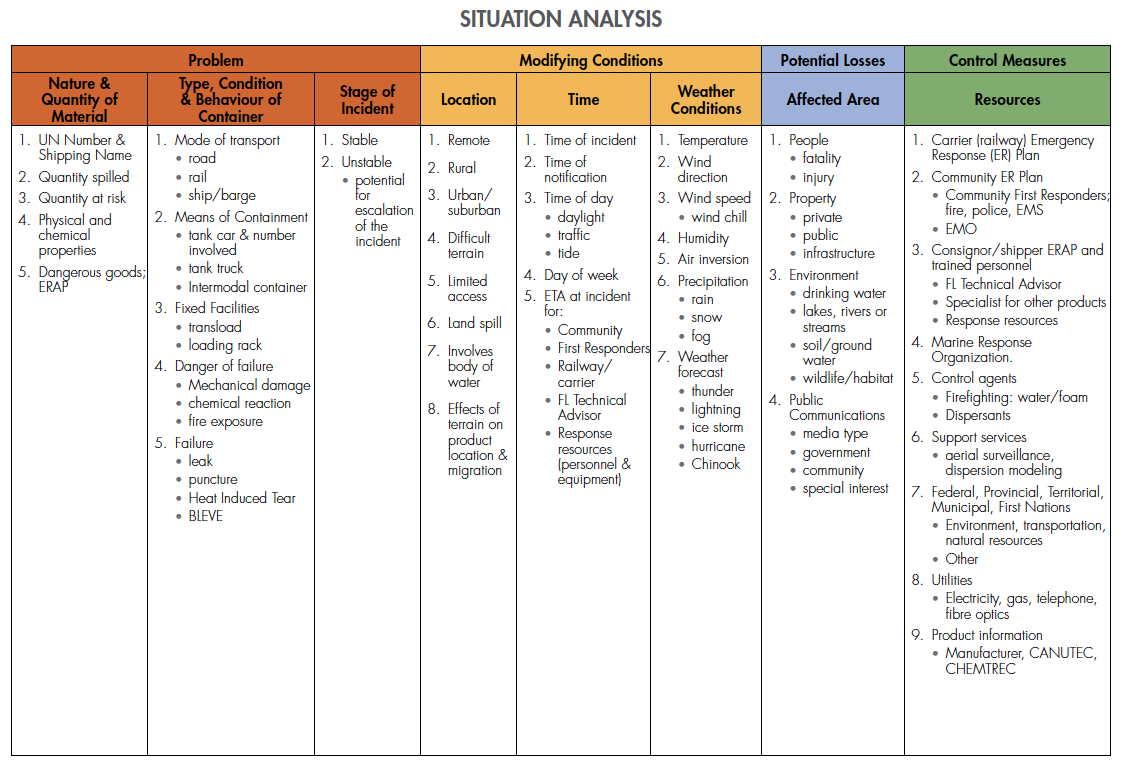
Situation Analysis
Start by analyzing the situation. The goal is to define and prioritize critical objectives: what needs to be protected (life, property, and environment) from what hazards? This includes identifying and analyzing:
- The problem (nature and quantity of material, type and condition of Container; stability of the incident);
- Modifying conditions (location, time and weather conditions);
- Potential losses (affected area): from the list of potential losses, identify and prioritize those that are critical.
- Control measures: determine the right kind and amount of resources needed to protect life, property and environment.
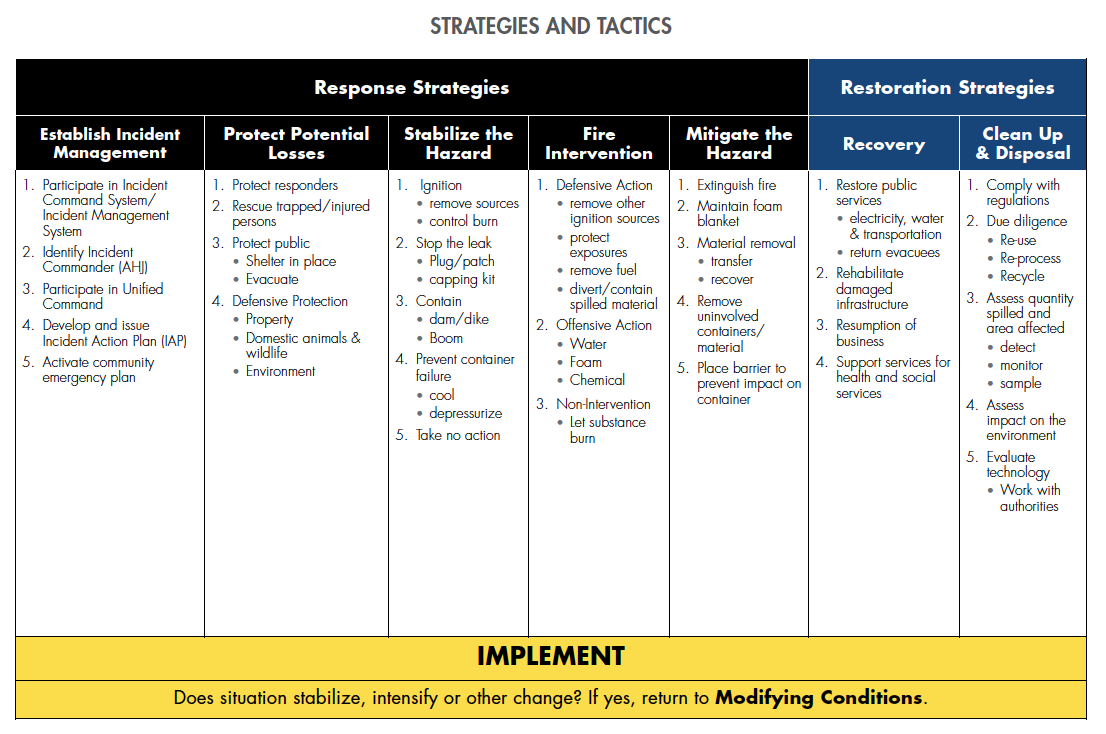
Strategies and Tactics
Develop the response and restoration tactics to meet the critical objectives, including:
- Establishing Incident Command Structure
- Protecting from Additional Losses
- Stabilizing the hazard
- Planning Fire Interventions
- Mitigating the hazard
- Following Recovery and Clean Up Strategies.
Implementation
Does the situation stabilize, intensify, or change in other ways? If yes, return to the Situation Analysis Modifying Conditions list.
Risk-based response is defined as a systematic process through which responders apply facts, science, and circumstances of an incident to:
- analyze a problem involving hazardous materials;
- assess the hazards;
- evaluate the potential consequences; and
- determine appropriate response actions.
The Emergency Response Task Force (ERTF) identified A.P.I.E. and D.E.C.I.D.E. as useful risk-based response methodologies to help incident commanders evaluate safety risks before choosing an intervention strategy.
The acronym A.P.I.E. describes this methodology as:
- Assess the incident
- Plan the response
- Implement the response
- Evaluate the progress of the response
The acronym D.E.C.I.D.E. is another incident assessment methodology used for decision making in hazardous materials emergencies. It consists of six steps:
- Detect hazardous materials presence;
- Estimating likely harm without intervention;
- Choosing response objectives;
- Identifying actions options;
- Doing the best options and
- Evaluating progress
The Incident Commander can use the DISCIPLINED APPROACH CHART with either the A.P.I.E. or the D.E.C.I.D.E. methodology. Incident size-up starts the process of assessing the hazards and evaluating the potential risks at a High-Hazard Flammable Trains (HHFT) incident. As part of a risk-based response process, understanding the behavior of the Means of Containment (MOC) involved, its contents, the incident’s location and surrounding exposures are critical elements in determining whether responders should and can safely intervene. One example of high risk MOC behavior during incidents involving tank cars containing flammable liquids is the potential for a Heat Induced Tear (HIT).