
In this article I would like to lay the foundation for future discussions on one of my favorite topics…Flammable Liquids. I will try to explain flammable liquids at their very basic level. There is MUCH MORE to learn about flammable liquids, but this will get us off to a good start with the fundamentals.
Let’s start by discussing the term Flash Point. We could say IT ALL starts with the Flash Point of both flammable and combustible liquids. In fact, one major way we distinguish between between a flammable and combustible liquid is by their flash points. We say anything with a FP less than 100 degrees F is a flammable liquid and everything with a FP between 100 -200 degrees F is a combustible liquid. When I say it all starts with the Flash Point of the liquid, I mean it really starts there. We have to achieve a temperature at the liquid surface (preferably the entire liquid mass would be at this temperature) for the liquid to emit enough vapors at a fast enough rate that in the presence of an ignition source the vapors would ignite. If the temperature of the liquid is less than the flash point of the liquid then there will NOT be sufficient quantity of vapors emitting from the liquids surface to achieve the Lower Explosive Limit (LEL). The liquid may be “evaporating” but at this rate it is not emitting enough vapors to form an ignitable mixture (e.g. LEL). One IMPORTANT matter to understand is that at the Flash Point, when we remove the ignition source the fuel will stop burning. If the fuel continues to burn, we call this the fire point, which is entirely different, but often confused with flash point. ALWAYS REMEMBER this very basic fact about flammable liquid fires…it is the VAPOR that burns and NOT the liquid. Even though we call these flammable liquid fires, the liquid does NOT burn; ONLY the vapor emitting from the liquids surface burns.
Some flammable liquids have very low flash points! Some have flash point of ZERO DEGREES F!!!! Acetone has a flash point of ZERO degrees F. Gasoline has even a lower flash point of -50 degrees F. This is why our cars and trucks will start on very cold winter morning. It also means that the stuff you handle on a weekly basis is EXTREMELY FLAMMABLE thus making it EXTREMELY DANGEROUS! Acetone is something that is commonly used and it too is EXTREMEMY FLAMMABLE!
Along with Flash Point, I need to mention Boiling Point (BP), as this property is another indication of a liquids volatility. Liquids that have low BPs will have High Vapor Pressures (VP). What does this mean and why is it important when discussing flammable liquids. Well, simply put, when a liquid is boiling it is emitting MUCH MORE vapor than when it is not boiling. Think about a pot of water on a stove…even when the liquid is very hot, but below it’s BP, there is steam emitting from the surface of the liquid. Now, when the liquid reaches 212F (BP of water at sea level), the amount of steam emitting from the surface GREATLY INCREASES. The same rule applies to flammable liquids. At it’s FP, a flammable liquid will emit enough vapor to form an ignitable mixture; at it’s BP, the flammable liquid will emit so much vapor that we will achieve the Lower Explosive Limit (LEL) much faster than when the liquid was just above it’s FP. A sort of standard for VP that I like to use is water; the VP of water is around 25 mm/hg. That bottle of water sitting on your desk is just sitting there. Why? Well there is about 14.7 psi of atmospheric pressure sitting on top of it. For use to get the water to change states from a liquid to a gas (e.g. to boil), we have to put more energy in the mass of water than the atmosphere sitting on it. We do this by putting heat into the water. Once we have enough energy/heat in the water, we can over come the atmosphere sitting on top of it and the water begins to boil, which then the water is changing from a liquid to a vapor. But some flammable liquids have Vapor Pressures MUCH HIGHER than 25 mm/hg. Oh and I should tell you…1 atmosphere is equal to 760 mm/hg which is all the same as 14.7 psi, which means that anything with a VP over 760 mm/hg is normally a GAS and not a liquid. There are some flammable liquids that have high VPs, which means they have low boiling points and low flash points.
Why all this about Flash Point, Boiling Point, and Vapor Pressure? They make up the fundamentals of flammable liquids. In fact, we use FP and BP to categorize flammable and combustible liquids. Then regulatory standards and consensus standards for flammable liquids safety are written based on the “Class” the flammable or combustible liquid belongs to. OSHA and NFPA use the following classifications:
Class IA shall include liquids having flash points below 73ºF (22.8ºC) and having a boiling point below 100ºF (37.8ºC).
Class IB shall include liquids having flash points below 73ºF (22.8ºC) and having a boiling point at or above 100ºF (37.8ºC).
Class IC shall include liquids having flash points at or above 73ºF (22.8ºC) and below 100ºF (37.8ºC).
Class II liquids shall include those with flash points at or above 100ºF (37.8ºC) and below 140ºF (60ºC), except any mixture having components with flash points of 200ºF (93.3ºC) or higher, the volume of which make up 99 percent or more of the total volume of the mixture.
Class III liquids shall include those with flash points at or above 140ºF (60ºC). Class III liquids are subdivided into two subclasses:
Class IIIA liquids shall include those with flash points at or above 140ºF (60ºC) and below 200ºF (93.3ºC), except any mixture having components with flash points of 200ºF (93.3ºC), or higher, the total volume of which make up 99 percent or more of the total volume of the mixture.
Class IIIB liquids shall include those with flash points at or above 200ºF (93.3ºC). This section does not regulate Class IIIB liquids. Where the term “Class III liquids” is used in this section, it shall mean only Class IIIA liquids.
PLEASE NOTE: When a combustible liquid is heated to within 30ºF (16.7ºC) of its flash point, it shall be handled in accordance with the requirements for the next lower class of liquids.
Once a flammable or combustible liquid reaches it’s flash point, the next item we have to discuss is it’s Lower Explosive Limit (LEL), which is also called the Lower Flammable Limit (LFL). The LEL (always given in %) is the MINIMUM amount of vapor needed in a volume of air for the vapor to ignite. For example the LEL of Gasoline is ~1.5%. This means that the room you are sitting in has 100% air in it. To have you sitting in a flammable/explosive atmosphere I need to just take out 1.5% of the air and replace it with gasoline vapor, introduce an ignition source and BOOM! Don’t worry it is not quite that easy or simple, but in theory that is what Lower Explosive Limit is telling us. On the other end of the flammable range is the Upper Explosive Limit (UEL or UFL). This is the maximum amount of vapor that can be present in a volume of air for the vapor to ignite. It is also given to us in percentage (%). Gasoline’s UEL is ~ 7.0%. Meaning that if the atmosphere you are sitting in had more than 7% gasoline vapors, you could (do NOT try this!!) light a match and the vapor would most likely not ignite. This is because with this much vapor, we have changed the atmospheric make-up and we have dropped the Oxygen levels (via displacing the oxygen) to such a low level that there is not enough to support combustion. Again, it is NOT this simple and NEVER EVER ASSUME you are safe just because you are over the LEL!!!! It is easy to dilute an atmosphere and create a flammable atmosphere from one that is too rich (e.g. above the UEL); simply opening a door/hatch can introduce enough fresh air (oxygen =20.8%) and the atmosphere can QUICKLY drop into a flammable range!! Also, the science behind LEL and UEL is NOT an exact science and their exact valves should NEVER be used as a sole means to measure risk of an atmosphere. One other interesting point regarding LEL and UEL…the mid-point of the flammable ranage, meaning the half way point between the LEL and UEL, is the concentration when the vapor is most easily ignited. Below is a graphic representation of LEL and UEL.
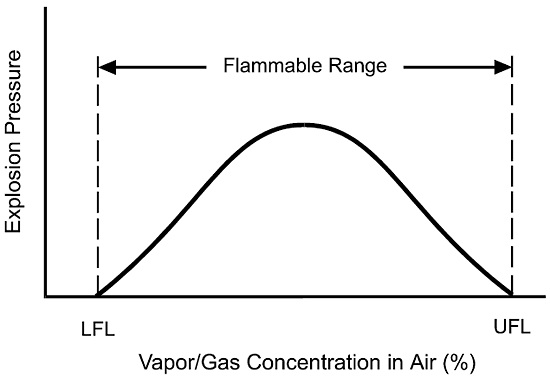
So now you have the fundamentals of flammable liquids. Remember, we have to reach the Flash Point of the liquid for the liquid to emit enough vapors for us to achieve the Lower Explosive Limit. Once we have achieved the LEL and there is an ignition source present, we will have ignition of the vapor. Depending on the actual temperature of the liquid, the fire may burn out (Flash Fire) or the fire may continue to burn on the liquids surface, meaning we have achieved the Fire Point of the liquid (e.g. a tank fire that continues to burn). Flammable liquids are much more dangerous because they have flash points less than 100 degrees F, meaning they can be putting off enough vapors to burn even on the coldest winter day! Combustibles have higher flash points; BUT DON’T BE FOOLED, combustibles are EVERY BIT AS DANGEROUS as flammables ONCE they have achieved their Flash Points. In fact, did you know that Diesel Fuel has an LEL% that is HALF that of Gasoline’s!?!?! So once I have my diesel fuel heated to it’s Flash Point, it will take 2X less diesel fuel vapor to reach a flammable atmosphere than if it I was dealing with gasoline vapor! The LEL% of Diesel Fuel is 0.6%!!!! Something to remember when the worker are getting ready to cut the diesel tank in half with a torch!
See Part B for more on Flammable liquids and feel free to ask questions or comments below.
Bryan