Leave it up to FM Global to lead the way in Hot Work Safety. I know in my career there has been no other force in hot work safety like FM Global (Formerly Factory Mutual). And I am guessing that all of these large loss fires in the construction industry these past couple of years has gotten a lot of insurance companies attention. So last month, FM Global issued a revised Property Loss Prevention Data Sheet on Hot Work (DS 10-3 HOT WORK MANAGEMENT) and in this revision FM Global has:
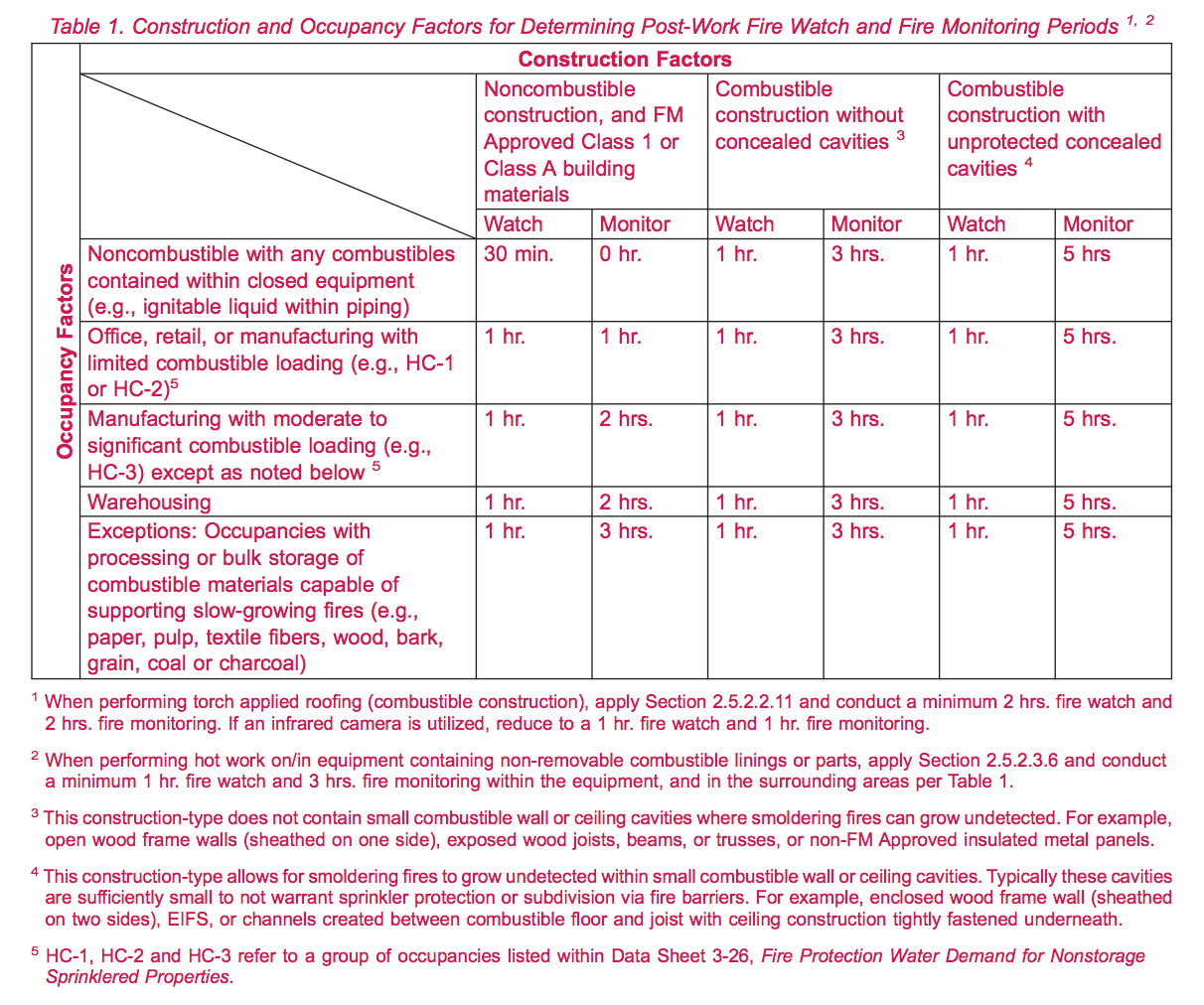
- simplified and combined tables related to post-work fire watch and monitoring periods,
- added further torch applied roofing guidance,
- added Appendix D – Sample Hot Work Permit (highly recommended if you’re looking to improve your HW permitting process) which now reflects the newer Fire Watch requirements, and
- other minor editorial changes were made.
Improperly managed hot work remains a leading cause of large fires and explosions. Based on a review of FM Global loss history, the following conclusions were drawn regarding key factors in hot work losses:
- Failing to identify and isolate combustible construction in the hot work area increases the likelihood and severity of a hot work fire.
- Failing to identify and isolate combustibles in a hot work high-risk area increases the likelihood and severity of a hot work fire.
- In-service fire protection systems significantly reduce the severity of a hot work fire.
- The overwhelming majority of hot work fires occur while the work is being done or within 60 minutes of completion, highlighting the importance of a fire watch both during and following hot work.
Here are the significant improvements and their new Fire Watch Table, but I strongly encourage you to visit FM Global Data Sheets and register (FREE) and download DS 10-3 HOT WORK MANAGEMENT. I highly recommend these Data Sheets as both educational readings for people in risk management roles and as a means to greatly improve safe work practices at industrial facilities. As I have said in the past, if your management won’t splurge and buy full RAGAGEPs, these are your next best bet to get the facility heading in the right direction.
Disclaimer: FM Global is a “Partner in Safety” but they are no longer required to pay membership fees. This is an unpaid and unsolicited posting and I fully endorse FM Global Data Sheets.
2.5.2.2.9 Treat hot work on thermally-conductive materials at or near penetrations into combustible building assemblies as a hot work high-risk operation. In addition, take the following additional required precautions:
…
E. Report all “hot spots” or fires, even if extinguished to the fire service. Smoldering may continue after extinguishment and may take place for hours before flaming begins in areas unsuspected by nonprofessionals.
2.5.2.2.11 Treat work on torch-applied roofing systems as a hot work high-risk operation. Work may include installing, altering, or repairing roof systems. Torch-applied roofing includes modified bitumen roof covers using an open-flame roofer’s torch. When using torch-applied roofing systems, follow the guidelines of the roofing system manufacturer, and take the following additional required precautions:
A. Follow guidelines within FM Global Data Sheet 1-33, Safeguarding Torch-Applied Roof Installations.
…
D. Conduct a continuous fire watch over the hot work area during torch application.
E. Conduct the post work fire-watch in accordance with Note 1 of Table 1, and adhere to the following:
1. Where thermal imaging such as an infrared camera is used to check all roof areas worked on for hot spots, if temperatures are in excess of 250 °F (121 °C), remove and safely discard all charred or smoldering insulation and roof covering, including materials within a 4 ft (1.2 m) radius beyond. Initiate emergency action if hot spots are detected.
2. Inspect the entire top surface of the roof area worked on as well as the inside of the building for signs of fire, dripping bitumen or smoke. Pay particular attention to areas around roof expansion joints and other roof penetrations.
F. Conduct fire monitoring in accordance with Note 1 of Table 1 and 2.5.4.2.
G. Report all “hot spots” or fires, even if extinguished to the fire service. Smoldering may continue after extinguishment and may take place for hours before flaming begins in areas unsuspected by nonprofessionals.
2.5.4.3 Provide post-work fire watch and fire monitoring periods based on the construction and occupancy factors shown in Table 1.
…
B. When conducting hot work in unprotected areas (e.g., unsprinklered), fire monitoring becomes more critical as a primary means of protecting against hot work fires. Treat unprotected areas as hot work high-risk areas and refer to Section 2.5.2.1.3 for additional required precautions.