The company specializes in the cleaning of gasoline and gasoline tanks for gasoline retailers. On December 30 and 31, 2014, OSHA’s Compliance Officer (CSHO) conducted an inspection following a fatal accident at that worksite. An employee died after being found unresponsive at the bottom of a well containing a submersible turbine pump (STP) at a retail store under construction. Based upon the CSHO’s inspection, the Secretary of Labor, on May 14, 2015, issued a Citation and Notification of Penalty with three items (with subparts) alleging serious violations of 29 C.F.R. § 1910.23(a)(6) for failure to guard an open manhole; various subparts of § 1910.134 for deficiencies in its respirator program; and various subparts of § 1910.146 for failure to protect its employees from hazards associated with confined spaces. The Secretary proposed a total penalty of $13,600.00 for the Citation. Company timely contested the Citation. All of the violations are at issue.
Jurisdiction
The company is a small family-owned business with approximately 30 employees. It performs fuel and tank cleaning services for fuel retailers and bulk storage fuel facilities. The process used by the company removes water and other contaminants from fuel. The purpose of the service is to ensure that the gasoline meets State consumer protection standards. A station whose gasoline does not meet these standards can be prohibited by the State from selling its gasoline.
The Fuel Cleaning Process
The company performs two services at retail sites. Prior to delivery of the initial supply of fuel at a newly constructed retail store, the tanks and fuel must be cleaned to remove water and construction debris. At existing stores, fuel can become contaminated and the company performs a remediation service. The accident that precipitated the OSHA inspection in the instant matter arose during the former type of work. The same crew can perform either service and all equipment necessary for either service is contained in the same truck operated by the the company crew.
The procedure for the services performed at new retail stores was described consistently by the company employees as a three-day process. When the tanks are placed in the ground, they are filled with either water or gasoline to act as ballast, ensuring the tanks remain below grade. Once the tanks are in place and the concrete tank pad has been laid over them, the water is removed. the company’s first step in this process is to ensure the tanks are completely dry. This is done by removing the automatic tank gauge (which is not operational at the time) and manually checking the water level with a flashlight and stick. If water remains in the tank, the company removes it until the tank is dry. This first step is generally done the day before the gasoline has been scheduled to be delivered and, once complete, the tanks are ready to be filled with gasoline. the company crew returns to the site on the day gasoline is scheduled to be delivered. They inspect the equipment to ensure it is operating properly and bring any problems to the attention of the construction crew. The supplier fills the tanks to approximately 50% capacity. The crew then cleans the tank of hard water stains, solids, or any construction debris that may have entered the tank . This is done by removing covers to the access ports, including the STP well, and removing the STP. Next a “stinger” or jet that circulates the fuel and blasts the residue off the sides of the tank is inserted into the tank. Fuel is pulled from one access port, run through the filtration system in the company truck, and returned through another. During this process, the crew are watching the intake and output through “site glasses” on the filtration equipment. Once the intake is as clear as the output, the crew will sample the fuel from the bottom of the tank. Samples are taken every 5 to 10 minutes until there is no visual particulate. Once the fuel is visually clear, the crew replaces the covers and moves on to the next tank. The process of cleaning one tank of gasoline takes approximately 2½ hours. The crew returns a third day. Any gasoline in the wrong tank (in a lower grade tank) is transferred to the correct tank, the tanks are topped off, the gasoline is run through the filtration process, and its quality is verified. Once these steps are complete, the gasoline is ready for inspection by the State Department of Agriculture.
This procedure was contrasted in the record with that performed on existing retail stores with contaminated fuel. Upon being notified by a store that there is a problem with its gasoline quality, the company dispatches one of its two-man crews to the site. After assessing the work that needs to be done, the company provides the retailer with an estimate of the cost for the services. Once the scope of the work is determined, the company begins the cleaning process in the same manner as performed during the second stage of the process described above with one exception. Because the fuel is often contaminated with water, water must be removed with a coalescer. In contrast, because the company has removed all the water from the tanks prior to delivery of new fuel, the water coalescer is not necessary at a newly constructed store.
Both processes are performed by a two-man crew consisting of a lead fuel technician and a side technician. The lead fuel technician receives notice of the crew’s assignment via email from the company’s operations manager. The crew involved in the accident had performed both types of processes. The lead fuel technician is the more experienced member of the crew and directs the work at the site. the company requires an individual to go through on-the-job training to become a lead fuel technician. First, the employee performs the work of a side technician with another, more experienced, lead fuel technician. After a time, the employee is sent to company headquarters in Indiana to train with other lead fuel technicians. Once that training is complete, the employee is sent out with his own two-man crew to worksites. The lead fuel technician does not have authority to hire, fire, or discipline the side technician. He does direct the work of the side technician and is considered the individual with oversight of the worksite, including addressing any safety issues.
The Accident
The worksite at issue was a retail store under construction. At the time of the accident, construction was largely complete with only finishes to the interior of the store, some caulking of the tank pads, and landscaping left to be completed. The gasoline tanks, tank pad, covers, and gasoline lines were complete. The electricity had not been turned on. The company had contracted directly with the retail store company to perform the tank preparation and fuel cleaning service six months prior. the company was notified via email on December 17, 2014, gasoline was to be delivered to the site on December 29, 2014. Prior to the delivery day, the company needed to ensure the tanks were ready to receive fuel.
On December 28, 2014, the company dispatched a two-man crew consisting of the Lead Fuel Technician and the Side Technician to the worksite. According to the Lead Fuel Technician, who testified at the hearing, the crew checked the tanks to ensure they were ready for fuel delivery and then left the worksite. They returned early on December 29, 2014, and waited for the gasoline delivery. The gasoline was not delivered until late in the afternoon. At this point in the day, it was growing dark and the crew used their truck lights to illuminate their work. Once the gasoline was delivered, the crew began the process of cleaning the tank. The first tank cleaned contained regular gasoline. The crew completed the process on that tank and had begun the process of moving the hoses and other equipment to the next tank. The Lead Fuel Technician testified after taking a reading, he went to the cab of the truck to record the tank level. He believed this process took him only a few minutes. In the meantime, the Side Technician was moving hoses. The men had left the covers off the tank openings because they had noticed the odor of gasoline and wanted to allow the tanks to “air out.” Neither had donned a respirator. The Lead Fuel Technician testified they opted to let the tanks vent because putting on respirators would have taken time and “time is money.”
Once he had completed his paperwork, the Lead Fuel Technician went to continue to assist in setting up for the next tank. He did not immediately see the Side Technician and assumed he had gone to the restroom. He testified he found that unusual because the crew generally would let one another know if they were leaving the area for any reason. At some point, the Lead Fuel Technician decided to look for the Side Technician. As he walked past the well containing the STP, he saw the Side Technician lying in the well with his legs wrapped around the STP. The Side Technician was unresponsive. The Lead Fuel Technician entered the STP well and attempted to pull the Side Technician out, but was unable to do so. Someone called 911.
The Daytona Beach Fire Department was dispatched to the worksite and arrived at 6:24 p.m. A firefighter wearing fire retardant clothing and a self-contained breathing apparatus (SCBA), entered the tank and removed the Side Technician. The Side Technician was transported to the hospital where he died. The autopsy revealed the Side Technician had toxic levels of benzene, toluene, xylene, and ethylbenzene in his system. Battalion Chief of the Daytona Beach Fire Department was at the scene of the rescue and testified at the hearing. He stated it was dark at the worksite at the time they arrived. The rescue team noticed the odor of gasoline coming from the tank in which the Side Technician was found. The Chief used a four-gas meter to test the atmosphere in the tank. According to the Chief, the alarm on the meter sounded, indicating a hazardous atmosphere of less than 19.5 percent oxygen. After the Side Technician was transported to the hospital, the Chief turned the worksite over to the company.
Due to the accident, the company was not able to complete the fuel and tank cleaning process. The store opened with one of the tanks not having been cleaned or the fuel filtered. Upon testing by the State, the fuel failed to meet consumer protection regulatory standards and the store was prohibited from selling it. The store remained open. the company came later and completed its work, allowing the store to resume sale of all the fuel.
The Inspection
The Daytona Beach Fire Department notified the OSHA Jacksonville Area Office of the accident the same day. The CSHO was assigned to perform the inspection. He went to the worksite the following morning. He observed the worksite was still under construction, with work being done inside the store and grading being performed outside. The CSHO first contacted the construction site superintendent. He next contacted the company’s safety and human resources director via telephone. He later met with a lead fuel technician with the company. At the time of the hearing, the lead fuel technician held the position of auditor, responsible for inspecting the company worksites for compliance with company policy. During his inspection, the CSHO took photographs and measurements of the worksite. He measured the depth of the STP well at 5 feet, 5 inches. The outer rim of the hole was 39 inches; the inner rim was 26 inches. CSHO did not perform any air sampling in or around the STP well.
During his interview with the safety and human resources director and the Lead Fuel Technician, CSHO asked about the company’s use of respirators. According to CSHO, he was informed the company uses half-face tight fitting respirators with 3M brand organic vapor cartridges. The Lead Fuel Technician told the CSHO both he and the Side Technician had used the respirators during their fuel filtration process, but had taken them off just prior to the accident. The CSHO noted one of the workers had facial hair and asked whether he was able to use a respirator with it. The CSHO requested the company provide him with the company’s safety program, the OSHA 300 logs, and, later, the respiratory protection program and medical screening forms. Although the company provided him with a safety program and respirator fit test sign-in sheets, the CSHO testified he did not receive a respiratory protection program or medical evaluations. The CSHO also inquired about the company’s confined space entry program. The CSHO testified he was informed the company had a policy not to allow entry into any well deeper than 4 feet.
Based upon his inspection, the CSHO recommended citations be issued to the company. the CSHO recommended a citation alleging a violation of § 1910.23(a)(6) be issued for failure to guard the open access port to the STP well. He recommended citations for violations of various subparts of § 1910.134 based upon his discussions with the company safety and human resources director and the Lead Fuel Technician which led him to conclude the company did not have an adequate respiratory protection program. He recommended citations for violations of various subparts of the standard at § 1910.146 for failure to protect employees from the hazards associated with confined spaces based on his conclusion employees were exposed to the toxic vapors in the STP well during their work duties. the company timely contested the citations. the company argues the cited general industry standards do not apply to the conditions at the worksite because the company was engaged in construction work. To the extent any of the cited standards would apply to the conditions at the worksite, the company argues it was not in violation of those standards.
DISCUSSION
The Secretary’s Motion to Amend
Post-hearing, the Secretary moved to amend Item 3c, Citation 1. The amendment sought would change the date of the alleged violation in the violation description from December 23, 2014, to December 29, 2014. The Secretary contends the change is intended to conform to the evidence and does not change the underlying legal theories or factual allegations. the company did not oppose the motion and has not alleged any prejudice should amendment be permitted.
The Secretary’s proposed amendment does not change the alleged conduct or conditions. Rather, it seeks only to correct the date to allege conduct on the night of the accident. Evidence adduced at trial by both parties addressed conditions and conduct on the night of the accident or December 29, 2014. the company never raised a defense based on an allegation it had no employees on site on December 23, 2014. It did not raise an objection to the Secretary’s motion to amend nor claim any prejudice. Therefore, I find the amended allegation was tried by consent. The Secretary’s motion to amend Item 3c is GRANTED.
Applicability of the General Industry Standards
A threshold issue to be resolved in this matter is whether the General Industry Standards at 29 C.F.R. § 1910 apply to the conditions at the worksite. the company contends the work being performed by its employees was construction work as that term is defined in 29 C.F.R. § 1910.12(b) and under Commission precedent because it was integral and necessary to completion of construction of the gas station. Therefore, the company asserts, the Construction Standards at 29 C.F.R. § 1926, rather than the General Industry Standards, apply. Although conceding the station was still under construction at the time of the accident and inspection, the Secretary contends the work being performed at the worksite was the same as work performed at existing retail stores and not integral to construction of the store. Consequently, the work does not fall within the definition of construction work. For the following reasons, I determine the work was not construction work and the General Industry Standards are applicable to the work performed by employees of the company.
The definition of construction work is found at 29 C.F.R. § 1910.12(b) which states, “For purposes of this section, Construction Work means work for construction, alteration, and/or repair, including painting and decorating. See discussion of these terms in § 1926.13 of this title.” The Sixth Circuit has held that the “explicit reference to section 1926.13 in 1910.12(b) mandates that the interpretation of the terms ‘construction, alteration, and repair’ in the Construction Safety Act, Davis-Bacon Act, and Miller Act should ‘have considerable precedential value’ in defining the term ‘construction work’ in section 1910.12.” Brock v. Cardinal Indus., 828 F.2d 373, 377 (6th Cir. 1987).
Based on a review of the totality of the circumstances, I conclude the work performed by the company employees was not construction work. Although performed while the construction project was underway, the service performed by the company was not integral and necessary to completion of the construction work. the company was not a subcontractor of the General Contractor but contracted directly with the retail business. While I am mindful a certain amount of coordination between the general contractor and the company was necessary for the company to perform its service, I find nothing in the record to suggest the timing of the company’s service would have an impact on the construction process. The testimony of the General Contractor’s site superintendent is consistent with my finding. the company’s service could have been performed after construction was complete and, therefore, was not a necessary part of the construction process. See Snyder Well Serv., 10 BNA OSHC at 1373. In fact, the store did open and was operating for some time after the accident, even though the company had not completed its work.
It is undisputed the company was performing its services on an active construction site. Uninstalled equipment remained in boxes and the electricity had not yet been turned on. Although a nexus to a construction site is necessary to find activities are construction work, such a finding is not dispositive. Rather, the work performed must also be integral to the construction work. To rely strictly on a finding of a nexus to a construction site would lead to absurd results. For example, were this the case, a retail establishment’s salesforce could be found to be performing construction work if that store remained open during a renovation project. Because the company’s activities were not integral to completion of the construction project, its activities on the worksite were not construction work.
In so finding, I am guided by the Commission’s holding in Royal Logging Company, 7 BNA OSHC 1744 (No. 15169, 1979). In Royal Logging, the Commission held the employer’s road building activities, which would normally be considered construction, were not construction because they were “ancillary to and in aid of its primary non-construction function.” Id. at 1750. The service performed by the company was necessary for the store to sell fuel – a non-construction purpose. It was not necessary to complete the construction of the store itself. The company was not performing construction work because the services it performed were ancillary to and in aid of a non-construction function. Nor am I persuaded that the distinction between the process used at existing sites to clean contaminated fuel and that used on construction sites renders one service construction and the other not. Commission precedent is clear the factors to consider are those that relate to the activities’ impact on the completion of the construction project, not the construction project’s impact on the activities at issue.
For the foregoing reasons, I find the company was not engaged in construction work and the general industry standards cited by the Secretary apply to the work performed at the worksite.
The Citation
The Secretary has the burden of establishing the employer violated the cited standard. To prove a violation of an OSHA standard, the Secretary must show by a preponderance of the evidence that
(1) the cited standard applies;
(2) the employer failed to comply with the terms of the cited standard;
(3) employees had access to the violative condition; and
(4) the cited employer either knew or could have known with the exercise of reasonable diligence of the violative condition.
Item 1: Alleged Serious Violation of 29 C.F.R. § 1910.23(a)(6)
Item 1 alleges:
On or about December 29, 2014, at the pump well manhole, a removable standard railing was not installed, exposing employees to a 5 feet and 5 inches fall hazard. An employee died after fall[ing] into the unprotected opening.
The standard at 29 C.F.R. § 1910.23(a)(6) reads:
Every manhole floor opening shall be guarded by a standard manhole cover which need not be hinged in place. While the cover is not in place, the manhole opening shall be constantly attended by someone or shall be protected by removable standard railings.
Applicability of the Standard
The cited standard falls under subpart D of the General Industry Standards which covers walking and working surfaces. Section 1910.23 covers generally “guarding floor and wall openings and holes.” The standard at § 1910.23(a)(6) mandates an employer protect employees from falls into any “manhole floor opening.” To apply to the company worksite, the opening to the STP well opening, depicted in Exhibits C-1 and R-18, must meet the definition of a “manhole floor opening.” The definitions applicable to § 1910.23 are found at § 1910.21. The standard at § 1910.21(a)(2) defines “floor opening” as
An opening measuring 12 inches or more in its least dimension, in any floor, platform, pavement, or yard through which persons may fall; such as a hatchway, stair or ladder opening, pit, or large manhole. Floor openings occupied by elevators, dumb waiters, conveyors, machinery, or containers are excluded from this subpart.
There is no dispute the STP well opening met the size requirements of the standard’s definition of a floor opening. In its Reply, the company argues the STP well is occupied by the STP and, therefore, falls within the exception for those openings occupied by machinery. The company’s argument ignores Commission precedent. In National Rolling Mills Co., 4 BNA OSHC 1719, 1720 (No. 7987, 1976), the Commission held:
The clear intent of the exception is to exclude only those openings which are fully occupied by the listed items so that there is no hazard of falling into the opening. The inclusion of elevators and dumbwaiters, which totally cover a floor opening, strongly indicates that the terms ‘machinery’ and ‘conveyors’ should be interpreted as encompassing only those which completely occupy the opening. Respondent’s interpretation of the exception would permit a pit filled only partially with a machine to be unguarded even though it presents the same or a greater hazard as a totally empty pit. We will not adopt such an unreasonable interpretation since it would be inconsistent with the purposes of the Act.
As evidenced by the Side Technician’s position in the STP well, the STP does not so occupy the STP well as to prevent a fall into it. The STP well opening was a floor opening under the standard.
The standards do not define “manhole.” The parties both argue the definition that should be applied is the same dictionary definition of manhole found in the Merriam-Webster’s Dictionary. That definition reads, “a hole through which a man may go esp. to gain access to an underground or enclosed structure.” Merriam Webster’s New Collegiate Dictionary (1981). The Secretary contends because the opening is a hole through which a man would go to access the STP well and the STP, it meets the definition of a manhole. The company contends because its employees did not enter the STP well pursuant to its policy not to enter any well deeper than 4 feet, it is not a hole through which a man may go. I find the company’s definition overly narrow and not consistent with the intent of the standard.
Because the standard does not define the term manhole, it is reasonable to apply a common understanding or dictionary definition of the term. The definition referenced above is consistent with common usage of the term manhole and I agree with the parties it is applicable. The record establishes the STP well opening meets this definition. The purpose of the opening is to access the STP well. The opening is large enough for a man to fit through and the well itself is large enough to hold a man as evidenced by the accident and subsequent rescue efforts. Even if the company employees are prohibited from entering the well, others are not. The safety and human resources director testified if the company employees cannot remove the STP with their tools, a maintenance company would be called to do so. In its post-hearing brief, the company concedes some work in the STP well would require entry. Respondent’s Post-Hearing Brief at p. 15. that the company did not use the opening as a manhole does not mean it is not one.
I am not persuaded because it prohibited its employees from entering the STP well, the company lacked fair notice of the applicability of the standard. Constitutional due process requires only that the cited employer be given “a fair and reasonable warning;” it “does not demand that the employer be actually aware that the regulation is applicable to his conduct or that a hazardous condition exists.” Moreover, “a standard is not impermissibly vague simply because it is broad in nature.” J.A. Jones Constr. Co., 15 BNA OSHC 2201, 2205, (No. 87–2059, 1993). Instead, “a broad regulation must be interpreted in the light of the conduct to which it is being applied, and external objective criteria, including the knowledge and perceptions of a reasonable person, may be used to give meaning to such a regulation in a particular situation.” The company cannot reasonably argue it could not have recognized the fall hazard created by a 26 inch floor opening of a 5 feet, 5 inch deep well. Nor do I find persuasive an argument it lacked warning the standard would be interpreted so as to give the term “manhole” its common, dictionary definition. the company was well aware a man could enter the STP well through the opening. It gave its employees a specific prohibition against doing so and required its employees to call someone else when entry was required. the company’s argument it lacked fair notice of the applicability of the standard is without merit.
Failure to Comply with the Terms of the Standard
The standard allows for the employer to protect employees from accidental falls into the opening of a manhole by either a standard manhole cover, temporary guardrails, or by someone “constantly” attending it. 29 C.F.R. § 1910.23(a)(6). The Lead Fuel Technician admitted the manhole cover to the STP well remained off and no removable standard railings had been used. In failing to ensure the STP well manhole was guarded, the company violated the cited standard.
The company contends it was in compliance because the two crew members were constantly attending the manhole. This contention lacks merit. There is no Commission precedent addressing the meaning of the terms “constantly attended by someone.” The plain meaning of the term “constant” is “invariable” or “unchanging.” See Merriam Webster’s New Collegiate Dictionary (1981). To attend means “to be present at” something. Giving the terms their plain meaning, to constantly attend to something would be to be invariably present at it. I find an employee who is otherwise engaged in a work activity cannot be constantly attending an open manhole. Footnote Both employees were engaged in their work activities while the STP well remained uncovered. At the time of the accident, the Lead Fuel Technician was completing paperwork while the Side Technician moved hoses. At some point, the Lead Fuel Technician moved the truck while the Side Technician performed other work. During this time, both men were focused on their tasks and neither was “constantly” attending the STP well opening.
The company appears to concede both men were performing their work. In its post-hearing brief, the company states “Given that no one else was present at the worksite, the mere moving of equipment to a spot a few feet away from the openings cannot be considered leaving the STP well opening unattended.” Respondent’s Post-Hearing Brief at p. 19. I disagree. In addressing a similar construction standard, the Commission has held that the purpose of such requirements is to ensure against “accidental situations when employees are not looking precisely where they are walking.” Stearns-Rogers, Inc., 7 BNA OSHC 1919, 1922 (No. 76-2326, 1979). The purpose of the standard at § 1910.23(a)(6) is likewise to prevent accidental falls. That the employees are in a position to see the open manhole while performing their work duties is not the equivalent of being constantly mindful of their location. While performing their duties, the crew could not have been constantly aware of where they were walking; they would be exposed to exactly the hazard the standard was intended to address. Because both crew members were performing work duties, the open manhole to the STP well was not constantly attended. the company was in violation of the 29 C.F.R. § 1910.23(a)(6).
Employee Exposure to a Hazard
The standard presumes a hazard where its terms are not followed. To establish exposure to the hazard, “the Secretary … must show that it is reasonably predictable either by operational necessity or otherwise (including inadvertence), that employees have been, are, or will be in the zone of danger.” The zone of danger is the “area surrounding the violative condition that presents the danger to employees.” The Lead Fuel Technician and the Side Technician worked throughout the tank pad in proximity to the STP well opening. While doing so, they were exposed to the hazard of falling into the STP well while performing their duties at the worksite. Nothing prevented either from accidentally falling into the STP well, particularly while they were attending to separate work duties. The Secretary has established employee exposure.
Employer Knowledge of the Violation
The Secretary must establish the company had knowledge of the violative condition. In order to establish employer knowledge of a violative condition, the Secretary must show that the employer knew, or with the exercise of reasonable diligence could have known of a hazardous condition. An employer is required to make a reasonable effort to anticipate the particular hazards to which its employees may be exposed during the course of their scheduled work. Knowledge of a supervisory employee may be imputed to an employer. An employee who has been delegated authority over another employee, even if only temporarily, is considered to be a supervisor for purposes of imputing knowledge to an employer. American Engineering & Development Corp., 23 BNA OSHC 2093, 2012 (No. 10-0359, 2012); Diamond Installations, Inc., 21 BNA OSHC 1688 (Nos. 02-2080 & 02-2081, 2006); Tampa Shipyards, Inc., 15 BNA OSHC 1533 (Nos. 86-360 and 86-469, 1992).
It is undisputed having the STP well manhole open is a necessary part of the fuel cleaning process and the company would have been aware of that condition. The company’s safety and health program addresses floor openings on walking/working surfaces (Exh. C-9 pp. B20-1 – B20-3). In it, the company mandates the use of railings or covers for “Every temporary floor opening.” (Exh. C-9 p. B20-2). The program makes no mention of the use of an attendant or allowing employees to attend floor openings as an alternative to guardrails. The company did not contend it supplied its crews with temporary guardrails to protect the open manhole openings. The Lead Fuel Technician testified it takes both crew members to move the hoses. With the exercise of reasonable diligence, the company should have been aware the STP well manhole is open during work operations and that it was not guarded by either temporary guardrails or an employee constantly attending it.
In addition to constructive knowledge, the Lead Fuel Technician’s actual knowledge of the worksite conditions is imputable to the company. The Lead Fuel Technician was aware the STP well manhole was open and neither guarded with temporary guardrails nor constantly attended on the night of the accident. As previously discussed, the Lead Fuel Technician was aware the Side Technician was engaged in work activities on the tank pad while he attended to his paperwork and moved the truck. The duties of the Lead Fuel Technician include obtaining the crew’s job assignment, directing the work of the Side Technician, and providing guidance on safety issues (Tr. 372-73, 392, 431-32). Under Commission precedent, the Lead Fuel Technician was a supervisor for purposes of imputing knowledge to the company. The Lead Fuel Technician’s actual knowledge of the violative condition is imputed to the company.
Classification of Item 1
The Secretary alleges Item 1 is a serious violation. A violation is serious when “there is a substantial probability that death or serious physical harm could result” from the hazardous condition at issue. 29 U.S.C. § 666(k). The Secretary need not show that there was a substantial probability that an accident would occur; only that if an accident did occur, death or serious physical harm would result. The STP well is over 5 feet deep. An employee inadvertently walking into the STP well would likely sustain serious physical injuries (Tr. 147). He could also be overcome by the oxygen-deficient atmosphere (Tr. 148). The Secretary has established a serious violation of 29 C.F.R. § 1910.23(a)(6).
Item 2a: Alleged Violation of 29 C.F.R. § 1910.134(c)(1)
Item 2a alleges:
On or about December 29, 2014, at the Store job site, the employer had not developed and implemented a written respiratory program for employees required to wear a tight fitting 3M model 6200 respirator during fuel tank cleaning operations while overexposed to toxic aromatic vapor components of gasoline. An employee died from an overexposure to benzene, ethyl benzene, xylene, acetaldehyde, and toluene. The required elements of items (i) through (ix) of the 29 CFR 1910.134(C)(1) standard were not in effect, specifically:
1. The employer had not established procedures for respirator selection based on contaminant concentration.
2. The employer had not conducted medical evaluations of employees required to wear respirators.
3. The employer had not developed written procedures for the use of respirators in routine and reasonably foreseeable emergency situations.
4. The employer had not developed procedures for cleaning disinfecting, storing, inspection, repairing, discarding, and otherwise maintaining respirators.
5. The employer had not developed procedures for evaluating the effectiveness of the program.
The standard at 29 C.F.R. § 1910.134(c)(1) requires:
In any workplace where respirators are necessary to protect the health of the employee or whenever respirators are required by the employer, the employer shall establish and implement a written respiratory protection program with worksite-specific procedures. The program shall be updated as necessary to reflect those changes in workplace conditions that affect respirator use. The employer shall include in the program the following provisions of this section, as applicable:
1910.134(c)(1)(i): Procedures for selecting respirators for use in the workplace;
1910.134(c)(1)(ii): Medical evaluations of employees required to use respirators;
1910.134(c)(1)(iii): Fit testing procedures for tight-fitting respirators;
1910.134(c)(1)(iv): Procedures for proper use of respirators in routine and reasonably foreseeable emergency situations;
1910.134(c)(1)(v): Procedures and schedules for cleaning, disinfecting, storing, inspecting, repairing, discarding, and otherwise maintaining respirators;
1910.134(c)(1)(vi): Procedures to ensure adequate air quality, quantity, and flow of breathing air for atmosphere-supplying respirators;
1910.134(c)(1)(vii): Training of employees in the respiratory hazards to which they are potentially exposed during routine and emergency situations;
1910.134(c)(1)(viii): Training of employees in the proper use of respirators, including putting on and removing them, any limitations on their use, and their maintenance; and
1910.134(c)(1)(ix): Procedures for regularly evaluating the effectiveness of the program.
Applicability of the Standard
The standard at 29 C.F.R. § 1910.134(c)(1) requires an employer to establish and implement a respiratory protection program where either “respirators are necessary to protect the health of the employees or whenever respirators are required by the employer…” the company provided respirators to its fuel technicians and required their use whenever an employee was performing “a task that could generate vapors,” such as changing filters on the equipment in the truck, or any time an employee smelled gasoline vapors. The standard applies and the company was required to establish and implement a written respiratory protection program.
Failure to Comply with the Terms of the Standard
The Secretary contends the company’s respiratory protection program was deficient because it was not site-specific and did not contain procedures for respirator selection; medical evaluations; emergency procedures; cleaning procedures; and did not contain procedures for regular evaluation of the program’s effectiveness. No respiratory protection program was provided to the CSHO upon request during his inspection. The record contains what the company purports to be its written respiratory protection program at Exhibit R-14. The safety and human resources director testified he was informed by a consulting company he hired that Exhibit R-14 was obtained from the OSHA website. A cursory review of the document reveals it to be a PowerPoint presentation covering the contents of the standard at 29 C.F.R. § 1910.134.
The standard at 29 C.F.R. § 1910.134 is a performance standard that must be interpreted in light of what is reasonable. Based upon my review of the contents of Exhibit R-14, I find no reasonable employer would conclude it was compliant with the cited standard. It is lacking the “worksite-specific procedures and elements required for respirator use” mandated by 29 C.F.R. § 1910.134(c). Much of the content is inapplicable to the conditions encountered by employees of the company during their work activities or to the type of respirators used by employees of the company. Among other deficiencies, the program does not contain a provision for medical evaluations and the company concedes it did not conduct them. The program does not provide instruction on cleaning of respirators. It contains no information regarding selection of respirators. It lacks a schedule or rule for changing of the respirator cartridges. It does not contain a provision for evaluating the effectiveness of the program. To the extent Exhibit R-14 is the company’s written respiratory protection program, it fails to comply with the requirements of 29 C.F.R. § 1910.134(c)(1). To the extent the company suggests because the PowerPoint was obtained from OSHA’s website, it should be found compliant, I disagree. On the second page of the document is the following provision:
This program is intended to be a resource for instructors of Occupational Safety and Health and not a substitute for any of the provisions of the Occupational Safety and Health Act of 1970 or for any standards issued by the United States Occupational Safety and Health Administration (OSHA).
An employer reading this sentence could not reasonably conclude the document serves a substitute for a compliant respiratory protection program.
I disagree with the company’s contention the violations alleged in Items 2b-2g are mere duplications of the allegations in Item 2a. In the preamble to the standard, the Secretary emphasized the need for the respiratory protection program to be in writing:
OSHA’s experience and that of the industrial hygiene community have demonstrated that health and safety programs can best be effectively implemented and evaluated when written. In addition, because workplaces differ substantially, each program must be tailored to the specific conditions of the workplace if it is to protect employee health, and developing a written program is the most efficient way of ensuring that the program reflects the unique characteristics of each workplace. Developing and writing down worksite-specific procedures requires employers to design their respiratory protection programs to address the respiratory hazards in their particular workplace, and this process requires employers to think about and document all relevant information pertaining to the hazardous atmospheres that their employees may encounter under normal operating conditions or during reasonably foreseeable emergencies that may occur in the workplace. Finally, OSHA’s enforcement data indicate that compliance with the previous standard has not been optimal, particularly in smaller workplaces, and a written program will help employers, employees, and compliance officers gauge the adequacy of a given program.
Because of the importance of documentation of the program provisions, the company’s failure to have a compliant written program is a violation distinct from the failure to comply with the requirements of the standards cited in Items 2b – 2g.
Employee Exposure to a Hazard
A respiratory protection program is intended to ensure appropriate respirators are properly used in order to protect employees from inhalation hazards to which they may be exposed. the company management conceded employees were exposed to gasoline vapors. On the night of the accident the company’s crew and rescue personnel smelled gasoline vapors. The Side Technician’s autopsy report indicates he was exposed to fatal levels of some of the components of gasoline (Exh. C-14). According to the Material Safety Data Sheet for gasoline, gasoline poses an inhalation hazard to the “nose, throat, lungs and respiratory tract.” (Exh. R-15 p. 2). It can also pose an inhalation hazard to the central nervous system (Exh. R-15 p. 2). The purpose of a written safety and health program is to ensure effective protection of employees. The Secretary has established employees of the company were exposed to inhalation hazards associated with gasoline vapors as a result of the company failure to develop and implement a respiratory protection program.
Employer Knowledge of the Violation
There is no dispute the company was aware its employees were exposed to gasoline vapors and that there were occasions employees used respirators for respiratory protection. It is also undisputed the company management was aware of the contents of its purported respiratory protection program. Company safety and human resources director testified he trained employees using the program contained in Exhibit R-14 (Tr. 398). Lead technician testified employees receive annual refresher training on the program.
The company contends it reasonably relied on the consultant it hired to develop a respiratory protection program. Such reliance was not reasonable under the circumstances. The program provided by the consultant was nothing more than a PowerPoint presentation summarizing the contents of the standard itself. It contains the proviso referenced above indicating it was not a substitute for compliance with the standard. Reasonable diligence requires an employer, at a minimum, read its safety programs before implementing them. Even a cursory review of the PowerPoint presentation would have lead to the conclusion it was not a substitute for the written program required under 29 C.F.R. § 1910.134(c)(1). The Secretary has established the company’s knowledge of the violation.
Item 2b: Alleged Violation of 29 C.F.R. §1910.134(d)(1)(i)
Item 2b alleges:
On or about December 29, 2014, the employer had not determined all respiratory hazards that would affect the selection, performance, and reliability of respirators worn by employees who were exposed to gasoline vapors and diesel exhaust gases while filtering fuel tanks.
The standard at 29 C.F.R. §1910.134(d)(1)(i) reads:
The employer shall select and provide an appropriate respirator based on the respiratory hazard(s) to which the worker is exposed and workplace and user factors that affect respirator performance and reliability.
Applicability of the Standard
Like the requirements of 29 C.F.R. § 1910.134(c), the requirements of § 1910.134(d)(1) apply whenever an employer provides respirators to employees and requires their use. The company provided its employees with respirators and mandated use under certain conditions. The standard applies.
Failure to Comply with the Terms of the Standard
The Secretary contends the company failed to make an adequate assessment of the chemicals to which its employees were exposed before selecting the respirator for its employees to use. The company provided employees with half-face tight fitting respirators for use at the worksite. According to the safety and human resources director, he selected the 3M 6003 cartridge filter for use with the respirator based on the manufacturer’s representation that the cartridge was suitable for use in “environments where petrochemicals would be present.” He testified he consulted several manufacturer’s documents found at Exhibits R-4; R-5; R-6; R-7; R-8; and R-9. The lead technician had also performed atmospheric testing in the winter of 2013 at a worksite in Ohio. On that occasion, he tested only for hexane. He testified he could not recall specifically why he only tested for hexane, but believed it was because his review of the MSDS for gasoline lead him to conclude hexane was “more prevalent and presented more of a hazard.” The Secretary contends this evaluation was inadequate because it did not take into account all of the components of gasoline or the different concentration levels that might be found at different worksites at different times. I agree with the Secretary that the company did not comply with the requirements of the standard.
As noted in the preamble to § 1910.134(d)(1), the standard is intended to ensure that employers take into consideration “the context of the workplace and worker conditions that may reduce or impair the effectiveness of a respirator otherwise appropriate for the hazard” when selecting a respirator. 63 Fed. Reg. 1152-01, 1196. The preamble goes on:
There is general agreement that taking working conditions into account is crucial to proper respirator selection: a respirator that is protective under some conditions of wear will fail under others, while a respirator that is appropriate for a given hazard may not be workable in a particular workplace…
Workplace factors such temperature and humidity may also affect the physiological stress on the wearer as well as the effectiveness of the filters and cartridges. The company failure to take into account the difference in workplace conditions between the tested workplace (a location in Ohio in the winter) and other workplaces (many of which are in southern states) violated the mandates of the standard. The company’s contention that providing respiratory protection that may be used for exposure to petrochemicals is sufficient simply ignores the provisions of the standard requiring the employer take into consideration “workplace and user factors that affect respirator performance and reliability.”
The Secretary has established the company failed to comply with the cited standard.
Nor could the company have reasonably relied on the information it points to from the cartridge manufacturer to make its respirator selection. The safety and human resources director did not explain how he used the documents referenced, he simply testified that he did. Upon careful review of these documents, I am unable to find a basis for his reliance on these documents. The manufacturer’s overview of the cartridge from its product catalog provides only a general description of the types of respiratory irritants from which it may provide protection (Exh. R-4). The User Instructions provide even less information and prohibit use where concentrations of contaminants are unknown (Exh. R-5 at p. 3). Exhibit R-6 is an “Article Information Letter” that states “User is responsible for determining whether 3M product is fit for a particular purpose and suitable for user’s method of use or application.” The Selection Guide indicates the cartridge is approved for use to protect against “Certain Organic Vapors, Chlorine, Hydrogen Chloride, and Sulfur Dioxide or Hydrogen Sulfide or Hydrogen Fluoride and Particulates.” It does not specifically indicate approval for use with petrochemicals or all the chemical components of gasoline (Compare Exh. R-15 to R-7). The manufacturer’s selection guide contained in Exhibit R-8 recommends air sampling and, if concentrations are unknown, it recommends air-supplied respirators be provided (Exh. R-8 at pp. 11, 13-14). It also recommends a full-face respirator for use with exposure to gasoline (Exh. R-8 at p. 57). Exhibit R-9 summarizes the results of a study that gives no indication it is applicable to the company’s worksites or work activities. the company’s reliance on these documents to select respirators for use at its worksites does not meet the requirements of the standard.
Employee Exposure to a Hazard
The proper selection of respirators ensures employees are protected from those hazards to which they may be exposed. Failing to take into consideration both the conditions of the worksite and the respiratory irritants to which employees may be exposed resulted in the company employees being exposed to the hazards associated with inhalation of gasoline vapors previously discussed. In addition, respirators that are not appropriate to the environment can increase the stress level on employees wearing those respirators. 63 Fed. Reg. 1152-01, 1196. the company required its employees to wear respirators despite having failed to ensure those respirators were appropriate for the worksite conditions. The Secretary has established employee exposure.
Employer Knowledge of the Violation
The safety and human resources director made the selection of respirator for use by the company employees. He did so without knowledge of exposure levels for all components of gasoline or all worksite conditions that affect exposure to respiratory hazards. He also made the determination based on documentation that did not contain sufficient information. The company had knowledge of the inadequacy of its respirator selection process.
Item 2c: Alleged Violation of 29 C.F.R. § 1910.134(d)(3)(iii)(B)(2)
Item 2c alleges:
On or about December 29, 2104, employees wearing tight-fitting respirators with 3M 6003 organic vapor cartridges while exposed to gasoline vapors were not provided a change schedule by the employer for replacement of the cartridges.
The Standard at 29 C.F.R. § 1910.134(d)(3)(iii)(B)(2) reads:
If there is no ESLI appropriate for conditions in the employer’s workplace, the employer implements a change schedule for canisters and cartridges that is based on objective information or data that will ensure that canisters and cartridges are changed before the end of their service life. The employer shall describe in the respirator program the information and data relied upon and the basis for the canister and cartridge change schedule and the basis for reliance on the data.
Applicability of the Standard
The standard applies where air purifying respirators that do not contain ESLI (end of service life indicator) are used by employees. The company provided its employees with respirators and mandated their use. The respirators used by the company employees were air purifying respirators and did not have an ESLI. The standard applies and the company was required to implement a change schedule for its respirator cartridges, and to include the basis for that change schedule in its written respirator program.
Failure to Comply with the Terms of the Standard
The standard at § 1910.134(d)(3)(iii)(B) specifies the conditions under which air-purifying respirators may be used. Among those conditions is the requirement the employer implement a change schedule and document the basis for that schedule in its written respiratory protection program. 63 Fed. Reg. 1152-01, 1206-07. As explained in the preamble:
Developing a filter change schedule involves a number of decisions. The employer must evaluate the hazardous exposure level, performance capacity of the filters being used, and the duration of employee use of the respirator, which impact on the service life calculations.
The company’s change schedule consisted of an unwritten rule. According to the Lead technician and the safety and human resources director, employees were instructed to change the cartridges a minimum of three months “or if it quits working.” Employees know the cartridge has quit working if he or she can “smell gas when you put it on.” The safety and human resources director could not recall the “exact” calculation that went into the company’s three month rule. He testified it was based on the time it took to perform those jobs for which the company anticipated employees would be exposed to gasoline vapors. The Secretary contends the company policy is inadequate because it did not include an evaluation of the exposure time or concentration. As a result, the company would not know the rate at which the cartridges are absorbing the air contaminants to which its employees may be exposed. I agree with the Secretary, the company did not comply with the standard’s requirements.
The company’s respiratory protection program contains no instruction on its cartridge change schedule. Nor does it contain any information regarding the objective basis for development of its unwritten schedule. The record is devoid of such evidence. the company conducted no testing of the components of gasoline vapors to which its employees were exposed and therefore, could not have known whether its rule was adequate to ensure continued protection. The lead tech testified to significant variance from job to job in the amount of time respirators would be worn. There was no credible evidence regarding how employees were to track the three month schedule.
The only instruction contained in the documents upon which the safety and human resources director testified he relied indicate 3M P-series particulate filters should be disposed of when damaged, soiled, or if breathing becomes difficult or, when used in environments containing only oil aerosols, after 40 hours of use or 30 days, whichever is first. To the extent the safety and human resources director relied on this document, it does not support his conclusion that a filter change every three months was appropriate.
Based upon the totality of the evidence, I find the company’s policy to change respirator cartridges every three months was arbitrarily adopted. The company has not developed a respirator change schedule in accordance with the requirements of 29 C.F.R. § 1910.134(d)(3)(iii)(B)(2).
Employee Exposure to a Hazard
A respirator change schedule ensures respirators are not used beyond their effective life. Failing to ensure respirators were not used after they had become ineffective resulted in the company employees being potentially exposed to the hazards associated with inhalation of gasoline vapors previously discussed. the company required its employees to wear respirators despite having failed to ensure those respirators were appropriate for the worksite conditions. The Secretary has established employee exposure.
Employer Knowledge of the Violation
The safety and human resources director was aware of the contents of the company respiratory protection program. He should have been aware it did not contain documentation of a respirator change schedule or the objective basis for that schedule. He could neither recall the calculations upon which the schedule was purportedly developed, nor did the documentation on which he relied comport with the company’s unwritten schedule. The company had knowledge of the inadequacy of its respirator change schedule.
Item 2d: Alleged Violation of 29 C.F.R. § 1910.134(e)(1)
Item 2d alleges:
“On or before December 29, 2014, the employer had not provided medical evaluations to employees required to wear tight fitting respirators while exposed to gasoline vapors.”
The standard at 29 C.F.R. § 1910.134(e)(1) requires the employer to “provide a medical evaluation to determine the employee’s ability to use a respirator, before the employee is fit tested or required to use the respirator in the workplace.”
Applicability of the Standard
The standard at § 1910.134(e)(1) requires a medical evaluation prior to fit testing or respirator use. The standard applies regardless of duration of use. 63 Fed. Reg. 1152-01, 1209. The company provided employees with respirators, fit tested those employees for their respirators, and mandated their use. The standard applies and the company was required to provide its employees with medical evaluations.
Failure to Comply with the Terms of the Standard
The company does not dispute it did not provide employees with medical screenings before providing them with respirators and requiring their use (Tr. 435). When interviewed by the CSHO, employees could not recall having had such evaluations before using company supplied respirators (Tr. 165). The company violated the cited standard.
Employee Exposure to a Hazard
The Lead Fuel Technician testified he used his respirator on December 29th, prior to the accident, when changing a filter on the filtration system. He had not undergone a medical evaluation to determine whether he was able to wear a respirator prior to that date. The purpose of the medical evaluation is to ensure employees do not have a medical condition that could compromise his ability to tolerate the physiological burden imposed by respirator use. 63 Fed. Reg. 1152-01, 1208. The record establishes employees were exposed to hazards associated with this physiological burden.
Employer Knowledge of the Violation
It is undisputed the company was aware it had not provided its employees with medical evaluations. The company was aware its employees had been fit tested, were provided with respirators, and expected employees to use them. The company had knowledge of the violation.
Item 2e: Alleged Violation of 29 C.F.R. § 1910.134(h)(1)
Item 2e alleges:
On or about December 29, 2014, employees performing fuel tank filtration wore respirators that had not been properly cleaned following use with gasoline vapors, allowing migration of contaminants throughout the respirators.
The standard at 29 C.F.R. § 1910.134(h)(1) states:
The employer shall provide each respirator user with a respirator that is clean, sanitary, and in good working order. The employer shall ensure that respirators are cleaned and disinfected using the procedures in Appendix B-2 of this section, or procedures recommended by the respirator manufacturer, provided that such procedures are of equivalent effectiveness.
Applicability of the Standard
The standard requires where employees use respirators, the employer is required to provide them in a clean, sanitary and working condition. The standard applies whenever respirators are provided or used. The company provided employees with respirators and mandated their use. The standard applies.
Failure to Comply with the Terms of the Standard
The Secretary contends the company did not comply with the terms of the standard because the company did not have written procedures for cleaning respirators, did not store the respirators in a manner that ensured no cross contamination, and used only wipes to clean out respirators. During the inspection, the company did not provide the CSHO with any written procedures for cleaning respirators. The Lead Fuel Technician told the CSHO he was storing his respirator in a bag on the side of his truck. The CSHO found this inadequate because the company had not instituted any procedures to ensure the respirator was not subject to contamination during storage. The Lead Fuel Technician told the CSHO he was provided wipes to use for cleaning the respirator. The procedures the company had in place for cleaning of respirators did not comply with the requirements of the cited standard.
The safety and human resources director testified the company respirator cleaning procedures were contained in the company’s respiratory protection program. According to The safety and human resources director, in addition to the procedures contained on page 60, employees were verbally “encouraged to clean [their respirator] as often as they feel comfortable doing so” or at a minimum every time it is used and before putting in storage. The Lead Fuel Technician testified it was “drilled into” him that he was to clean his respirator every two or three times it was used or if it was visually dirty.
The procedures described in Appendix B-2 include washing the respirator with warm water and a mild cleanser after disassembling it. The section of Exhibit R-14 to which the company points contains no specific instructions. It simply reads: “Use procedures in Appendix B-2 or the equivalent manufacturer’s instructions.” (Exh. R-14 at p. 60). It does not specify the frequency with which respirators are to be cleaned. Rather, it reads: “as often as necessary when issued for exclusive use.” There was no showing that the use of wipes is the equivalent of the procedures contained in Appendix B-2 or recommended by the manufacturer. The inconsistencies in the testimony of the safety and human resources director and the Lead Fuel Technician belie the company’s contention it verbally instructed its employee to clean their respirators consistent with Appendix B-2, the manufacturer’s instructions, or any other procedure. That is provided employees with only wipes to clean the respirators establishes the company’s procedures were inadequate. I find the preponderance of the evidence establishes the company did not have procedures to ensure respirators were maintained in a clean condition consistent with the requirements of 29 C.F.R. § 1910.134(h)(1).
Employee Exposure to a Hazard
Procedures for proper cleaning and storage of respirators ensures respirators remain effective for employee protection. Allowing the use of respirators that have not been properly cleaned resulted in the company’s employees being exposed to the hazards associated with inhalation of gasoline vapors previously discussed. the company required its employees to wear respirators despite having failed to ensure those respirators were appropriately maintained. The Secretary has established employee exposure.
Employer Knowledge of the Violation
The safety and human resources director was aware of the contents of the company respiratory protection program. He should have been aware it did not contain documentation of respirator cleaning procedures. I find the company’s contention employees were verbally instructed on proper cleaning procedures not credible. the company had knowledge of the inadequacy of its respirator cleaning procedures.
Item 2f: Alleged Violation of 29 C.F.R. § 1910.134(k)(1)
Item 2f alleges:
On or about December 29, 2014, employees required to wear respirators when exposed to gasoline vapors while performing fuel tank filtration had not been trained on proper respirator cleaning, storage, filter replacement, and all chemical inhalation exposure hazards.
The standard at 29 C.F.R. § 1910.134(k) requires an employer to provide training to employees required to wear respirators on, among other things, the capabilities, proper fit, and maintenance of respirators. The standard at 29 C.F.R. 1910.134(k)(1) specifically requires the employee be able to demonstrate knowledge of the information required to be covered in the training.
Applicability of the Standard
The training requirements of 29 C.F.R. § 1910.134(k) apply whenever employees are required to wear respirators. It is undisputed the company required its employees to use respirators. The standard applies.
Failure to Comply with the Terms of the Standard
The Secretary contends the company violated the standard based on statements made by the safety and human resources director, the Lead Fuel Technician, and the documentation provided during the inspection. The CSHO testified at the time of the inspection, the Lead Fuel Technician had a growth of facial hair. When asked, the safety and human resources director told the CSHO he believed he could use a respirator with facial hair as long as he could obtain an adequate seal. The CSHO testified when asked, the safety and human resources director did not appear to understand what a medical screening was. The CSHO testified the answers given by the Lead Fuel Technician regarding the cartridge change schedule led him to conclude he had not been properly instructed on that component of a respiratory protection program. Because the company had not done air sampling for all the components of gasoline, the CSHO concluded it could not have provided training to employees on their potential exposure.
I find the evidence establishes the company did not train its employees consistent with the requirements of the standard. The cited standard requires not only that an employer provide training, but that it ensure that the employees to whom the training is provided can demonstrate knowledge of the components of that training. The Lead Fuel Technician could not provide a definitive answer as to when the company required respirators be used. In response to the question “How do you know when you need to use a respirator?” he responded, “Common sense mostly.” He provided incorrect information regarding the requirements for cleaning his respirator. The the safety and human resources director’s testimony regarding the use of respirators with facial hair directly contradicted the company’s program which reads: “Respirators with tight-fitting facepieces must not be worn by employees who have facial hair.” Neither employee had the demonstrated understanding of the components of the company’s respiratory protection program mandated by the standard. I find it particularly telling that the company auditor, who is responsible for auditing worksites for proper respirator use was unable to state definitively whether company rules regarding respirator use were in the written program or only verbally explained to employees:
Q: And is that –is that a rule that is communicated verbally to Clean Fuels’ technicians?
A: It is both verbally –and I believe it’s in our –it’s in our training manual.
Q: Okay. And when you say, “it’s in our training,” would that be in Exhibit R-14?
A: It might be. Or it might just have been something we covered verbally. I’m not an expert on the safety program.
The safety and human resources director testified he provided training to the company employees on the contents of the company’s respiratory protection program. He testified he goes through the contents of Exhibit R-14 with the employees and allows them to ask questions. He initially testified he goes through “several PowerPoints” at the time individuals are hired. He did not testify he covers the respiratory protection program during this initial training. The company training records indicate the Lead Fuel Technician and Side Technician were not trained on the contents of the respiratory protection program until November 14, 2014 – several months after being hired. The Lead Fuel Technician was unable to recall whether there was a written respiratory protection program at the worksite. When pressed, he admitted he did not know what a written respiratory protection program was and that he had only received onsite training on respirator use. The Lead Fuel Technician’s testimony contradicts the safety and human resources director’s testimony about training of employees on the respiratory protection program.
The company admits it did not train employees on its respiratory protection program upon hire and prior to starting work. In an attempt to explain away this shortcoming, the safety and human resources director testified neither the Lead Fuel Technician nor the Side Technician would have used a respirator prior to the November 2014 training and fit testing. This statement is so implausible as to lack credibility. The Lead Fuel Technician testified he had been hired in June of 2014. He testified he worked as a side technician before being promoted to a lead fuel technician sometime in August or September of 2014. During that period of time, he testified he did “everything” including changing filters – a task for which employees were required to wear respirators. The company auditor testified the Lead Fuel Technician would have undergone extensive training in Indiana before being promoted. To suggest the Lead Fuel Technician would not have worn a respirator during this period is disingenuous. His willingness to tell such an obvious falsehood draws into question all of the safety and human resources director’s testimony regarding the training he purportedly provided.
The preponderance of the credible evidence establishes the company did not adequately train its employees in respirator fit and maintenance. the company was in violation of the standard.
Employee Exposure to a Hazard
Effective training is necessary to ensure employees use respirators properly and the respirators are providing protection. The Lead Fuel Technician testified he used a respirator on the day of the accident. His testimony indicated he did so without the sufficient understanding of its proper use. The evidence establishes employees at the worksite were exposed to hazardous levels of gasoline vapors. The Secretary has established employee exposure.
Employer Knowledge of the Violation
The safety and human resources director was responsible for training employees on the company’s respiratory protection program. He would have been aware whether the training was provided and of the contents of that training. As previously discussed, I find incredible his claim he was unaware the Lead Fuel Technician would have worn a respirator prior to being trained. Given the nature of the work and the company’s policy regarding when respirators are to be worn, The safety and human resources director should have been aware employees would be using respirators. The Secretary has established employer knowledge of the violation.
Item 2g: Alleged Violation of 29 C.F.R. § 1910.134(l)(1)
Item 2g alleges:
On or about December 29, 2014, the employer had not performed an evaluation to determine the effectiveness of the 3M 6200 half-face respirators with organic cartridge filters that employees were required to wear when exposed to gasoline vapors while performing fuel tank filtration at the [store].
The standard at 29 C.F.R. § 1910.134(l)(1) requires the employer to “conduct evaluations of the workplace as necessary to ensure that the provisions of the current written program are being effectively implemented and that it continues to be effective.”
Applicability of the Standard
The company provided respirators to its fuel technicians and required their use whenever an employee was performing “a task that could generate vapors,” such as changing filters on the equipment in the truck, or any time an employee smelled gasoline vapors (Tr. 346, 349, 378, 385, 410, 421, 478-79). The company was required to establish and implement a written respiratory protection program. The standard applies and the company was required to perform an evaluation of that program.
Failure to Comply with the Terms of the Standard
The Secretary contends the company did not comply with the terms of the standard because the company’s program did not contain procedures for reviewing the effectiveness of its respirator selection or training. The CSHO testified to comply with the standard the company could have conducted sampling or used a questionnaire. As previously noted, the company’s respiratory protection program does not contain such procedures and there is no evidence such procedures were undertaken by the company. The safety and human resources director admitted the company had done no job hazard analysis at the sited worksite. He testified the company would become aware of overexposure of its employees through employee “feedback.” The auditor testified he does audits of worksites in his new position to ensure compliance.
Section 1910.134(l) requires the evaluation contain two components – an evaluation of the worksite and consultation with employees – both with the purpose of ensuring the respiratory protection program is being effectively implemented. The cited standard at § 1910.134(l)(1) addresses the worksite evaluation. It does not prescribe the manner in which such evaluations are to be conducted and does not require air sampling. In adopting the final rule, the Secretary determined a more “performance-oriented” standard was appropriate and eliminated from the proposed rule specific references to annual evaluations and random worksite audits. 63 Fed. Reg. 1152-01, 1263. Under the final rule, such evaluations must be conducted “as necessary.” The standard does not define “as necessary.” The preamble indicates factors to consider include, …the nature and extent of workplace hazards, types of respirators in use, variability of workplace processes and operations, number of respirator users, and worker experience in the use of respirators.
63 Fed. Reg. 1152-01, 1263. The Secretary appears to argue because the company did not perform a jobsite hazard analysis specific to each worksite, it failed to comply with the terms of the standard. The Secretary did not explain how the factors discussed in the preamble necessitate an evaluation of every worksite to which the company crews may be dispatched. Because the cited standard is a performance standard, the Secretary has the burden to prove not only what a reasonable evaluation of a respiratory protection program would include, but also when one is necessary under the particular circumstances of the worksite and work activities. The Secretary did not present such evidence. For that reason, I find the Secretary has not met his burden to establish the company violated the standard.
Item 2g of Citation 1 is vacated.
Classification of Items 2a – 2f
The Secretary contends the violations alleged in Items 2a through 2f are serious. As previously noted, the MSDS for gasoline indicates exposure from inhalation can result in irritation to the respiratory and central nervous system. Effects to the central nervous system “may include headache, dizziness, loss of balance and coordination, unconsciousness, coma, respiratory failure, and death.” (Exh. R-15 p. 2). Based on the evidence discussed herein, I find the Secretary has established a serious injury could result from failure to use, or improper use of, respiratory protection. The inadequacies in the company’s respiratory protection program discussed herein exposed its employees to a serious hazard. In addition, failure to ensure employees are physically capable of using a respirator can pose a serious hazard to employees due to the increased physiological load associated with respirator use. The Secretary has met his burden to establish Items 2a through 2f are serious violations.
Item 3a: Alleged Violation of 29 C.F.R. § 1910.146(c)(1)
Item 3a alleges:
On or about December 29, 2014, at [the store], the employer did not evaluate the job site to determine that the Submersible Turbo Pump wells were permit-required confined spaces, exposing employees to a toxic atmosphere.
The standard at 29 C.F.R. § 1910.146(c)(1) requires: “The employer shall evaluate the workplace to determine if any spaces are permit-required confined spaces.”
Applicability of the Standard
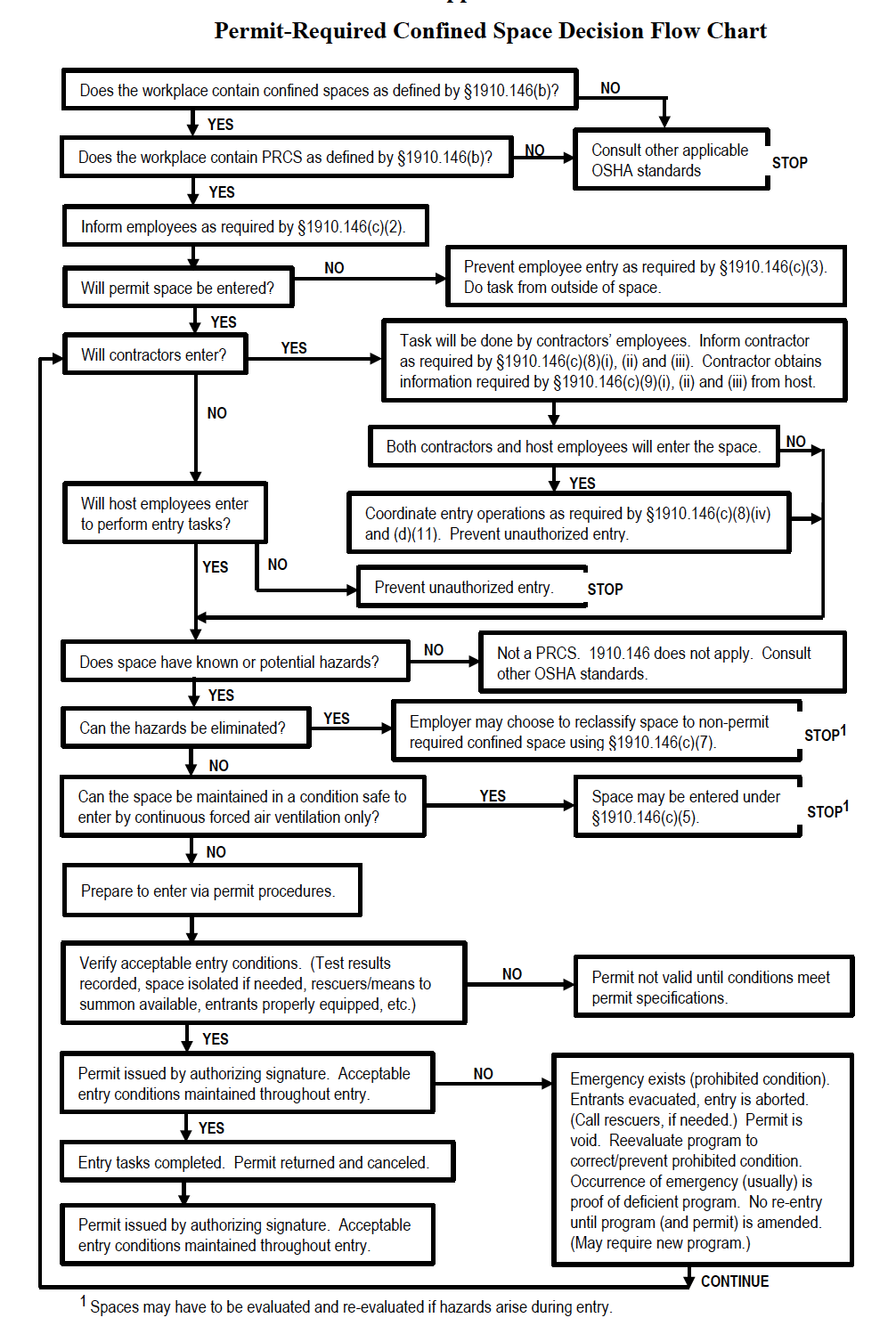
In order for the standard to apply, the employer’s workplace must first contain confined spaces that have the potential to be permit-required. Section 1910.146(b) defines a “confined space” as one that
(1) Is large enough and so configured that an employee can bodily enter and perform assigned work; and
(2) Has limited or restricted means for entry or exit (for example, tanks, vessels, silos, storage bins, hoppers, vaults, and pits are spaces that may have limited means of entry): and
(3) Is not designed for continuous employee occupancy.
All three listed conditions must be met for a space to qualify as a confined space. The CSHO testified the STP well met the criteria for a confined space because an employee could enter the well, access in and out of the well was limited, and employees did not normally work in the well. There is little dispute the STP well was a confined space. Employees could enter the well through the manhole, and, as previously discussed, the well would be entered by contractors in the event the company’s tools were inadequate to remove the STP. Entry into and out of the well could only be made via the manhole which measured 26 inches at its inner opening. Although some work might be performed in the well, it was intended to house the STP and not designed for continuous occupancy by employees. The standard applies and the company was required to conduct an evaluation to determine whether the STP well was a permit-required confined space.
Failure to Comply with the Terms of the Standard
The Secretary contends the company violated the standard because the Lead Fuel Technician failed to evaluate the cited worksite to determine whether the STP well was a permit-required confined space. the company contends it complied with the terms of the standard because it evaluated the STP well, determined it was over 4 feet deep and, as a permit-required confined space, was not to be entered by employees. The Lead Fuel Technician measured the STP well before commencing work and determined it was greater than 4 feet. The Lead Fuel Technician testified in doing so, he determined the company policy to not enter the well applied. The Secretary contends because the company does not specifically train its employees that doing so is determining whether the space meets the definition of a permit-required confined space, it has not complied with the terms of the standard. I disagree.
The citation specifically addresses only the company’s failure to evaluate the cited worksite to determine whether the STP well was a permit-required confined space. The CSHO was told during the inspection about the company’s policy prohibiting entry into the STP well if it was over 4 feet deep. That policy is documented in a memorandum to employees dated April 4, 2013 (Exh. R-13). The Lead Fuel Technician measured the STP well to determine whether entry was prohibited. In the preamble to the confined space standard, the Secretary clarified § 1910.146(c)(1) “requires only the identification of permit spaces. The detailed evaluation and classification of hazards found within the space is addressed by paragraph (d)(2).” 58 Fed. Reg. R 4462, 4481 (January 14, 1993). There is no requirement the evaluation be reduced to writing. Given the minimal requirements of the standard, the Lead Fuel Technician’s measuring of the STP well to determine whether it was more than 4 feet deep was sufficient to comply with the company’s obligation to evaluate the worksite.
The Secretary has failed to meet his burden to establish the company violated the cited standard and Item 3a is vacated.
Item 3b: Alleged Violation of 29 C.F.R. § 1910.146(c)(2)
Item 3b alleges:
On or about December 29, 2014, at [the store], the employer did not post danger signs or provide other effective means of alerting employees to the danger posed by toxic atmosphere in the Submersible Turbine Pump wells, exposing employees to a toxic atmosphere.
The standard at 29 C.F.R. § 1910.146(c)(2) reads:
If the workplace contains permit spaces, the employer shall inform exposed employees, by posting danger signs or by any other equally effective means, of the existence and location of and the danger posed by the permit spaces.
NOTE: A sign reading DANGER — PERMIT-REQUIRED CONFINED SPACE, DO NOT ENTER or using other similar language would satisfy the requirement for a sign.
Applicability of the Standard
The cited standard applies where a worksite contains a permit-required confined space. As previously discussed, the STP well meets the regulatory definition of a confined space. For that well to be a “permit space” it must also meet the regulatory definition of permit-required confined space. The regulation defines a permit-required confined space as one that has one or more of the following characteristics:
(1) Contains or has a potential to contain a hazardous atmosphere;
(2) Contains a material that has the potential for engulfing an entrant;
(3) Has an internal configuration such that an entrant could be trapped or asphyxiated by inwardly converging walls or by a floor which slopes downward and tapers to a smaller cross-section; or
(4) Contains any other recognized serious safety or health hazard.
29 C.F.R. § 1910.146(b). A hazardous atmosphere is defined as one “that may expose employees to the risk of death, incapacitation, impairment of ability to self-rescue (that is, escape unaided from a permit space), injury, or acute illness from” among other causes, “atmospheric oxygen concentration below 19.5 percent or above 23.5 percent.” 29 C.F.R. § 1910.146(b). Testing performed by the Daytona Beach Fire Department showed the STP well to contain an atmosphere containing an oxygen concentration below 19.5 percent. The Secretary has established the STP well was a permit space and the standard applies.
Failure to Comply with the Terms of the Standard
There is no dispute the company did not post signs warning employees of the hazards of the STP wells. The company contends it complied with the standard because it informed employees not to enter any well in excess of 4 feet deep. In consideration of commentators’ objections to the proposed standard, the Secretary wrote in the preamble to the standard:
OSHA believes that this language will require employers to protect their employees but will also allow them to use the most cost-effective method available. For example, employers who are already providing sufficient training to protect their employees effectively need not purchase and maintain unnecessary signs. On the other hand, employers can choose to post danger signs to protect employees if they desire. Whatever method is used, the standard requires it to inform employees exposed to the hazards posed by permit-required confined spaces of the existence, location, and danger of those spaces. Additionally, the provision in the final rule makes it clear that the sign is to indicate the danger involved in permit space entry, not to list all the specific hazards that might be encountered…
In enforcing this provision, OSHA will check to ensure that methods other than warning signs are truly effective in imparting the required information to employees. General training in the OSHA standard, for example, cannot be expected to adequately inform employees of the location of permit spaces in the workplace. The final rule places the burdens of identifying the spaces and of controlling the resultant hazards on the employer not on the employee. 58 Fed. Reg. 4462, 4483. The alternative to posting of signs contained in the standard is not met by merely telling employees not to enter permit spaces. The auditor admitted the company’s training did not include training on the definition or hazards of a permit required confined space. The company violated the requirements of 29 C.F.R. § 1910.146(c)(2).
Employee Exposure to a Hazard
Failure to place employees on notice of the hazards of permit-required confined spaces exposes them to the hazards associated with entry. As previously noted, entry into the STP well exposed the company employees to an oxygen deficient atmosphere. Employees had not been trained on those hazards, only that they were not to enter the STP well if it was deeper than 4 feet. As previously discussed, that notice was insufficient. Based on the auditor’s testimony, the Side Technician would not have been trained on the hazards of permit-required confined spaces. There is no evidence he was warned about the hazards he might encounter if he entered the STP well. The record contains no evidence the Lead Fuel Technician told the Side Technician the depth of the STP well or warned him not to enter it. The memorandum regarding the company’s policy on entry into wells deeper than 4 feet was issued in 2013, a year before the Side Technician began work for the company and there is no evidence he was ever provided the memorandum. The Secretary has established the Side Technician was exposed to the hazard addressed in the cited standard.
Employer Knowledge of the Violation
There is no evidence indicating whether the company provided signs to its employees to post at any worksite. The Lead Fuel Technician was aware no signs were posted. The Lead Fuel Technician’s actual knowledge of the violation is imputed to the company. Contrary to the safety and human resources director’s testimony, the auditor admitted employees were not trained in permit-required confined space entry. Both the safety and human resources director and auditor were aware of the contents of employee training. The company had knowledge signs were not posted at the STP wells and that employees had not been informed of the hazards of the STP wells by other effective means within the meaning of the standard.
Item 3(c): Alleged Violation of 29 C.F.R. § 1910.146(c)(3)
Item 3(c) alleges “On or about December 29, 2014, at RaceTrac store 2367, the employer had not prevented employees from entering the permit-required confined spaces of the Submersible Turbine Pump wells.”
Section 1910.146(c)(3) requires:
If the employer decides that its employees will not enter permit spaces, the employer shall take effective measures to prevent its employees from entering the permit spaces and shall comply with paragraphs (c)(1), (c)(2), (c)(6), and (c)(8) of this section.
Applicability of the Standard
As previously discussed, the STP well was a permit-required confined space. the company does not dispute its policy was to prohibit employees from entry into the STP well. The standard applies and the company was required to take effective measures to prevent employee entry into the STP well.
Failure to Comply with the Terms of the Standard
The purpose of the cited standard is to prevent accidental or inadvertent entry into permit-required confined spaces. In the preamble to the standard, the Secretary noted, OSHA also agrees with these comments. Paragraphs (c)(3) and (d)(1) require the employer to take steps to prevent unauthorized entry into permit-required confined spaces. These steps are intended to include measures, such as guarding and barricading, necessary to protect employees from accidentally entering a permit space. In order to ensure that employees are adequately protected against falling into or otherwise inadvertently entering a permit space, the Agency has revised the language in the proposed definition to include unintentional as well as intentional entry. 58 Fed. Reg. 4462, 4472. The Secretary went on to clarify that compliance could include permanently closing the space and barriers, supplemented by training employees and posting danger signs. In any event, the steps taken by the employer must be effective in preventing employee entry into permit spaces. 58 Fed. Reg. 4462, 4483.
While the Side Technician moved the hoses from one tank to the next and the Lead Fuel Technician completed his paperwork, the STP well cover remained off and the STP well remained unguarded. The Side Technician was found at the bottom of the open STP well. Although it will never be known why the Side Technician entered the STP well, whether his entry was intentional or accidental is not dispositive. The standard requires measures be taken to prevent both. Informing employees not to enter the STP well that is more than 4 feet deep does nothing to prevent accidental entry. To the extent the company did anything, those measures were not effective under the standard. Footnote
Employee Exposure to the Hazard
The Side Technician was exposed to the hazard posed by unauthorized entry into the STP well. The STP well contained an oxygen deficient atmosphere to which the Side Technician was exposed. The autopsy report also shows the Side Technician had been exposed to toxic levels of gasoline vapors (Exh. C-14). The Secretary has established employee exposure to the hazard.
Employer Knowledge
The Lead Fuel Technician was aware the STP well remained open while he and the Side Technician continued work at the site. The Lead Fuel Technician’s knowledge of the worksite conditions is imputed to the company. the company has no rule requiring guarding or otherwise preventing unauthorized entry into the STP well. The Secretary has established the company knew, or with the exercise of reasonable diligence should have known of the violation.
Classification of Items 3b and 3c
The Secretary alleges Items 3b and 3c are serious violations of the confined space standard. As discussed herein, accidental or inadvertent entry into the STP well exposed employees to the atmospheric hazards within it. An oxygen deficient atmosphere can result in an individual losing consciousness to death. As evidenced by the MSDS for gasoline, inhalation of gasoline vapors can result in serious respiratory irritation, central nervous system impairment, and ultimately, death. The Secretary has established the violations of 29 C.F.R. § 1910.146 were serious.
Penalty Determination
The Commission, in assessing an appropriate penalty, must give due consideration to the gravity of the violation and to the size, history and good faith of the employer. In assessing a penalty, the Commission gives due consideration to all of the statutory factors with the gravity of the violation being the most significant. “Gravity is a principal factor in a penalty determination and is based on the number of employees exposed, duration of exposure, likelihood of injury, and precautions taken against injury.” Siemens Energy and Automation, Inc., 20 BNA OSHC 2196, 2201 (No. 00-1052, 2005).
The Secretary proposed a penalty of $7,000.00 for Item 1. Both employees on the worksite were exposed to the hazard of falling into the unguarded STP wells. The well remains open for the duration of the tank cleaning process which was approximately 2 ½ hours. Two wells were open while the Side Technician moved the hoses and the Lead Fuel Technician was otherwise occupied (Exh. C-13). During this period, the Side Technician was particularly vulnerable to an accidental fall into one of the STP wells. A high gravity-based penalty is warranted. the company is a small employer. The was no evidence the company has a significant history of OSHA violations or other accidents. the company is entitled to a reduction in the gravity-based penalty. A penalty of $5,000.00 is assessed for Item 1.
The Secretary proposed a total grouped combined penalty of $5,000.00 for Items 2a – 2g. Item 2g was vacated. My penalty assessment takes into consideration only Items 2a – 2f. At various times throughout the workday, employees at the company’s worksite were exposed to the hazards associated with inhalation of gasoline vapors. the company’s poor implementation of its program and inadequate training made it more likely employees would either not use respirators when required or use them improperly. A high gravity-based penalty is warranted. For the reasons discussed previously, the company is entitled to a reduction in the gravity-based penalty for its small size and lack of significant violation history. A penalty of $5,000.00 is assessed.
The Secretary proposed a total combined penalty of $1,600.00 for Items 3a – 3c. Item 3a was vacated. My penalty assessment takes into consideration only Items 3b and 3c. Both the Side Technician and Lead Fuel Technician were exposed throughout the workday to the open STP well. Although entry was not necessary to perform their work and the crew members were aware of the location of the open STP wells, an accidental fall by either crew member was possible. the company’s small size and lack of history merit a reduction in the gravity based penalty. A penalty of $1,600.00 is assessed.
I do not find the company entitled to a reduction in any of the penalties for good faith. the company had a written safety and health program (Exh. C-9), but had failed to implement many of its provisions at its jobsites. Although The safety and human resources director testified he provided training to employees on the program, the record makes clear this testimony was not credible. the company’s respiratory protection program is deficient for the reasons discussed herein. The Side Technician and Lead Fuel Technician were not provided with training on that program nor fit tested for their respirator until months after starting work and using respirators at jobsites. The Lead Fuel Technician felt he could ignore the requirement to use respirators when it was too time consuming to do so. Due to these deficiencies, the company is not entitled to a reduction in the penalties for good faith.
Considering all of the statutory factors, it is determined that a penalty of $5,000.00 for Item 1, $5,000.00 for Items 2a – 2f, and $1,600.00 for Items 3b and 3c, for a total penalty of $11,600.00 is appropriate.
FINDINGS OF FACT AND CONCLUSIONS OF LAW
The foregoing decision constitutes the findings of fact and conclusions of law in accordance with Rule 52(a) of the Federal Rules of Civil Procedure.
ORDER
Based upon the foregoing decision, it is ORDERED that:
1. Item 1, Citation 1, alleging a violation of 29 CFR § 1910.23 (a)(6), is affirmed as a serious violation and a penalty of $5,000.00 is assessed;
2. Item 2a, Citation 1, alleging violation of 29 C.F.R. § 1910.134(c)(1), is affirmed as a serious violation;
3. Item 2b, Citation 1, alleging violation of 29 C.F.R. § 1910.134 (d)(1)(i), is affirmed as a serious violation;
4. Item 2c, Citation 1, alleging violation of 29 C.F.R. § 1910.134 (d)(3)(iii)(B)(2), is affirmed as a serious violation;
5. Item 2d, Citation 1, alleging violation of 29 C.F.R. § 1910.134 (e)(1), is affirmed as a serious violation;
6. Item 2e, Citation 1, alleging violation 29 C.F.R. § 1910.134 (h)(1), is affirmed as a serious violation;
7. Item 2f, Citation 1, alleging violation 29 C.F.R. § 1910.134 (k)(1), is affirmed as a serious violation;
8. Items 2a, 2b, 2c, 2d, 2e, and 2f, Citation 1, are assessed a total combined penalty of $5,000.00;
9. Item 2g, Citation 1, alleging a violation of 29 C.F.R. § 1910.134(1)(1), is vacated;
10. Item 3a, Citation 1, alleging a violation of 29 C.F.R. § 1910.146(c)(1), is vacated;
11. Item 3b, Citation 1, alleging a violation of 29 C.F.R. § 1910.146(c)(2), is affirmed as a serious violation;
12. Item 3c, Citation 1, alleging a violation of 29 C.F.R. § 1910.146(c)(3), is affirmed as a serious violation; and
13. Items 3b and 3c, Citation 1, are assessed a total combined penalty of $1,600.00.
CLICK HERE for the Decision