Over the past four (4) years, I have been involved in an industry that I would have never thought would be some of my Process Safety clients and over these same four years, I have come to feel sorry for an entire industry. This industry was forced to change to an alternative chemical in order to “protect the environment”; albeit their new chemical is NOT a less “hazardous” chemical! In fact, the replacement chemical is a Category 1 Flammable Gas (as defined by GHS/OSHA) and the chemical it replaced was NOT flammable gas and in fact was darn near “safe” for workers, but it had too high of a Global Warming # and such was deemed a threat to our environment. This “replacement chemical” is manufactured by a hand full of companies and the one thing they seem to agree on is that using the Globally Harmonized System (GHS) that this chemical is a “Category 1 Flammable Gas“. Unfortunately, that is where their similarities end. What confuses many of the Safety Professionals responsible for managing this material is how Category 1 Flammable Gas can be anything but a “4” in the NFPA 704 or HMIS labeling systems. What is more curious is how one of these manufacturers’s started out stating the CAT 1 Flammable Gas was a “1” in the NFPA 704 and HMIS labeling system. That company has gone full circle and now states the NFPA rating is a 3-Health and 4-Flammability; that is quite a change from 0-Health and 1-Flammability. While one manufacturer has brought their SDS more in line with what one would expect; the other manufacturer has gone in the opposite direction; they started out with these NFPA ratings, 2-Health and 4-Flammability and have now revised their NFPA 704 ratings to 2-Health and 2-Flammability in their 2018 revision of their SDS. So the question I have… how does a CAT 1 Flammable Gas (Extremely Flammable) end up with a “2” for the NFPA 704 rating? Let’s see…
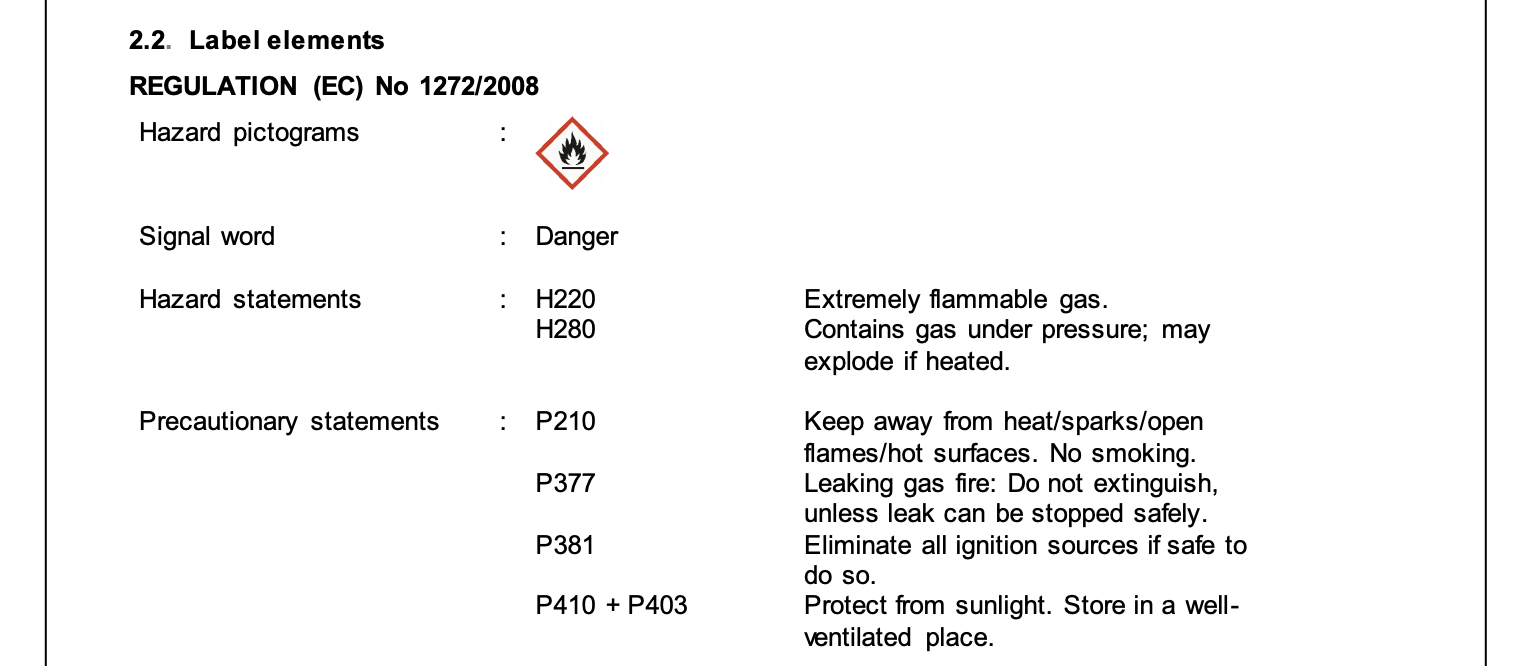
Here is a screenshot for the most current SDS from one of the manufacturers. The other manufacturers is almost exactly the same – BOTH state the material is an “Extremely Flammable Gas” and both agree that it is a Category 1 Flammable Gas.

But then we see the following:

Can a Category 1 Flammable Gas, called an Extremely Flammable Gas, have an NFPA rating of a “2” for it’s “degree of hazard” related to Flammability Hazards? I say no way, but I am just a small voice who sees things in black and white, such as here are the “criteria” from NFPA 704 for a material to be rated a “2” in it’s flammability hazard(s):
(emphasis by me)
- LIQUIDS having a FLASH POINT at or above 37.8°C (100°F) and below 93.4°C (200°F) (i.e., Class II and Class IIIA LIQUIDS)
- Finely divided SOLIDS less than 420 μm (40 mesh) that present an ordinary risk of forming an ignitible dust cloud
- SOLID MATERIALS in a flake, fibrous, or shredded form that burn rapidly and create flash fire hazards, such as cotton, sisal, and hemp Solids and semisolids that readily give off flammable vapors
- SOLIDS containing greater than 0.5 percent by weight of a flammable or combustible solvent are rated by the closed cup flash point of the solvent.
As we can see, the criteria mention flammable LIQUIDS and solids – NO mention of flammable gas. So where do we find the mention of a Flammable Gas? Let’s look at the criteria for a “4” in its flammability hazard(s):
- FLAMMABLE GASES
- Flammable cryogenic materials
- Any liquid or GASEOUS MATERIAL that is liquid while under pressure and has a flash point below 22.8°C (73°F) and a boiling point below 37.8°C (100°F) (i.e., Class IA liquids)
- Materials that ignite spontaneously when exposed to air
- Solids containing greater than 0.5 percent by weight of a flammable or combustible solvent are rated by the closed cup flash point of the solvent.
So I ask you again… What would criteria would you think best fits a Category 1 Flammable Gas? Over the years we have seen this same chemical cover the entire spectrum from a “1” to a “4” and both manufacturers have changed their “suggested ratings” on their SDS for unknown reasons. What say you?