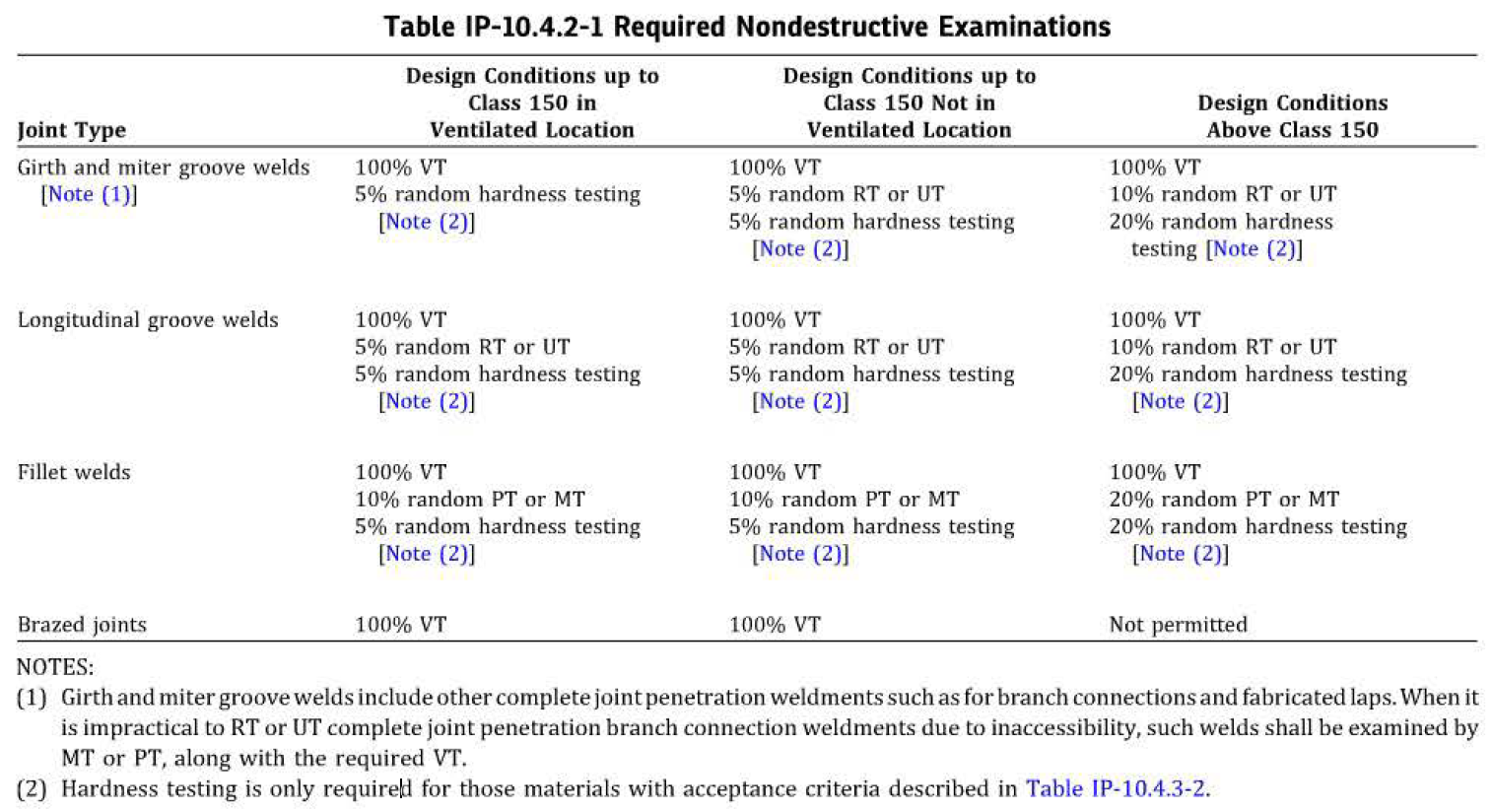
I have written many articles relating to ASME B31.3 and the QA/QC requirements each weld/flange must meet. However, in B31.12, Table IP-10.4.2-1 Required Nondestructive Examinations, the code requires 100% VT (Visual examination). The code goes on to require a more extensive examination sampling of 5-10% joints using with Liquid Penetrant (PT) or Magnetic Particle (MT). Even the VT requirements for Hydrogen piping are more specific…
Visual examination shall be performed in accordance with ASME BPVC, Section V, Article 9, including the following:
(a) materials, components, and products conform to the specified requirements
(b) applicable procedures with proper qualifications and certifications are used
(c) welding or brazing personnel have proper qualifications and certifications
(d) assembly of threaded, bolted, and other joints conforms to the applicable requirements of Chapter IP-9
(e) alignment, supports, and cold spring are in accordance with the engineering design
(f) for weldments
(1) joint preparation and cleanliness
(2) preheating/interpass temperatures
(3) fit-up, joint clearance, and internal alignment prior to joining
(4) filler material
(5) welding position and electrode
(6) welding condition of the root pass after cleaning, either external and, where accessible, internal, or aided by liquid penetrant or magnetic particle examination when specified in the engineering design
(7) welding slag removal and weld condition between passes
(8) imperfect ions are acceptable
(9) appearance of the finished weldment to be suitable for additional NDE and leak tests
(g) for brazements
(1) verification of brazing position, cleaning, fluxing, brazing temperature, proper wetting, and capillary action
(2) visual examination shall include postbraze cleaning of brazed deposit and affected base metal
(3) imperfections are acceptable