
Flammable liquids shall be drawn from or transferred into vessels, containers, or portable tanks within a building:
- only through a closed piping system,
- from safety cans,
- by means of a device drawing through the top, or
- from a container or portable tanks by gravity through an approved self-closing valve.
Transferring by means of air pressure on the container or portable tanks shall be prohibited.
So what is approved self-closing valve?
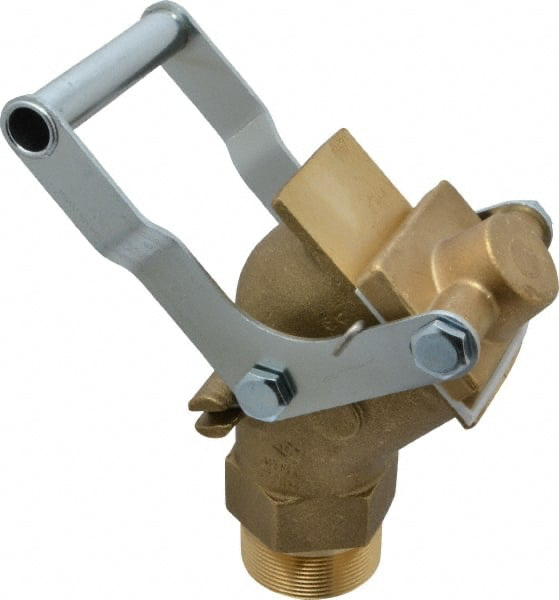
Looking at FM Globals specs:
Seat leakage. Through-the-seat leakage in the closed position shall not exceed 24 in3/hr (400 cc/hr) of air or nitrogen for gas valves and 0.4 oz/hr (11.8 ml/hr) water or water glycol-based hydraulic fluid for liquid valves.
Body leakage. Safety shutoff valves shall be able to withstand an internal pressure equal to 200 percent of the rate working pressure without external leakage or damage.
Durability. Safety shutoff valves shall operate reliably after 20,000 operational cycles or the specified maximum allowable cycles (whichever is greater) at the rated working pressure. The total operational cycles may be reduced to 1,000 for heat-actuated valves (i.e., spring-loaded and fusible link-activated).
Electrical insulation. All electrical components of a safety shutoff valve, if so equipped, shall be capable of withstanding a high potential between input terminals and ground, for one minute without arcing or breakdown.
Fire exposure test. To be classified as fire-safe, safety shutoff valves must not exceed an average combined internal and external leakage rate of 17 oz./min (500 ml/min) while at rated working pressure (+/- 10%) during a 60 minute fire exposure at a uniform heat flux of 125 kW/m2 (+/- 5%).
Visual observation of external valve leakage in the form of a spray shall be considered a failure.
Operational requirements include: demonstrated quality control program, initial and surveillance audits, installation inspections, change notification, and manufacturing and productions test.
The IFC requires the following:
5706.2.5.2 Tanks for gravity discharge.
Tanks with a connection in the bottom or the end for gravity-dispensing liquids shall be mounted and equipped as follows:
Supports to elevate the tank for gravity discharge shall be designed to carry all required loads and provide stability.
Bottom or end openings for gravity discharge shall be equipped with a valve located adjacent to the tank shell that will close automatically in the event of fire through the operation of an effective heat-activated releasing device.
Where this valve cannot be operated manually, it shall be supplemented by a second, manually operated valve.
The gravity discharge outlet shall be provided with an approved hose equipped with a self-closing valve at the discharge end of a type that can be padlocked to its hanger.