
 Last year, we came across a very interesting LOTO practice that we completely disagreed with, but we were the only ones in the room who were not in agreement, so I think we may need to be “calibrated” in our LOTO expectations! I am not saying I will ever agree with this practice at a facility I am managing, but we were at a VPP site, and the safety professionals were truly world-class in many aspects of safety and health, so I thought maybe it was just me getting old and set in my ways.
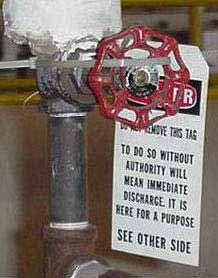
The practice involved using a specially colored, self-locking, non-reusable nylon tie wrap (the color and design of these nylon tie wraps were specified in their written program) and a LOTO-prescribed tag to secure an isolation device in the safe position. Now, I will give credit here; the practice was to “secure” the isolation device in the “safe position.” But when I read and observed the practice, this was a “tagout” and not a “lockout.”
The facility viewed this practice as a “lockout” since the nylon tie wrap(s) were the locking type and were being used to “secure” the isolation device in the “safe” position. No lock is used, only the specially colored nylon tie wraps and their prescribed LOTO tag. Here is more…
How would you view this practice? Would it be “tagout,” or would you give them credit for a “lockout” for this practice?
I refused to accept it as a lockout (which you can imagine how a VPP STAR site would take this). They quickly pointed to the seven (7) OSHA VPP assessments they had undergone in the past 20 years and not one peep from OSHA about this practice.
Here is my logic and why I refused to accept the practice as a “lockout” and called it a “tagout,” which meant the facility allowed “tagout in lieu of lockout,” resulting in additional LOTO program and practice issues for the facility (e.g., Tag-Plus was not practiced when using this practice and periodic inspections did not include affected employees when this practice was inspected)
First, let’s look at the definitions of Lockout, Lockout Device, Tagout, and Tagout Device to get a baseline on what 1910.147 says:
|
Lockout. The placement of a lockout device on an energy isolating device, in accordance with an established procedure, ensuring that the energy isolating device and the equipment being controlled cannot be operated until the lockout device is removed. Lockout device. A device that utilizes a positive means such as a lock, either key or combination type, to hold an energy isolating device in the safe position and prevent the energizing of a machine or equipment. Tagout. The placement of a tagout device on an energy isolating device, in accordance with an established procedure, to indicate that the energy isolating device and the equipment being controlled may not be operated until the tagout device is removed. Tagout device. A prominent warning device, such as a tag and a means of attachment, which can be securely fastened to an energy isolating device in accordance with an established procedure, to indicate that the energy isolating device and the equipment being controlled may not be operated until the tagout device is removed. |
In all fairness, I want to remind everyone that the practice did “secure” the isolation device in a safe position. It was done using specially colored nylon tie wraps and a LOTO tag.
I also point us to the OSHA requirement when attaching a tag in a “tagout” situation:
| 1910.147(c)(5)(ii)(C)(2) Tagout devices. Tagout devices, including their means of attachment, shall be substantial enough to prevent inadvertent or accidental removal. Tagout device attachment means shall be of a non-reusable type, attachable by hand, self-locking, and non-releasable with a minimum unlocking strength of no less than 50 pounds and having the general design and basic characteristics of being at least equivalent to a one-piece, all environment-tolerant nylon cable tie. |
The LOTO program specifically required these specially colored nylon tie wraps to meet these “tagout device” requirements word for word.
Here is a photo (not from the facility, but from EPA Region X article on PSM/LOTO) showing the practice of how the valve is secured in the safe position; other than the facility using specially colored nylon tie (the same style, just different color as shown in the photo) this is precisely how they would secure an isolation device in the safe position.
Here is another photo taken at the same facility. It appears side by side in the EPA Region X article showing a Lockout, and you can see the above arrangement in the background. Note: I placed the yellow circles so as to point out the differences: one has a chain and lock securing the valve closed, and the other LOTO in the background is the same one shown above.
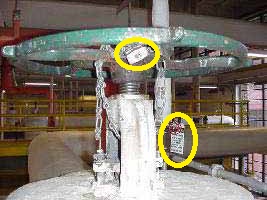
In my eyes, the facility is taking “tagout” to an additional level by using the “tagout” to secure the isolation device in its safe position, but this practice falls well short of being called “lockout.” What say you????
Now, to really confuse us, just as a point of reference, in 2004, OSHA issued this LOI regarding the use of heavy-duty nylon cable ties as an alternative to chains and locks on devices that are not specifically designed to accommodate a lock and back then (12/7/2004) OSHA did NOT accept the practice; however, the 2004 LOI has been “archived” for some reason.
So, can we assume that, in some way, OSHA now accepts this?
NO, the LOI was archived because in 2008, OSHA issued their revised Compliance Directive, CPL 02-00-147, which states the following in Section V, c. (page 3-33):
(emphasis added by me)
| Additionally, the lockout device must be substantial enough to prevent removal without the use of unusual techniques. For example, the use of nylon cable ties would not be an appropriate substitute for more traditional and substantial lockout devices, such as the use of locks and chains to hold a valve in the safe position. While a cable tie is a positive means of holding the energy isolating device in a safe position, nylon ties are generally removable through the use of common cutting tools (e.g., pocket knives, side cutters, or scissors) or by releasing the pawl mechanism with a device such as screwdriver; neither of which constitutes an “unusual technique,” as required by the standard. NOTE: An employer using machines capable of being locked-out could, however, use the cable ties as part of a tagout system consistent with 1910.147(c)(5), as long as the use of the tagout system provided full employee protection, (e.g., double-block and bleed arrangement with a tag, using a nylon cable tie as a means of attachment) as set forth in 1910.147(c)(3). Tag attachments, used to attach the tag, must be non-reusable, self-locking, and non-releasable, with a minimum unlocking strength of 50 pounds. Tags must be attachable by hand, and the device for attaching the tag should be a one-piece nylon cable tie or its equivalent so it can withstand all environments and conditions. |