
When most ordinary people hear the term “Hazardous Location” many conjure images of a dangerous location associated with typical hazards; however, when a safety engineer or engineer from the process industries hear the phrase we immediately elvate our antenna and sit up and pay close attention to what is being said. But for those outside of chemical processing indutries, most have no idea as to when an area needs to be classified as a Hazardous Location (HAZLOC), how big of an area is impacted, how to go about with their hazard analysis. A lot of my work in process safety, and my professional roots in process safety, involves flammable liquids. I learned HAZLOCs from “Garth” during my MSU Internship and in the most unusal places to learn HAZLOCs – hospitals! Then in my first job out of school I met “Roy” and “Roger” who went great lengths to get me up to speed on HAZLOC. Back in those days, Factory Mutual had a set of binders much like NFPA that covered just about any hazard that could be found in a processing plant. I did a lot of reading in those days and was lucky to have Roy and Roger’s instruction along the way. But not everyone was as lucky as I and they did not have P.E.’s to teach them and guide them in their hazard analysis and this leads to a lot of facilities who should have areas designated as a HAZLOC and for whatever reason have not. With the recent explosion in TX involving a suspected flammable gas, I have received a number of inquiries from clients who, in the past, have balked at my inquiry about their lack of “calssification” within their facilities – simply because “we are not a chemical plant Bryan… that stuff does not apply to us”.
In this article I hope to help those who are NOT a chemical plant understand how this engineering practice may apply to your business and how best to implment this critical engineering control.
Let’s start with the basics…
Your business/facility has flammable liquids or gases it uses in the manfacturing (or just storage) of your product. The type of flammable material present will dicate our degree of hazard and how we go about “classifying” an area. If you have any of these flammable materials, then you very well may have HAZLOCs within your facility.
Pressurized/Compressed Liquefied Gases
These gases are stored above their normal boiling point but are kept in the liquid state by pressure. When released, the liquid immediately expands and vaporizes, creating large volumes of cold gas. The cold gas behaves like a heavier-than-air gas.
Cryogenic Flammable Liquids and Other Cold Liquefied Combustible Materials
Cryogenic liquids are generally handled below -150°F. These behave like flammable liquids when they are spilled. Small liquid spills will immediately vaporize, but larger spills may remain in the liquid state for an extended time. As the liquid absorbs heat, it vaporizes and will form an ignitible mixture. Some liquefied combustible materials (not cryogenic) are stored at low temperatures and at pressures close to atmospheric pressure; these include anhydrous ammonia, propane, ethane, ethylene, and propylene.
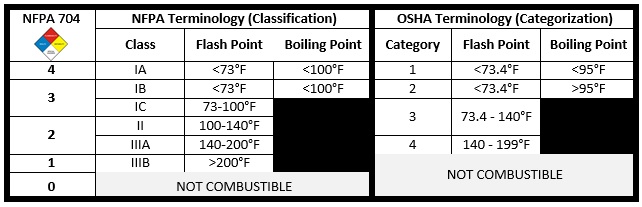
Flammable Liquids (Category 1 & 2 Liquids)
When released in appreciable quantity, a Class I liquid (Category 1 & 2 Liquids) will begin to evaporate at a rate that depends on its volatility:
the lower the flash point, the greater the volatility; hence, the faster the evaporation.
The vapors of Class I liquids form ignitible mixtures with air at ambient temperatures more or less readily. Even when evolved rapidly, the vapors tend to disperse rapidly, becoming diluted to a concentration below the lower flammable limit (LFL). Until this dispersion takes place, however, these vapors will behave like heavier-than-air gases. Class I liquids (Category 1 & 2 Liquids) normally will produce ignitible mixtures that will travel a finite distance from the point of origin; thus, they will normally require area classification for proper electrical system design.
Combustible Liquids (Category 3 & 4 Flammable liquids)
A combustible liquid will form an ignitible mixture only when heated above its flash point.
With Class II liquids (, the degree of hazard is lower because the vapor release rate is low at normal handling and storage temperatures. In general, these liquids will not form ignitible mixtures with air at ambient temperatures unless heated above their flash points. Also, the vapors will not travel as far because they tend to condense as they are cooled by ambient air. Class II liquids should be considered capable of producing an ignitible mixture near the point of release when handled, processed, or stored under conditions where the liquid could exceed its flash point.
Class IIIA liquids do not form ignitible mixtures with air at ambient temperatures unless heated above their flash points. Furthermore, the vapors cool rapidly in air and condense. Hence, the extent of the area requiring electrical classification will be very small or nonexistent.
Class IIIB liquids seldom evolve enough vapors to form ignitible mixtures even when heated, and they are seldom ignited by properly installed and maintained general purpose electrical equipment. A Class IIIB liquid will cool below its flash point very quickly when released. Therefore, area classification is seldom needed and Class IIIB liquids are not included in Table 4.4.2.
The next step we consider is “Conditions Necessary for Ignition” In a Class I area, the following three (3) conditions must be satisfied for the combustible material to be ignited by the electrical installation:
- A combustible material must be present.
- It must be mixed with air in the proportions required to produce an ignitible mixture.
- There must be a release of sufficient energy to ignite the mixture.