
Like all Personal Protective Equipment (PPE), hearing protection has limitations. Often, workers use hearing protection that is inadequate for their exposures. 1910.95(j) is intended to ensure this does not happen to workers, but…
Many facilities have not formally evaluated the hearing protection available to the workforce. I am not going to get into the technical aspects of how this evaluation should occur, as OSHA has provided some excellent materials to aid us in doing this properly (1910.95 Appendix B).
What does OSHA require for workplaces that have workers exposed to an action level of 85 dBA (TWA)? We find the answer in 1910.95(j), which states:
1910.95(j) “Hearing protector attenuation.”
1910.95(j)(1) The employer shall evaluate hearing protector attenuation for the specific noise environments in which the protector will be used. The employer shall use one of the evaluation methods described in Appendix B: “Methods for Estimating the Adequacy of Hearing Protection Attenuation.”
1910.95(j)(2) Hearing protectors must attenuate employee exposure at least to an 8-hour time-weighted average of 90 decibels as required by paragraph (b) of this section.
1910.95(j)(3) For employees who have experienced a standard threshold shift, hearing protectors must attenuate employee exposure to an 8-hour time-weighted average of 85 decibels or below.
1910.95(j)(4) The adequacy of hearing protector attenuation shall be re-evaluated whenever employee noise exposures increase to the extent that the hearing protectors provided may no longer provide adequate attenuation. The employer shall provide more effective hearing protectors where necessary.
Facilities are required to “evaluate” the hearing protection they make available to ensure that the Noise Reduction Rating (NRR) offers enough protection to ensure the workers are not overexposed to noise (e.g., 90 dBA-TWA). Remember that if your noise readings are presented in the A-scale (dBA), as most are, then the first step in our evaluation is to SUBTRACT 7 from the NRR provided by the manufacturer. This means that if the protector is rated for noise reduction of 32 (NRR=32), we subtract 7 from 32, which means the REAL NRR for this device will be 25 (NRR=25). So, to us, these protectors will provide ample protection for workers in noise exposures LESS THAN 110 dBA. Do you think my math is a little bit off? I never used 90 dBA as my goal, but rather, I used 85 dBA to keep things simple for me! Here’s what I mean.
For employees who have suffered a “Standard Threshold Shift”(STS), which is defined as “a change in hearing threshold relative to the baseline audiogram of an average of 10 dB or more at 2000, 3000, and 4000 Hz in either ear”, 1910.95(j)(3) requires us to attenuate their exposures down to 85 dBA TWA, not 90 dBA as allowed in (j)(2). So, rather than having two groups to manage, I treat everyone in my evaluation as if they have had an STS. Thus, I use 85 dBA as my attenuation evaluation target rather than 90 dBA.
A couple of things ALWAYS caused issues for me in the facility.
The first one was I tried to get fancy! Don’t get fancy; keep this stuff simple! With workers being more mobile these days, we must be careful that they use the correct protection for EACH area they work in. When I got fancy, I would provide workers in Department A with hearing protection ratings for noise exposures in Department A. The problem was Department A had the lowest noise level in the plant. When they ventured over to work in Department B, which was the loudest department in the plant, they would naturally use the HP they normally use, which would put them in an overexposure situation. To rectify this, I just ensured that everyone who worked in or frequently traveled through (e.g., forklift drivers) an area with high noise ONLY had access to protectors with the highest NRR I could buy. There is no problem with OVER PROTECTING workers, and it cost almost nothing more to buy HP with an NRR of 32 vs. an NRR of 25. This also makes my “hearing protector attenuation evaluation” much easier to document.
So what happens if we have noise areas over 110 dBA? First, attempt to use ENGINEERING CONTROLS to lessen the noise exposures. If some specific pieces of equipment are generating noise, noise curtains may go a long way to reducing exposures.
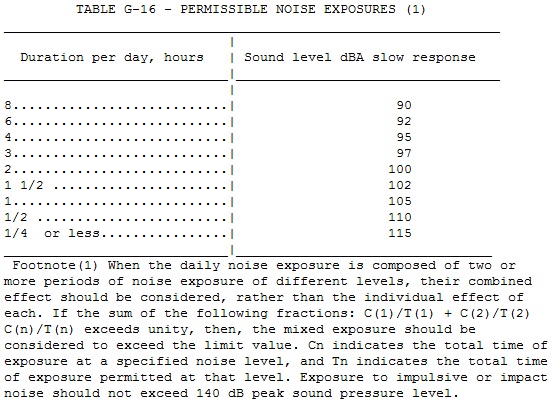
If we cannot get the noise levels down using engineering controls, our next option to explore is ADMINISTRATIVE CONTROLS, which is the easiest way to control and LESSEN the TIME of exposure. Remember, noise is just like chemicals when it comes to exposure – it is exposure and time-dependent. The higher the exposure, the less time we can be exposed. (See table below)
The LAST OPTION for us is to issue PPE, but when we use this option, we MUST ENSURE that the PPE is adequate for the exposure(s) that workers will face. Issuing hearing protection for workers and NOT having completed the evaluation evaluation on that protection could be placing workers in an overexposure situation, and even though they are wearing their hearing protection and wearing it properly, they will eventually suffer an STS if they stay in that exposure long enough.
I am passing on this advice as we have received quite a few requests for help after facilities have gone through their annual audiograms and found a large number of employees suffering from a STS. It is almost natural for management to jump to the conclusion that workers are not wearing their protectors and the problem is a worker behavior issue. In the vast majority, and I mean nearly 100%, of the cases we have worked on, it turned out that no one at the facility understood noise exposure or how hearing protection worked. We observed hearing protection being worn, but most were not worn properly; however, when we asked about the NRR of the available protectors, no one knew what an NRR was. When we asked about how the current protection was chosen, it was based on two simple factors: cost and popularity. Both of these MUST BE considered when purchasing any PPE, but they are NOT the ONLY two (2) and certainly not the first two (2) considerations. We have to make sure the employee likes the PPE, or they will never use it, but we have an obligation to ensure that when they do use it, they are PROTECTED.