
These days the one thing I love about my job is when a client actually asks me to lessen their risks through safety engineering. Yes, I went to school and got my BS in OSH and my MS in SE and they are stunningly different applications. With one, I help companies with their OSHA compliance matters and that is fundamental to building a strong safety foundation. But OSHA compliance is the MINIMUM and I am lucky to have such a great group of core clients who oftentimes go well beyond OSHA compliance. Take one of my international clients who has chlorine. I have been working with these folks for 16 years – one of my very first clients when I started consulting in 2004. The VP of operations was a former colleague at one of my former plants where we managed large inventories of chlorine. He wanted to bring those engineering and administrative controls over to his new employer. We did and their LOPC events dropped by 97% over a 3-year period; but with chlorine, we need this to be a 100% reduction. So not being able to achieve this mark, the client took my advice and reduced their inventories substantially. They went from running off a 55-ton railcar to using a bank of four (4) 1-ton cylinders. This worked for several years and they continued to achieve fewer LOPC events; which when working with 1-ton cylinders says a lot because the probability of an LOPC event increases substantially when making and breaking many more connections over the same time period. But with 1-ton cylinders we are still working with chlorine in a liquefied Pressurized Gas state and thus we had to store the cylinders in a specially designed room (gas room/building) that was remote (e.g. facility siting). And with the handling of cylinders, costs can go up considerably and the increased handling increases operational costs, as well as workers, are having to interact with the process much more often. This increased interaction also increases risks to workers; however, the catastrophic severity goes way down when comparing a 1-ton cylinder inside a specially designed building to a 55-ton railcar outside. But after a few audit findings related to administrative and physical failures in the 1-ton process, we went back to the drawing boards and looked at how risks could be reduced as well as find some cost savings to justify the capital to the “bean counters”. This is NOT a USA-based business, so projects are not compliance-driven but risk and $ driven – which some days oh I wish we could move in this direction in the USA.
Having worked with Chlorine for my entire career in both processing and emergency response I always loved the “gas cabinet” process design. This method of managing hazardous materials is prevalent throughout the semi-conductor industries (per code requirements), but often overlooked in chemical processes – mostly because of the quantitates a large-scale process needs to operate. But at this business, the cost reduction projects actually IMPROVED safety, as one of the core teachings that I am always harping on is REDUCE YOUR INVENTORIES – a key objective of both OSHA’s and EPA’s Process Safety standards. So the business spent a lot of money to find ways to reduce their COSTS associated with Chlorine. Remember, when they went away from the 55-ton rail car their costs per pound went up and the increase was enough to cause some discussions about my mental capacity and well-being. In other words, some of the business people thought I was crazy! But the business is ALL ABOUT cutting costs AND reducing risks – two things that normally do not make good bedfellows! So over the years, their engineering group was making changes to the process and these changes improved efficiencies that allowed them to continually reduce their chlorine demand. And now they were ready for the final step and it was one they welcomed with open arms.
For those of you that follow me on a regular basis know how I like to use RAGAGEPS from all around the world. My home and core business is in the USA and most of my hands-on experience lies in our USA based RAGAGEPS, but when I am working in parts of the world where codes and standards are scarce, I have been forced to learn many international codes and standards; some of which are better than our USA codes and standards. But one of my favorite codes of all time is the International Fire Code (IFC), specifically Part V – Hazardous Materials. And of course, this is where I turned to meet my client’s needs.
My design of the new chlorine delivery system was going to reduce inventories, reduce leak points, reduce MI costs, and reduce operating costs. And I did it all by going from 1-ton cylinders to 150-pound gas cylinders inside chlorine “gas cabinets” which were 75′ from the end-use-point vs. several thousand feet away. We eliminated the maintenance and operational costs of a chlorine vaporizer, reduced pipe size from 1.5″ to using SD tubing, and reduced the operational risks and cost and maintenance cost of the large overhead crane. Not to mention the reduced cost of maintaining the chlorine building safety systems and the building structure.
I did this by installing “gas cabinets” at the end-use-point. These cabinets are a fraction of the cost to install, operate, and maintain vs. a chlorine building. They are essentially a tiny chlorine building built for one purpose – to hold hazardous material gas cylinders. So let’s understand how these cabinets play into our safety by design…
What is a GAS CABINET? The IFC defines them as:
A fully enclosed, ventilated, noncombustible enclosure used to provide an isolated environment for compressed gas cylinders in storage or use. Doors and access ports for exchanging cylinders and accessing pressure-regulating controls are allowed to be included.
NOT to be confused with an “exhausted enclosure” or a “storage locker“! Here is what gas cabinets look like, take notice of the ductwork coming out of the top and louvers on the bottom of the door(s).
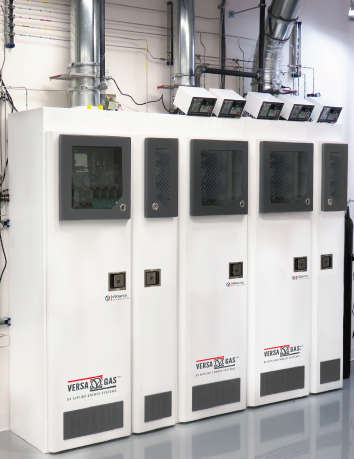
Not an endorsement of any brand, make, model, and NOT a picture from my client
These cabinets are used to provide sort of a secondary containment (i.e. control for escaping gas in the event of a leaking cylinder of the hazardous material).
Under the IFC, TABLE 5003.1.1(2), Chlorine is in the “toxic gas” category which means we can have 150 pounds of this gas in our “closed process” in our “control area” and another 150 pounds in “storage” in our control area. When we store the cylinders in a “gas cabinet” (see footnote e) the code allows us to double their amounts so we could have 300 pounds in storage and 300 pounds in the process.
NOTE: a 150-pound cylinder of Cl2 is around 810 Cubic Feet of Cl2 gas.
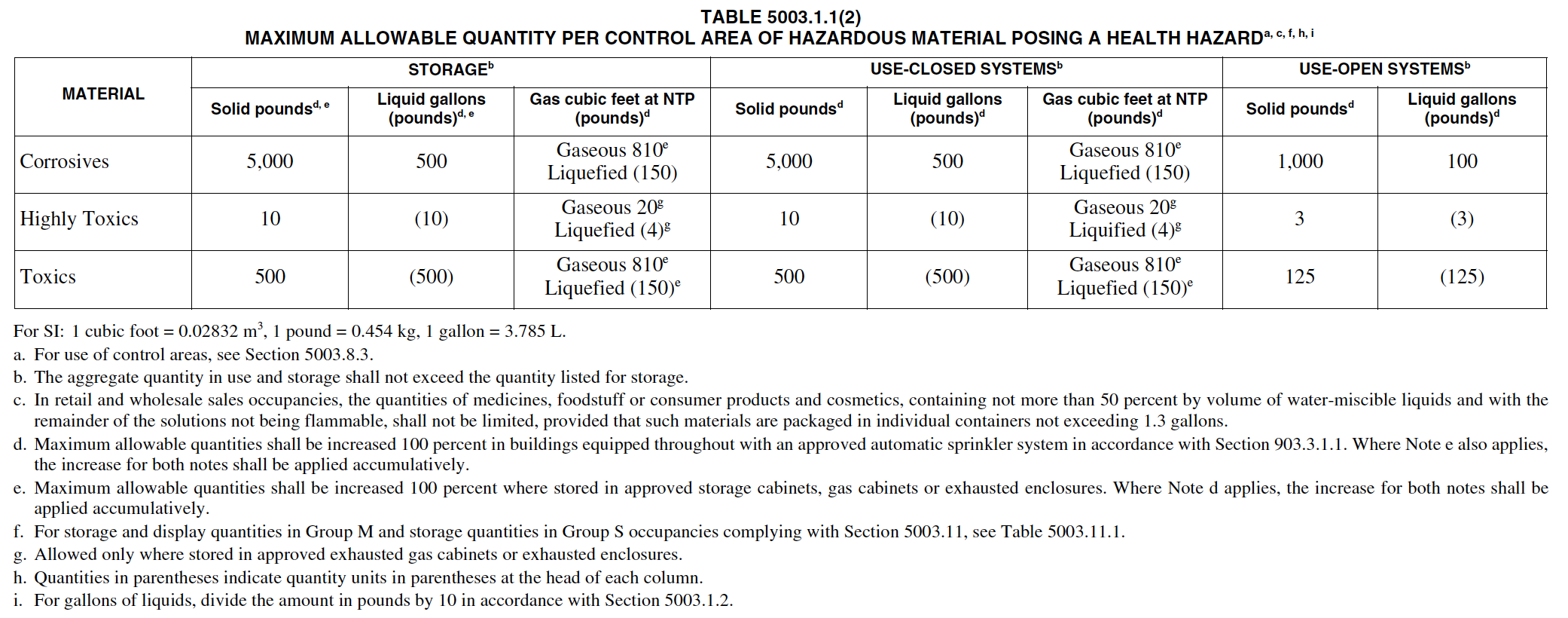
This physical state that chlorine is in matters in a BIG way, as chlorine has an expansion ratio of 1:450 which means 1 cubic ft of liquid chlorine will make 450 cubic ft of gas; a gas that has an IDLH of 10 ppm!. Without the gas cabinets, the table allows 300 pounds of Chlorine gas to be stored in the area and 300 pounds in the process before having to increase the design of the area. With gas cabinets, that is six (2) 150-pound cylinders in storage within a gas cabinet and 2 cylinders in process within a gas cabinet!!!
The IFC first talks about using gas cabinets to increase the Maximum Allowable Quantities (MAQ) in Section 5003 which applies to ALL hazardous materials; we will discuss the specific requirements for “toxic materials” and “highly toxic materials” later on.
5003.8.6 Gas cabinets. Where a gas cabinet is used to increase the maximum allowable quantity per control area or where the location of compressed gases in gas cabinets is provided to comply with the provisions of Chapter 60, the gas cabinet shall be in accordance with Sections 5003.8.6.1 through 5003.8.6.3.
5003.8.6.1 Construction.
Gas cabinets shall be constructed with the following:
1. Not less than 0.097-inch (2.5 mm) (No. 12 gage) steel.
2. Self-closing limited-access ports or noncombustible windows to give access to equipment controls.
3. Self-closing doors.
4. Interiors treated, coated or constructed of materials that are compatible with the hazardous materials stored. Such treatment, coating or construction shall include the entire interior of the cabinet.
5003.8.6.2 Ventilation.
Gas cabinets shall be provided with an EXHAUST VENTILATION SYSTEM. The ventilation system for gas cabinets shall be designed to operate at a NEGATIVE PRESSURE in relation to the surrounding area. Ventilation systems used for highly toxic and toxic gases shall also comply with Items 1, 2, and 3 of Section 6004.1.2. The ventilation system shall be installed in accordance with the International Mechanical Code.
The gas cabinet exhaust ventilation system MUST be designed to operate at a NEGATIVE PRESSURE to the area in which it is located in order to maintain a safe
the atmosphere in the area in the event of a leak.
5003.8.6.3 Maximum number of cylinders per gas cabinet.
The number of cylinders contained in a single gas cabinet SHALL NOT EXCEED THREE (3).
Now we are ready to discuss Chapter 60 Highly Toxic and Toxic Materials. The 2018 IFC puts chlorine in the “toxic” category – I put chlorine in the “highly toxic” category. It’s just how I was raised/taught to be a safety engineer in the chemical industry. We managed Ammonia as a “toxic” and chlorine as a “highly toxic” primarily due to their differing IDLH. And I should state this now, IDLH is NOT how the IFC/IMC/IBC defines toxic vs. highly toxic – they use LD50. Heck the IFC puts Phosgene in the “toxic” category and in two of my plants where we used phosgene we designed the process as “lethal service” under ASME RAGAGEPs. Phosgene has an IDLH of 2 ppm.
HIGHLY TOXIC. A material which produces a lethal dose or lethal concentration which falls within any of the following categories:
1. A chemical that has a median lethal dose (LD50) of 50 milligrams or less per kilogram of body weight when administered orally to albino rats weighing between 200 and 300 grams each.
2. A chemical that has a median lethal dose (LD50) of 200 milligrams or less per kilogram of body weight when administered by continuous contact for 24 hours (or less if death occurs within 24 hours) with the bare skin of albino rabbits weighing between 2 and 3 kilograms each.
3. A chemical that has a median lethal concentration (LC50) in air of 200 parts per million by volume or less of gas or vapor, or 2 milligrams per liter or less of mist, fume or dust, when administered by continuous inhalation for one hour (or less if death occurs within 1 hour) to albino rats weighing between 200 and 300 grams each.
TOXIC. A chemical falling within any of the following categories:
1. A chemical that has a median lethal dose (LD50) of more than 50 milligrams per kilogram, but not more than 500 milligrams per kilogram of body weight when administered orally to albino rats weighing between 200 and 300 grams each.
2. A chemical that has a median lethal dose (LD50) of more than 200 milligrams per kilogram but not more than 1,000 milligrams per kilogram of body weight
when administered by continuous contact for 24 hours (or less if death occurs within 24 hours) with the bare skin of albino rabbits weighing between 2 and 3 kilograms each.
3. A chemical that has a median lethal concentration (LC50) in air of more than 200 parts per million but not more than 2,000 parts per million by volume of gas or vapor, or more than 2 milligrams per liter but not more than 20 milligrams per liter of mist, fume or dust, when administered by continuous inhalation for 1 hour (or less if death occurs within 1 hour) to albino rats weighing between 200 and 300 grams each.
So we have our minimum of “toxic” or we can increase our design basis and put chlorine in the “very toxic” category. When you compare the two category requirements, you can make a sound business decision of the increased safety is worth the increased costs; but as a baseline, we will use the “toxic” requirements at the minimum.
The first thing Chapter 60 limits is the “occupancy” in which we can have cylinders of toxic and highly toxic gases. And of course, we are PROHIBITED from having these cylinders in the following occupancy groups:
A – Places of assembly
E – Educational
I – Institutional
U – Miscellaneous Group
R – Residental
In classrooms of Group B occupancies, cylinders with a capacity not exceeding 20 cubic feet (0.566 m3) at NTP are allowed in gas cabinets or fume hoods.
Our chemical facilities will fall under Groups F and/or H so we are permitted to have chlorine cylinders – I just want to make sure my readers who practice safety in schools realize they are DIFFERENT and PROHIBITED from having chlorine, except in small quantities and kept in a gas cabinet or fume hood DESIGNED for chlorine gas.
The code states the following for our chlorine gas cabinets:
SECTION 6004 HIGHLY TOXIC AND TOXIC COMPRESSED GASES
6004.1.2 Gas cabinets. Gas cabinets containing highly toxic or toxic compressed gases shall comply with Section 5003.8.6 and the following requirements:
1. The AVERAGE VENTILATION VELOCITY at the face of gas cabinet access ports or windows shall be NOT LESS THAN 200 FEET PER MINUTE (1.02 m/s) with not less than 150 feet per minute (0.76 m/s) AT ANY POINT OF THE ACCESS PORT OR WINDOW.
2. Gas cabinets shall be CONNECTED TO AN EXHAUST SYSTEM.
3. Gas cabinets shall NOT be used as the SOLE MEANS of exhaust for any room or area.
4. The MAXIMUM number of cylinders located in a single gas cabinet SHALL NOT EXCEED THREE, except that cabinets containing cylinders not exceeding 1 pound (0.454 kg) net contents are allowed to contain up to 100 cylinders.
5. Gas cabinets required by Section 6004.2 or 6004.3 shall be equipped with an approved automatic sprinkler system in accordance with Section 903.3.1.1. Alternative fire-extinguishing systems shall NOT be used.
Section 6004.1.2 sets additional requirements for gas cabinets used specifically for HIGHLY TOXIC AND TOXIC GASES.
Section 5003.8.6 (as discussed above) contains the general requirements for all gas cabinets. More specifically, Section 5003.8.6 sets out:
- construction specifications,
- requires negative pressure for ventilation and
- restricts the number of cylinders to three.
Section 6004.1.2 is more restrictive, requiring:
- an air velocity of at least 200 feet per minute at the face of the cabinet
- a connection to an exhaust system
- an area ventilation system IN ADDITION TO THE VENTILATION SYSTEM in the gas cabinet
- a sprinkler system
Section 6004.2.2.7 would require the exhaust to be connected to a treatment system.
INDOOR STORAGE AND USE
6004.2 Indoor storage and use.
The indoor storage and use of highly toxic or toxic compressed gases shall be in accordance with Sections 6004.2.1 through 6004.2.2.10.3.
This section is SPECIFIC TO THE INDOOR STORAGE AND USE of toxic and highly toxic gases. When Section 6004.2 applies, it focuses on the location of cylinders and the REMOVAL OF UNWANTED RELEASES. Treatment systems are required to process any gases collected when ventilating results in the release of toxic and
highly toxic gases.
6004.2.1 Applicability.
The applicability of regulations governing the indoor storage and use of highly toxic and toxic compressed gases shall be as set forth in Sections 6004.2.1.1 through 6004.2.1.3.
6004.2.1.1 Quantities NOT exceeding the maximum allowable quantity per control area.
The INDOOR STORAGE OR USE of highly toxic and toxic gases in amounts not exceeding the maximum allowable quantity per control area set forth in Table 5003.1.1(2) shall be in accordance with Sections 5001, 5003, 6001 and 6004.1.
When the MAQs have NOT been exceeded, only the more general requirements apply, such as restrictions on the storage and use in certain occupancies, piping connection requirements based on the level of health hazards, etc. Tables 5003.1.1(2) and 5003.1.1(4) would require putting highly toxic gases in a gas cabinet or exhausted enclosure regardless of the amount of gas stored or used. These gas cabinets and exhausted enclosures need to be in accordance with ONLY the basic requirements of Chapter 50 and do NOT need to be connected to a treatment system.
6004.2.1.2 Quantities exceeding the maximum allowable quantity per control area.
The INDOOR STORAGE OR USE of highly toxic and toxic gases in amounts EXCEEDING the maximum allowable quantity per control area set forth in Table 5003.1.1(2) shall be in accordance with Sections 6001, 6004.1, 6004.2, and Chapter 50.
If the MAQs has been exceeded, the requirements become much more extensive. This requires compliance with all applicable sections of Chapter 50 and also Section 6004.2, which has requirements for treatment systems and gas detection systems.
6004.2.2 General indoor requirements.
The general requirements applicable to the INDOOR STORAGE AND USE of highly toxic and toxic compressed gases shall be in accordance with Sections 6004.2.2.1 through 6004.2.2.10.3.
6004.2.2.1 Cylinder and tank location.
Cylinders shall be located within gas cabinets, exhausted enclosures, or gas rooms.
Portable and stationary tanks shall be located within gas rooms or exhausted enclosures.
Toxic and highly toxic gases pose a high threat to occupants and emergency responders if released to the atmosphere; therefore, this section places restrictions on where cylinders can be located. More specifically, cylinders must be in a gas cabinet or within gas rooms or exhausted enclosures; in my project, I used gas cabinets. Gas cabinets, exhausted enclosures, and gas rooms have specific requirements in Sections 6004.1.2, 6004.1.3 and 6004.2.2.6, respectively, in addition to the general requirements in Chapter 50.
6004.2.2.2 Ventilated areas.
The room or AREA in which gas cabinets or exhausted enclosures are located shall be provided with exhaust ventilation.
Gas cabinets or exhausted enclosures shall NOT be used as the sole means of exhaust for any room or area.
This section requires that gas cabinets and exhausted enclosures NOT be the only ventilation provided when toxic or highly toxic gases are stored or used. The room or AREA MUST HAVE ITS OWN VENTILATION SYSTEM. However, the ventilation for the room/area does not need to be hooked up to the treatment system; although I highly suggest we do this.
LEAKING CYLINDERS AND TANKS
6004.2.2.3 Leaking cylinders and tanks.
ONE OR MORE gas cabinets or exhausted enclosures shall be provided to handle leaking cylinders, containers, or tanks.
Exceptions:
1. Where cylinders, containers, or tanks are located within gas cabinets or exhausted enclosures.
2. Where APPROVED containment vessels or containment systems are provided in accordance with ALL of the following:
2.1. Containment vessels or containment systems shall be capable of fully containing or terminating a release.
2.2. Trained personnel shall be available at an approved location.
2.3. Containment vessels or containment systems shall be capable of being transported to the leaking cylinder, container or tank.
Section 6004.2.2.1 requires the use of gas cabinets, exhausted enclosures, or gas rooms for the STORAGE of cylinders and tanks.
Section 6004.2.2.3 takes the requirements one step further and requires that one or more ADDITIONAL gas cabinets or exhausted enclosures be provided AND READY TO RECEIVE LEAKING CYLINDERS or tanks.
Exception #1 is for cylinders and tanks that are already contained within gas cabinets or exhausted enclosures.
Exception #2 allows the use of containment vessels and containment systems in place of a gas cabinet or exhausted enclosure to address leaking cylinders based on three (3) conditions:
- the vessel or system must be sufficiently sized to contain the potential release;
- a trained person must be available; and
- the containment vessel or system must be transportable to the leaking cylinder or tank
6004.2.2.3.1 Location.
Gas cabinets and exhausted enclosures [for leaking cylinders] shall be located in gas rooms AND connected to an exhaust system.
NOTE that 6004.2.2.3.1 applies to the ADDITIONAL gas cabinets for leaking cylinders.
When gas cabinets and exhausted enclosures are used with leaking TANKS, they MUST be contained in gas rooms.
Containment vessels and systems would NOT have to be located in a gas room.
GAS ROOMS
6004.2.2.6 Gas rooms.
Gas rooms shall comply with Section 5003.8.4 and BOTH of the following requirements:
1. The exhaust ventilation from gas rooms shall be directed to an exhaust system.
2. Gas rooms shall be equipped with an approved automatic sprinkler system. Alternative fire-extinguishing systems shall NOT be used.
NOTE: the IMC defines an “exhaust system” as:
EXHAUST SYSTEM. An assembly of connected ducts, plenums, fittings, registers, grilles and hoods through which air s conducted from the space or spaces and exhausted to the outdoor atmosphere.
A gas room is a separately ventilated, fully enclosed room in which only compressed gases and associated equipment and supplies are stored or used. Gas rooms are used exclusively for the storage or use of hazardous gases in excess of the maximum allowable quantities. Gas rooms are commonly used as alternative storage areas for HPM gases in Group H-5 facilities.
A gas room is a site-built room that meets the construction requirements of the International Building Code. This room will require separation based on the number of gases stored in the room. The requirements in Chapter 50 address construction and basic ventilation. General gas room requirements are found in Section 5003.8.4. More specifically, Section 5003.8.4 REQUIRES an automatic sprinkler system, separation as required in the International Building Code, and maintaining negative pressure in the room. This section takes the requirements one step further and REQUIRES THAT EXHAUST VENTILATION BE DIRECTED TO AN EXHAUST SYSTEM. The second criterion is a restriction that does not allow any alternative fire-extinguishing systems in place of an automatic sprinkler system.
TREATMENT SYSTEMS
6004.2.2.7 Treatment systems.
The exhaust ventilation FROM GAS CABINETS, exhausted enclosures, and gas rooms, and local exhaust systems required in Sections 6004.2.2.4 and 6004.2.2.5 shall be directed to a TREATMENT SYSTEM.
The treatment system shall be utilized to handle the accidental release of gas and to process exhaust ventilation.
The treatment system shall be designed in accordance with Sections 6004.2.2.7.1 through 6004.2.2.7.5 and Section 510 of the International Mechanical Code.
Exceptions:
1. Highly toxic and toxic gases—STORAGE [ONLY].
A treatment system is NOT required for cylinders, containers, and tanks IN STORAGE WHERE ALL OF THE FOLLOWING CONTROLS ARE PROVIDED:
1.1. Valve outlets are equipped with gas-tight outlet plugs or caps.
1.2. Handwheel-operated valves have handles secured to prevent movement.
1.3. Approved containment vessels or containment systems are provided in accordance with Section 6004.2.2.3.
2. Toxic gases—USE.
Treatment systems are NOT required for “toxic gases” supplied by cylinders or portable tanks NOT EXCEEDING 1,700 pounds (772 kg) water capacity WHERE a GAS DETECTION SYSTEM complying with Section 6004.2.2.10 AND listed or approved AUTOMATIC-CLOSING FAIL-SAFE VALVES are provided.
The gas detection system shall have a sensing interval not exceeding 5 minutes.
Automatic-closing fail-safe valves shall be located IMMEDIATELY ADJACENT TO CYLINDER VALVES and shall close when gas is detected at the permissible exposure limit (PEL) by a gas sensor monitoring the exhaust system at the point of discharge from the gas cabinet, exhausted enclosure, ventilated enclosure, or gas room.
Treatment systems are required for ALL EXHAUST VENTILATION AND ACCIDENTAL RELEASES of HIGHLY TOXIC gases AND toxic gases with exceptions.
A treatment system essentially destroys the fumes/gases through methods such as diluting, absorbing, burning, and other various destruction methods, which are discussed in Section 6004.2.2.7.1. Generally, Section 6004.2.2.7 and related subsections contain the design criteria for such systems. There are two (2) overall exceptions where treatment systems would NOT be required. They are broken into:
#1 for the STORAGE of BOTH highly toxic and toxic gases
Exception 1 deals with cylinders, containers, and tanks of BOTH highly toxic and toxic gases in STORAGE ONLY.
A treatment system is NOT required if ALL THREE (3) CRITERIA (1.1 – 1.3) in the exception ARE MET.
#2 for USE of ONLY TOXIC gases
Exception 2 is for TOXIC gases ONLY supplied by cylinders limited to a size of 1,700 pounds (772 kg) water capacity. The 1,700-pound (772 kg) limit was derived as follows:
A ton container typically holds about 1,600 pounds (726 kg) of water, and a filling density of approximately 125 percent of the water capacity is
allowed for chlorine [1,600 x 1.25 = 2,000 pounds (908 kg)]. The resulting weight of the product in a filled container is one ton of chlorine. The maximum capacity of 1,700 pounds versus 1,600 pounds (772 kg versus 726 kg) is intended to accommodate manufacturing variations that occur from one container to the next, but this does not affect the ultimate gas capacity of a filled container, which is limited to 2,000 pounds (908 kg) regardless of the variation in water capacity. To avoid the use of a treatment system, a GAS DETECTION SYSTEM MUST ALSO BE ACCOMPANIED BY A FAIL-SAFE VALVE ADJACENT TO THE CYLINDER VALVE. The FAILSAFE VALVE MUST OPERATE WHEN GAS IS DETECTED AT THE POINT OF DISCHARGE OF THE LOCATION OF THE CYLINDER.
6004.2.2.7.1 Design.
Treatment systems shall be capable of diluting, adsorbing, absorbing, containing, neutralizing, burning or otherwise processing the contents of the LARGEST SINGLE VESSEL of compressed gas.
Where a total containment system is used, the system shall be designed to handle the maximum anticipated pressure of release to the system when it reaches equilibrium.
This section states that a treatment system must process the exhaust ventilation or an accidental release. Various methods are listed but the section is written to allow exploration of other methods. Additionally, this section sets important capacity criteria for the treatment system, which would require it to either be capable of processing the largest vessel or handle the maximum pressure of release at equilibrium when a total containment system is used.
6004.2.2.7.2 Performance.
Treatment systems shall be designed to reduce the maximum allowable discharge concentrations of the gas to one-half IMMEDIATE BY DANGEROUS TO LIFE AND HEALTH (IDLH) at the point of discharge to the atmosphere.
Where more than one gas is emitted to the treatment system, the treatment system shall be designed to handle the worst-case release based on the release rate, the quantity, and the IDLH for all compressed gases stored or used.
Once treated, the output from the treatment system must not exceed one-half of the immediately dangerous to life and health (IDLH) concentration. If the treatment system is used for a variety of different stored gases that have various levels of toxicity, the treatment system MUST BE ABLE TO ACCOMMODATE THE WORST-CASE SITUATION. As an example, the least-toxic gas may have the largest release potential, but the treatment system does not have to work as hard to reduce the IDLH; therefore, both the level of hazard and the amount of the gas must be addressed.
6004.2.2.7.3 Sizing.
Treatment systems shall be sized to process the maximum worst-case release of gas based on the maximum flow rate of release from the largest vessel utilized.
The ENTIRE CONTENTS of the largest compressed gas vessel shall be considered.
This section re-emphasizes that the treatment system MUST be capable of treating the LARGEST SINGLE VESSEL. In addition, this section requires that the maximum flow rates be considered; therefore, IT IS NOT SIMPLY THE CAPACITY OF THE LARGEST SINGLE VESSEL BUT ALSO HOW FAST THAT GAS IS RELEASED. Treatment systems need to account for only a single failure of a vessel but at the highest flow rate.
EMERGENCY POWER
6004.2.2.8 Emergency power.
Emergency power shall be provided for the following systems in accordance with Section 604:
1. Exhaust ventilation system.
2. Treatment system.
3. Gas detection system.
4. Smoke detection system.
5. Temperature control system.
6. Fire alarm system.
7. Emergency alarm system.
Because of the immediate health hazard posed by the release of toxic or highly toxic gases, emergency power that activates within 10 seconds is REQUIRED.
6004.2.2.8.1 Fail-safe engineered systems.
Emergency power shall not be required for mechanical exhaust ventilation, treatment systems, and temperature control systems WHERE APPROVED FAIL-SAFE ENGINEERED SYSTEMS ARE INSTALLED.
This allows the use of an engineered system designed to fail in the appropriate design mode WITHOUT HUMAN INTERVENTION in place of an emergency power system. The exception is intended to permit alternative systems that are not subject to power interruptions.
AUTOMATIC FIRE DETECTION SYSTEM
6004.2.2.9 Automatic fire detection system—HIGHLY TOXIC compressed gases.
An approved automatic fire detection system shall be installed in rooms or areas where highly toxic compressed gases are stored or used. Activation of the detection system shall sound a local alarm. The fire detection system shall comply with Section 907.
This section requires a fire detection system in rooms or areas where HIGHLY TOXIC GASES ARE STORED OR USED. I should make clear this is one of the major differences between Toxic and Highly Toxic design requirements! The intent is that a fire in the area could lead to the release of the highly toxic gases (or toxic gases). Fires can heat stored gases and cause expansion, leading to overpressures and releases; therefore, warning of a fire is critical to avoiding such releases. The alarm system needs to provide a local alarm at the building, but the detection is required only in the room or area where the HIGHLY TOXIC GAS is stored.
GAS DETECTION SYSTEM
6004.2.2.10 Gas detection system.
A gas detection system complying with Section 916 shall be provided to detect the presence of gas AT OR BELOW THE PEL OR CEILING LIMIT OF THE GAS for which detection is provided.
The system shall be capable of monitoring the discharge from the treatment system at or below one-half the IDLH limit AND shall initiate a response in accordance with Sections 6004.2.2.10.1 through 6004.2.2.10.3 if the gas detection alarm is activated.
Exception: A gas detection system is not required for TOXIC GASES when the physiological warning threshold level for the gas is at a LEVEL BELOW the accepted PEL for the gas.
This section requires a system in accordance with the gas detection requirements of Section 916 to detect the presence of gas in a large enough concentration to
EXCEED THE PERMISSIBLE EXPOSURE LIMIT (PEL).
The system must also be designed to be capable of detecting whether 1/2 of the IDLH concentration has been exceeded at the discharge from the treatment system.
This is to ensure that the treatment system is working to capacity or to indicate that there may be other problems, such as a release larger than the treatment system has been designed to handle. There is an exception to the requirement of a gas detection system where the odor of the gas or its physical effects are noticeable far before the PEL is reached. Those indicators should be sufficient to notify people to leave the area.
6004.2.2.10.1 Alarms.
The gas detection system shall initiate a local alarm and transmit a signal to a CONSTANTLY ATTENDED CONTROL STATION when a short-term hazard condition is detected.
The alarm shall be BOTH AUDIBLE AND VISIBLE and shall provide warning BOTH INSIDE AND OUTSIDE THE AREA where gas is detected. The audible alarm shall be DISTINCT from all other alarms.
Exception: Signal transmission to a constantly attended control station is not required where ONLY one (1) cylinder of highly toxic or toxic gas is stored.
Once the gas is detected at the levels noted in Section 6004.2.2.10, a local alarm must be initiated and a signal at a constantly attended control station (such as a security room or fire command center) must be transmitted. The alarm is intended to alert those both inside the particular area of detection and in the immediate vicinity. This is to prevent any gases that escape from causing harm to those outside the area of release. The notification to the control station provides information to those who must take a role in emergency response, whereas the local alarm is a warning for those in the vicinity of the release. A signal need not be sent to the control station if the amount of gas stored or used is a maximum of one cylinder. In that case, a local alarm is sufficient to notify people of the immediate hazard.
6004.2.2.10.2 Shut off of gas supply.
The gas-detection system shall AUTOMATICALLY close the shutoff valve at the source on gas supply piping and tubing related to the system being monitored for whichever gas is detected.
Exception: Automatic shutdown is not required for reactors utilized for the production of highly toxic or toxic compressed gases where such reactors are:
1. Operated at pressures less than 15 pounds per square inch gauge (psig) (103.4 kPa).
2. Constantly attended.
3. Provided with emergency shutoff valves that have ready access.
The exception applies ONLY to equipment used to make toxic or highly toxic gases AND ONLY when ALL THREE (3) of the stated conditions are met.
This exception recognizes that pressure is a critical element in how much and how fast a gas is released. A low operating pressure normally means a smaller, more easily controlled release. Having an operator monitoring the equipment at all times is considered an adequate safeguard when shutoff valves are easy to reach in case of an emergency.
Under these circumstances, notification by an alarm system and a signal to a constantly attended control station is sufficient to deal with the particular hazard. Automatic shutoff would probably be overly restrictive.
6004.2.2.10.3 Valve closure.
Automatic closure of shutoff valves shall be in accordance with the following:
1. Where the gas-detection sampling point initiating the gas detection system alarm is within a gas cabinet or exhausted enclosure, the shutoff valve in the gas cabinet or exhausted enclosure for the specific gas detected shall automatically close.
2. Where the gas-detection sampling point initiating the gas detection system alarm is within a gas room and compressed gas containers are not in gas cabinets or exhausted enclosures, the shutoff valves on all gas lines for the specific gas detected shall automatically close.
3. Where the gas-detection sampling point initiating the gas detection system alarm is within a piping distribution manifold enclosure, the shutoff valve for the compressed container of specific gas detected supplying the manifold shall automatically close.
Exception: Where the gas-detection sampling point initiating the gas detection system alarm is at a use location or within a gas valve enclosure of a branch line downstream of a piping distribution manifold, the shutoff valve in the gas valve enclosure for the branch line located in the piping distribution manifold enclosure shall automatically close.
This section describes three (3) situations in which gas lines need to AUTOMATICALLY CLOSE when gas is detected.
#1 – If the gas is detected within a gas cabinet or exhausted enclosure, only the gas line related to the gas cylinder or container within the cabinet or enclosure must be shut down.
#2 – If the gas is detected within a gas room, all gas lines containing that particular gas must be shut down because it is difficult to determine where the leak originates when the storage and use are in a larger area.
#3 – this criterion is related to situations where the gas sampling occurs within a piping manifold enclosure. Gas sampling in such locations is much more localized and the code requires shutting down only the cylinder supplying the manifold.
The exception is for situations where the gas is clearly being released downstream from the piping distribution manifold enclosure. The problem is with the piping or perhaps at a point of use and can be isolated by simply shutting off that particular branch line from the piping distribution manifold enclosure. This would be allowed only if the gas detection system was sampling at the location of use or within a gas valve enclosure downstream from the distribution piping. Otherwise, it would be difficult to determine where the leak originated and the supply at the cylinder or tank would have to be shut down.
There you have it – a chlorine cylinder process with all the safety-engineered into it via the IFC, IMC, and the IBC. I did not cover the OUTDOORS Storage and Use requirements (Section 6004.3) as my project had all equipment inside.