
In the PSM/RMP world, where Hot Work (HW) permits and all of 1910.252(a) are requirements, we tend to find HW programs, permits, and practices not meeting this critical requirement for SAFE HW. This is caused by a wide array of errors, from the written program/permit omitting this requirement, training not covering this requirement, and/or personnel who issue the HW permits not being involved/informed of sprinkler system impairments. But none the less, if the area where the HW is going to be performed is sprinkled, then that sprinkler MUST BE IN SERVICE. But our friends and property conservation colleagues over at FM Global have established excellent criteria of how we should view HW and Sprinklers…
So here is what Federal OSHA says about HW and Sprinklers…
1910.252(a)(2)(vi) Prohibited areas. Cutting or welding shall not be permitted in the following situations:
1910.252(a)(2)(vi)(A) In areas not authorized by management.
1910.252(a)(2)(vi)(B) In buildings with sprinklers while such protection is impaired.
I will listen to the discussion when someone likes to point out that OSHA’s requirement states “sprinkled buildings” and therefore a “sprinkled process area” may not apply. I saw that is a load of ______, but its hard to argue with black and white language! If the sprinkler is there for “fire protection,” it matters not where the location is – when the sprinkler is impaired we have lost a primary layer of protection!
This is why I like to refer clients to FM Global’s HW Data Sheet (FREE to everyone now!). FM Global is the WORLD LEADER (my opinion) when it comes to HW safety practices; so for those looking to shore up your HW program, methods, and permit their HW Data Sheet is a MUST READ. Specifically, I love their language…
(emphasis by me)
2.5.2.1 Protect the Hot Work Area
2.5.2.1.1 Verify automatic fire protection systems (e.g., sprinkler systems) are in service if provided.
2.5.2.1.2 Verify onsite water supplies serving fire protection systems are in service (e.g., pumps in automatic mode and suction tanks full), if provided.
2.5.2.1.3 Verify there are no active or planned fire protection system impairments near the hot work area scheduled to occur during work, or during the post-work fire watch and monitoring periods. If protection is impaired or not provided and hot work that requires a permit is unavoidable, do the following:
A. Delay the work until protection is restored.
B. Treat the unprotected area as a hot work high-risk area and provide additional required precautions, which may include extra measures to ensure combustibles have been identified and removed or isolated; laying charged firefighting hoses and stationing trained firefighting personnel in the hot work area; increasing post-work watch and monitoring periods from Section 2.5.4; and/or requiring permit authorization by senior management.
2.5.2.1.4 Provide manual firefighting equipment, including supplemental fire extinguishers (i.e., in addition to those extinguishers required per local codes) and/or, when necessary, firefighting hose laid out and connected to a closed hose valve. Ensure fire extinguishers are rated and sized appropriately for the hazard. Inspect the equipment prior to initiating the work. Inspect, test, and maintain fire extinguishers per Data Sheet 2-81, Fire Protection System Inspection, Testing, and Maintenance.
Did you catch that… we need to even keep the sprinkler in service during the POST-WORK fire watch and monitoring periods (usually 4-hrs).
Just as an FYI, FM Global has updated their HW Data Sheet (4/2018) to know that require:
2.5.4.3 Provide post-work fire watch and fire monitoring periods as follows:
A. Provide a one hr post-work fire watch and a three hr fire monitoring period.
B. If combustible construction with unprotected concealed cavities are present or torch applied roofing is being conducted, use Table 1 to determine post-work fire watch and monitoring periods.
C. If favorable factors are present, use Table 1 to determine reduced post-work fire watch and monitoring periods. Clients of FM Global should not modify post-work fire watch and monitoring periods from Table 1 without first discussing the modifications with their FM Global field engineer or client service team.
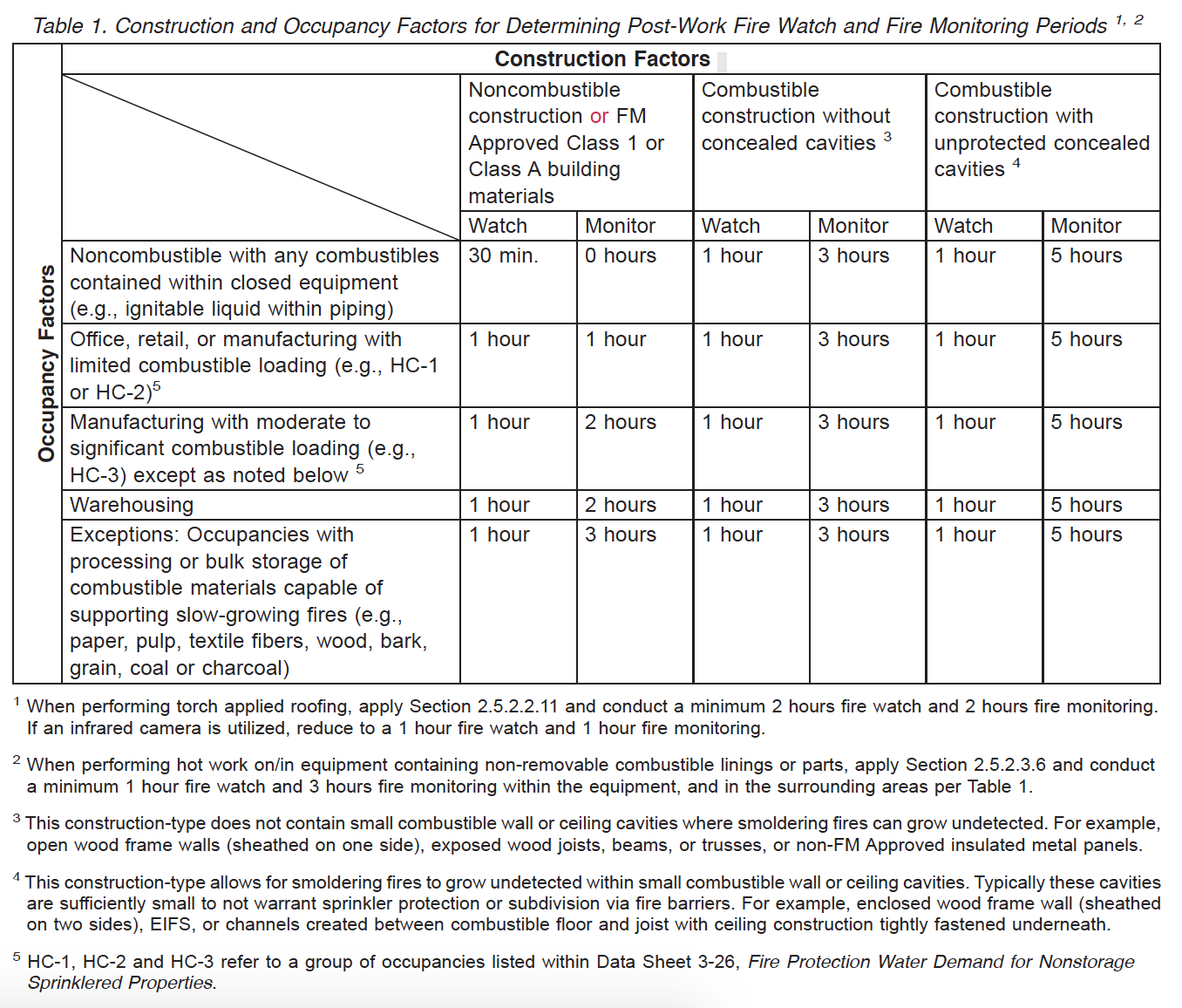
Source: https://www.fmglobal.com/research-and-resources/fm-global-data-sheets