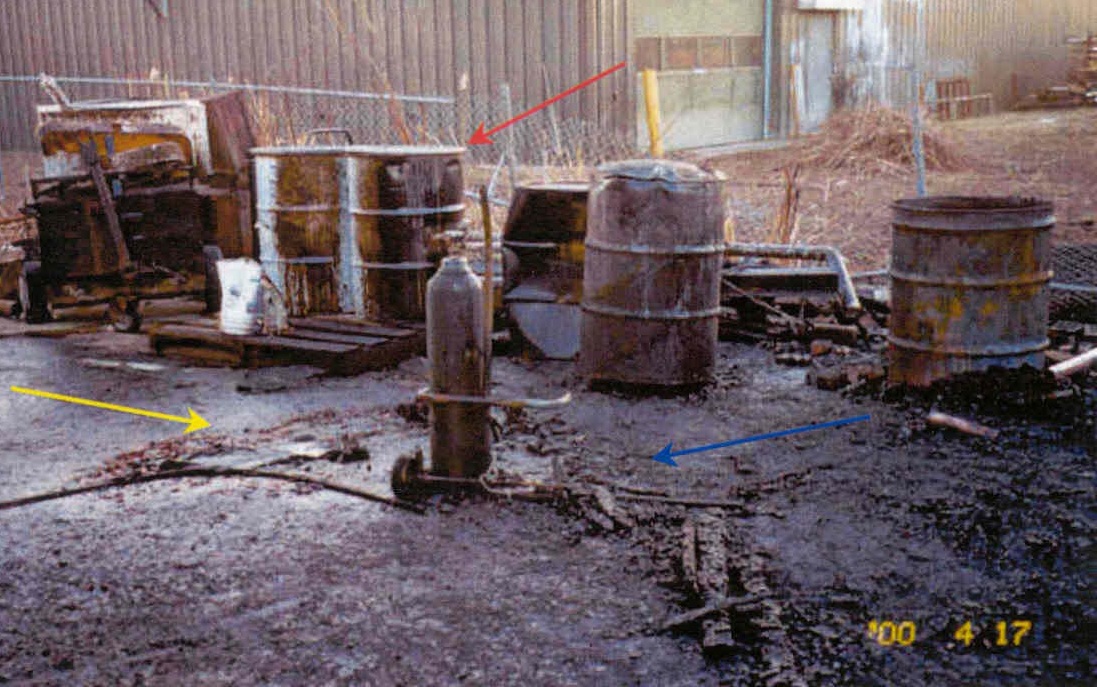
On April 17, 2000 at approximately 7:00 a.m., the worker started his shift at the work site. The total number of workers on shift the day of the incident was 16 and the worker’s crew comprised of 6 workers. The worker was employed as a general labourer. He performed various work activities on a GYP Crete crew, with his main function being the operator of the Crete Pump, during the building, restoring, finishing and application of protective finishes on various masonry and concrete structures. In the course of his duties he periodically conducted various small maintenance and fabrication jobs.
The worker began his workday engaged in work activities involved in a GYP Crete pour in the downtown area. The worker left the field work site, after the GYP Crete pour was completed, at approximately 11:30 a.m. and returned to the employer’s main shop. Only office staff was present at the work site when the worker arrived. At approximately 12:30 p.m. the worker began cleaning the GYP Crete pump and loading the employer’s five-ton trucks with materials and equipment in preparation for the next day’s GYP Crete pours.
At approximately 2:30 p.m. the worker’s supervisor arrived at the main shop. The worker, while still engaged in loading materials and equipment, asked the supervisor for direction on additional work duties. The supervisor indicated that a second gate for the GYP Crete pump needed to be fabricated and the worker could perform those activities. It was indicated that damage appeared on the GYP Crete Pump’s gate from extended use. When damages become apparent the gate can no longer maintain a seal and must be replaced.
The work activity of replacing the manufacturer’s GYP Crete Pump gate was the first time this work had been done by either the employer and worker (work activities included: removing the original gate and fabricating and reinstalling another gate). At approximately 2:45 p.m. the supervisor left the main shop to evaluate the fieldwork downtown. At approximately 4:40 p.m. the worker travelled across the street in one of the employer’s pick-up trucks to acquire a piece of scrap metal to be used in the fabrication of the second gate. The worker conducted the transaction, obtained a scrap piece of plain carbon steel plate, and returned to the main shop.
Due to the heavy nature of the steel plate, the employee backed the truck up, with the steel plate loaded in the box of the truck, to the far north corner of the main shop. He then placed the steel plate on top of a 205 l drum, one third full, of Asphalt Primer. The worker then parked the pick up truck in a designated stall and returned to the work activities on the GYP Crete pump. At approximately 5:05 p.m., the worker called the supervisor on his cellular phone. The worker indicated to the supervisor that he was experiencing troubles removing the first gate from the GYP Crete pump. The gate and attachments were saturated and coated with excess GYP Crete material. This condition contributed to the difficulties the worker was experiencing during the gate removal.
The supervisor indicated to the worker to discontinue his current work activities and wait until he arrived back at the main shop. At the time of the incident, the supervisor was in the process of travelling back to the main shop and was approximately ten minutes away. The worker proceeded to take a portable oxygen/acetylene cutting torch system to the rear, north corner, of the building where the steel plate was located. The worker then measured a 266.7 mm by 127.0 mm section, the dimensions of the GYP Crete pump gate, on the steel plate. The worker ignited the oxygen/acetylene torch with a flint striker and commenced to cut the 266.7 mm portion of the steel plate.
From the evidence, the worker was cutting the steel plate into two sections. The worker was cutting along a measured line from one end of the plate to the other. The steel plate was still located atop the 205 l drum of Asphalt Primer when the cutting activity commenced. The worker had completed a cut of approximately 432 mm into the steel plate when the cutting torch’s flame intersected and punctured a hole in the drum. (See Attachment “A”, Photograph 6)
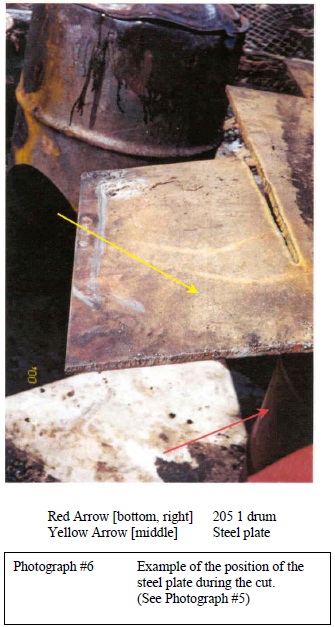
The worker’s cut into the steel plate began to arc and cut into the barrel. The introduction of an ignition source caused the vapours inside the drum to ignite. The vapours expanded causing the drum to rupture. rupture resulted in simultaneous events occurring: splitting the bottom section of the drum from the main body; throwing the main body of the drum through the air; throwing the steel plate; expelling the liquid contents of the drum, the Asphalt Primer, on the worker, materials and equipment surrounding the area; and knocking the worker to the ground. The liquid contents readily ignited and contributed to and accelerated the ensuing fire.
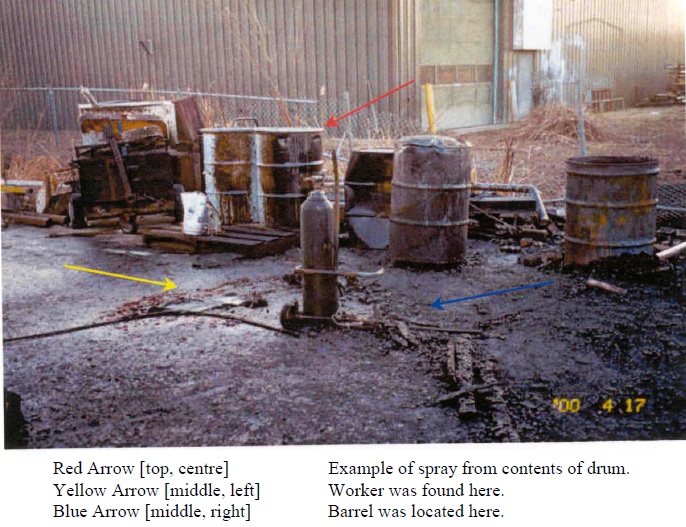
At approximately 5:08 p.m., The Emergency Response Department was called to he scene. At approximately 5:16 p.m., The Emergency Response Department arrived on scene and commenced to control the fire and found the worker. Shortly thereafter the Edmonton Police Service and ambulance arrived on the scene. Once the Emergency Response Department safely contained the fire, the worker was attended to, pronounced dead at the scene and removed from the location.
CLICK HERE to download the entire report (pdf)