
This post is a follow-up to my earlier post about NH3 being a CAT 2 Flammable Gas, as there are still businesses that dont fully grasp the full hazard profile of NH3. The fact that the facility is under the OSHA/RMP TQ of 10,000 pounds has NOTHING to do with needing the engine/mechanical room to be “adequately ventilated” in order to exempt the space from being a Class 1, Div 2, Group D HAZLOC using the NFPA 70 exemption.
Some may be surprised that just 226 pounds of NH3 is all that is needed to achieve the 16% LEL of NH3 in that size of space. A far cry from the 10,000 pound PSM/RMP TQ. Don’t believe me? Here are the numbers…
NOTE: Electrical Classifications and Ventilation are NOT driven by PSM/RMP requirements. Both of the Active and Passive Engineering Controls have been around LONG before PSM/RMP. Yes, they are both required for PSM/RMP covered process; however, BOTH are required for almost all areas handling/processing flammable liquids/gases, regardless of PSM/RMP Thresholds.
To achieve a 16% atmospheric concentration of anhydrous ammonia (NH3) in a 40′ x 40′ x 20′ space at standard room temperature 68F (20C) and normal atmospheric pressure, we would need approximately 226 pounds of the gas.
Critical Safety Note: A 16% concentration (160,000 ppm) represents the Lower Explosive Limit (LEL) of anhydrous ammonia. At this concentration, the gas becomes an explosion hazard if exposed to an ignition source. This concentration is also immensely toxic, sitting well above the Immediately Dangerous to Life or Health (IDLH) limit of 300 ppm.
Here is the step-by-step calculation using the Ideal Gas Law.
First, determine the total cubic footage of the space:
Vroom = 40′ x 40′ x 20′ = 32,000 ft3
To reach a 16% concentration by volume, calculate 16% of the total room volume:
VNH3 = 32,000 ft3 X 0.16 = 5,120 ft3
To convert this volume into pounds, we use the Ideal Gas Law. Gas volume changes based on temperature and pressure, so this calculation assumes standard atmospheric pressure (1 atm) and a typical room temperature of 68F (20C).
First, convert the cubic feet to liters to use standard chemical constants (1 ft3 = 28.317 L:
5,120 ft3 x 28.317 L/ft3 = 144,983 L
Next, use the Ideal Gas Law to find the number of moles (n):
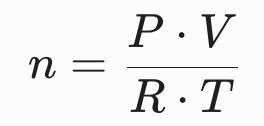
Where:
- P = 1 atm
- V = 144,983 L
- R = Ideal gas constant ($0.08206 L atm x K-1 x mol-1)
- T = 293.15 K

Finally, convert moles to pounds using the molar mass of ammonia (17.031 g/mol):
Mass (grams) = 6,027 moles x 17.031 g/mol = 102,645 g
Convert grams to kilograms, and then to pounds (1 kg = 2.2046 lbs):
102.645 kg x 2.2046 lbs/kg = 226.3 lbs
(Note: If the temperature of the space is colder, the gas becomes denser, meaning it would require slightly more mass to achieve the same 16% volume. For example, at freezing (32F / 0C), you would need approximately 243 pounds.)