
UPDATED 10/22/2019 with new images and new explanations.
UPDATE: Please see my June 2017 posting PHMSA’s New Cylinder “Special Permit” authorizes an extension of the 15-year service life of certain carbon fiber reinforced aluminum-lined cylinders (DOT-CFFC)
In general, composite-reinforced cylinders used with self- contained breathing apparatus (SCBA) all have a 15-year maximum life span. SCBA cylinders made entirely of steel or aluminum do NOT have a predetermined life. Cylinder life, along with most other cylinder requirements, is governed in the U.S. by the Hazardous Materials Regulations.
These are contained in Title 49, Code of Federal Regulations, Parts 171 to 185 and are handled by the Department of Transportation’s Pipeline and Hazardous Materials Safety Administration. DOT regulations are available at their web site at http://hazmat.dot.gov/regs/rules.htm.
The schedules for hydrostatic retests for steel and aluminum cylinders are defined in 49 CFR 180.209 Requirements for Requalification of Specification Cylinders. Specifications for all-steel and all-aluminum cylinders (that is, cylinders having no composite reinforcement) are detailed in those regulations. You can tell what type of cylinder you have by looking for a “DOT-” marking followed by an identifying code and the service pressure. Steel SCBA cylinders are marked with “3A” or “3AA” and aluminum cylinders with “3AL”.
The regulations do NOT define a maximum life for 3A, 3AA, or 3AL cylinders, so they may be used as long as they continue to pass their periodic requalification, including hydrostatic testing. Full details are found in 49 CFR Part 180. However, the regulations do not contain any specifications for composite-reinforced cylinders. These are usually made with an aluminum liner and wrapped with fiberglass, Kevlar, or carbon fiber. The DOT handles these by issuing “special permits” (formerly known as “exemptions”) to cylinder manufacturers on a case-by-case basis. To be certain of which rules apply, you need to see the special permit or exemption for your cylinder.
As an example, suppose your cylinder was marked “DOT-E 10915”. Looking up the special permit for this cylinder, you find that it is manufactured by Luxfer Gas Cylinders. It notes that “Cylinders manufactured under this exemption are NOT authorized for use fifteen (15) years AFTER the date of manufacture.” The only way to be sure of the requirements that apply to your composite-reinforced cylinder is to read the special permit or exemption for it. When it started granting exemptions for carbon-fiber-reinforced cylinders, DOT left an option open to potentially extend the service life for these cylinders to 30 years. However, to my knowledge, no such extension has yet been granted. (UPDATE 2016 – some of these cylinders have 30-year service lives)
Contact information for asking hazardous materials questions of DOT is at http://hazmat.dot.gov/sp_app/special_permits/spec_perm_index.htm.
Here is the information for the different types of SCBA cylinders in terms of the DOT service life and mandatory requirement for periodic hydrostatic testing:
- Steel cylinders—every 5 years (indefinite life until it fails a hydro test; but commonly regarded as 30 years)
- All aluminum (not including hoop wrapped)—every 5 years (indefinite life until it fails a hydro test; but commonly regarded as 30 years)
- Hoop-wrapped (aluminum) —every 3 years (15 year life)
- Fully wrapped fiberglass—every 3 years (15 year life)
- Fully wrapped Kevlar—every 3 years (15 year life)
- Fully wrapped carbon fiber—every 5 years (15 year life)
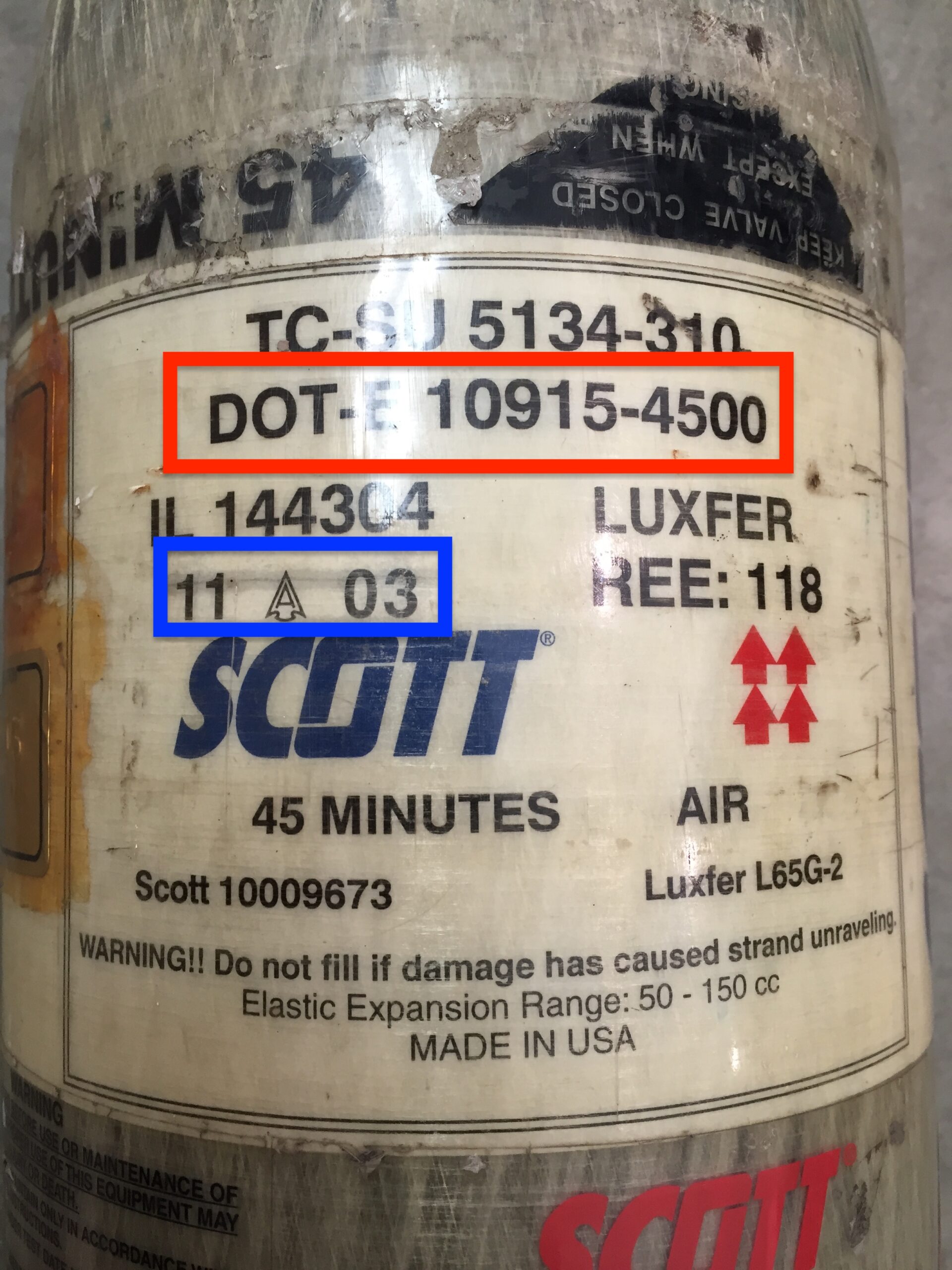
Using the label on your cylinder (like the one shown below) matches up the DOT # (in the red box) with the table below. So the cylinder below has a DOT # 10915 which means it is a “fully wrapped carbon fiber reinforced aluminum liner” and is to be hydro’ed every five (5) years and has a 15-year shelf-life. The cycle begins with the Manufactured Date (Blue Box). So we can see the manufactured date is “November 2003” (i.e. 11 03). This means by November 2008 this cylinder is due for its Hydro test.
BTW: the -4500 in the red box is the PSI rating of the bottle.
|
DOT Number |
Cylinder Construction |
Hydro Test Requirements |
Service Life |
|
DOT-SP-7235 |
Fiber reinforced plastic hoop wrapped aluminum liner |
Retest every 3 years |
15 years |
|
DOT-SP 9421 |
Steel |
Retest every 5 years |
Unlimited until cylinder fails a hydrostatic test |
|
DOT-SP 8059 |
Fiber reinforced plastic full composite aluminum liner |
Retest every 5 years |
15 years |
|
DOT-SP-10019 |
Fiber reinforced plastic fully wrapped composite aluminum liner |
Retest every 5 years |
15 years |
|
DOT-SP-10915 |
Fully wrapped carbon fiber reinforced aluminum liner |
Retested prior to May 11,2001 – 36 months. Retested on or after May 11,2001 – 5 years |
15 years |
|
DOT-SP-11194 |
Fully wrapped carbon fiber reinforced aluminum liner |
Retested prior to July 1,2001 – 36 months. Retested on or after July 1,2001 – 5 years |
15 years |
|
DOT-SP 11692 |
Steel |
Retest every 5 years |
Unlimited until cylinder fails a hydrostatic test |
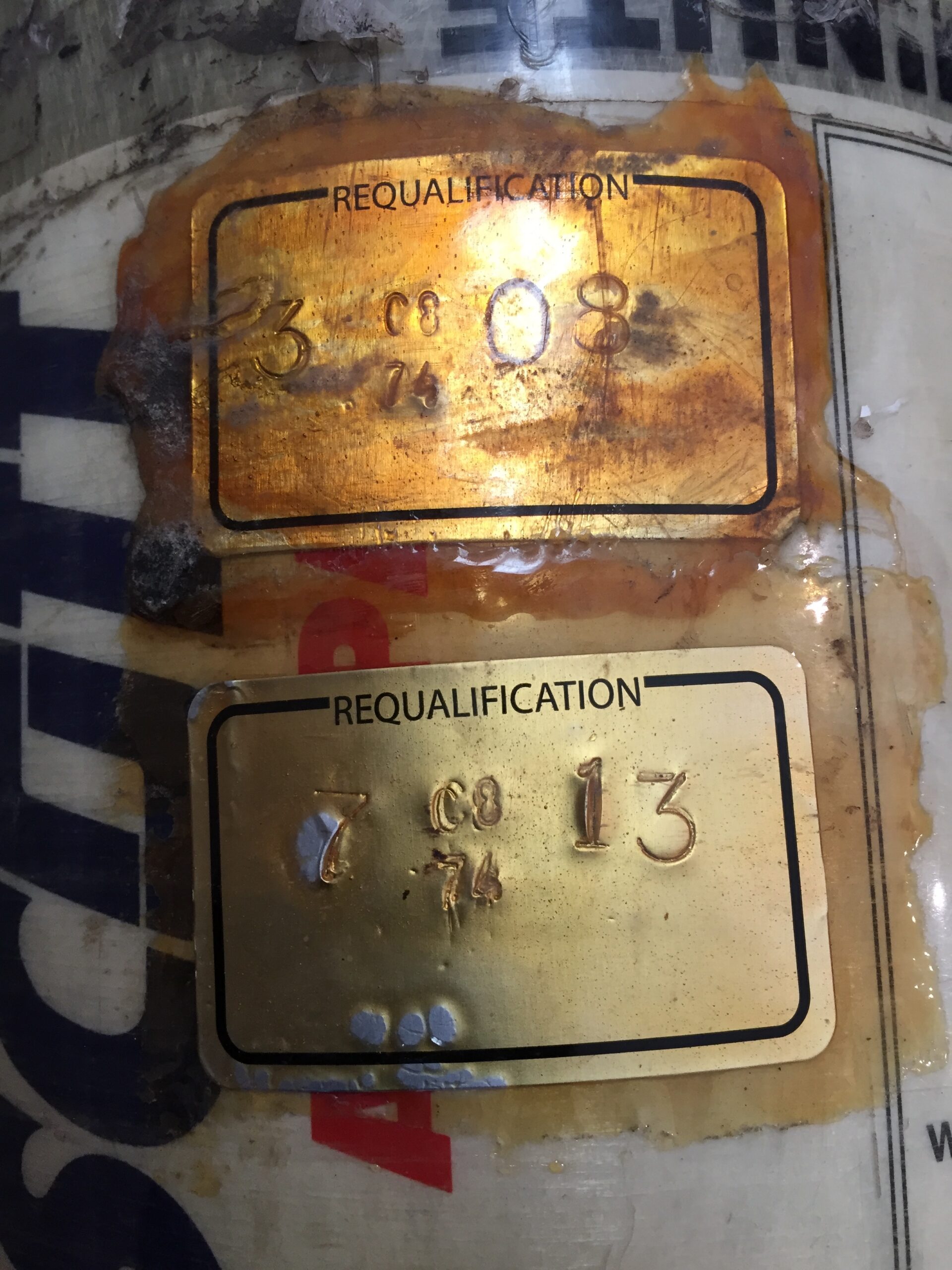
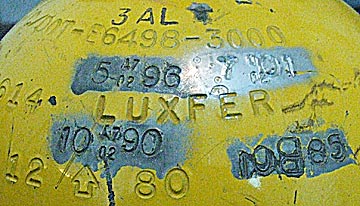
When the bottle/cylinder passes its hydro-test, it will be marked in 1 of 2 ways:
| Fiber Wrapped | Steel |
 |  |
180.209 Requirements for requalification of specification cylinders.
(a) Periodic qualification of cylinders. Each specification cylinder that becomes due for periodic requalification, as specified in the following table, must be requalified and marked in conformance with the requirements of this subpart. Requalification records must be maintained in accordance with § 180.215. Table 1 follows:
Table 1—Requalification of Cylinders1
|
Specification under which cylinder was made |
Minimum test pressure(psig)2 |
Requalification period(years) |
|
DOT 3 |
3000 psig |
5 |
|
DOT 3A, 3AA |
5/3 times service pressure, except noncorrosive service (see§ 180.209(g)) |
5, 10, or 12 (see§ 180.209(b), (f), (h), and (j) |
|
DOT 3AL |
5/3 times service pressure |
5 or 12 (see § 180.209(j) and § 180.209(m) 3 ). |
|
DOT 3AX, 3AAX |
5/3 times service pressure |
5 |
|
3B, 3BN |
2 times service pressure (see§ 180.209(g)) |
5 or 10 (see § 180.209(f)) |
|
3E |
Test not required | |
|
3HT |
5/3 times service pressure |
3 (see§§ 180.209(k) and 180.213(c)) |
|
3T |
5/3 times service pressure |
5 |
|
4AA480 |
2 times service pressure (see§ 180.209(g)) |
5 or 10 (see§ 180.209(h)) |
|
4B, 4BA, 4BW, 4B-240ET |
2 times service pressure, except non-corrosive service (see§ 180.209(g)) |
5, 10, or 12 (see§ 180.209(e), (f), and (j)) |
|
4D, 4DA, 4DS |
2 times service |
5 |
|
DOT 4E |
2 times service pressure, except non-corrosive (see§ 180.209(g)) |
5 |
|
4L |
Test not required | |
|
8, 8AL |
10 or 20 (see§ 180.209(i)) | |
|
Exemption or special permit cylinder |
See current exemption or special permit |
See current exemption or special permit |
|
Foreign cylinder (see § 173.301(j) of this subchapter for restrictions on use) |
As marked on cylinder, but not less than 5/3 of any service or working pressure marking |
5 (see§§ 180.209(l) and 180.213(d)(2)) |
|
1 Any cylinder not exceeding 2 inches outside diameter and less than 2 feet in length is excepted from volumetric expansion test. | ||
|
2 For cylinders not marked with a service pressure, see § 173.301a(b) of this subchapter. | ||