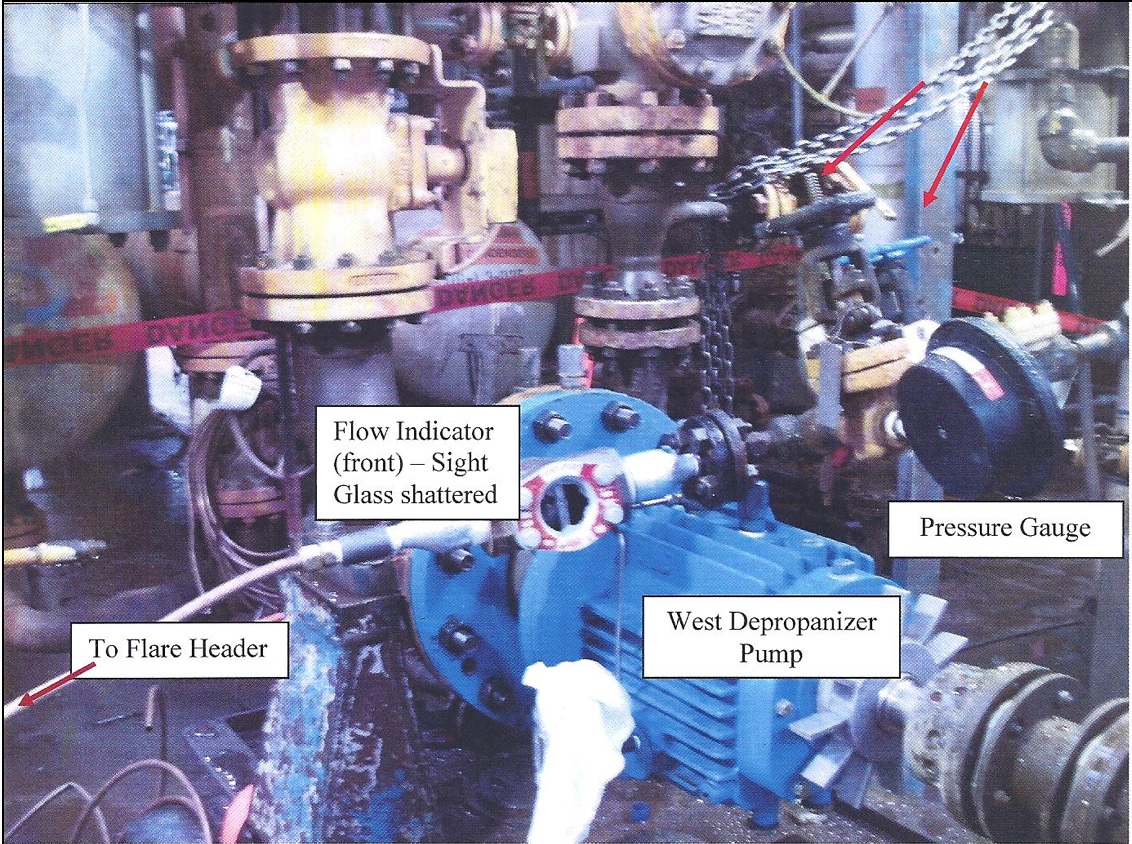
A 50-year-old mechanic was killed when a sight glass at an oil refinery ruptured and engulfed him in hydrofluoric acid. The incident occurred in an alkylation unit where the acid, a highly hazardous, toxic and corrosive chemical, is used as a catalyst in the process. The process uses the catalyst to produce higher octane gasoline. The victim was assigned to observe and verify that the flush of propane to a reflux pump was adequate to provide cooling to prevent overheating and damage to the pump.
A flow indicator unit equipped with a sight glass and propeller was installed in a bypass line around the reflux pump seal inlet/outlet. The flush line pressure exceeded the maximum rating for the flow indicator and as the flow was being established through the bypass line, the sight glass ruptured and discharged the contents of the bypass line. The victim had moved directly in front of the sight flow indicator and was sprayed in the face with the highly toxic and corrosive hydrofluoric acid and propane mixture. The victim was also struck in the face with flying glass. The sudden release of the poisonous liquid/gas mixture created a white cloud in the area around the reflex pump. The victim and two co-workers evacuated the area immediately. Decontamination procedures on the victim were begun within 1-2 minutes of the incident. He was transported to the hospital after neutralization agents were applied to the chemical burns, but he passed away shortly thereafter.
Citations as Originally Issued
Citation 1
|
Item 1a 1910.119(f)(1)(i)(C) |
The employer’s written operating procedures covering the steps for each operating phase did not address temporary operations. |
|
Item 1b 1910.119(l)(2)(III) |
The written procedures to manage changes did not assure that modifications to operating procedures were addressed prior to any change. |
|
Item 1c 1910.119(l)(5) |
A change resulted in a change in operating procedures or practices and such procedures or practices were not updated. |
|
Item 2a 1910.119(i)(1) |
The employer did not perform a pre-startup safety review for modified facilities when the modification was significant enough to require a change in the process safety information. |
|
Item 2b 1910.119(i)(2)(i) |
The pre-startup safety review did not confirm prior to the introduction of highly hazardous chemicals to the process that construction and equipment were in accordance with design specifications. |
|
Item 2c 1910.119(i)(2)(ii) |
The pre-startup safety review did not confirm prior to the introduction of highly hazardous chemicals to the process that the safety, operating, maintenance and emergency procedures were in place and were adequate. |
|
Item 2d 1910.119(i)(2)(iii) |
The pre-startup safety review for modified facilities did not confirm prior to the introduction of highly hazardous chemicals to the process that the modified facility met the requirements contained in management of change. |
|
Item 2e 1910.119(i)(2)(iv) |
The pre-startup safety review did not confirm prior to the introduction of highly hazardous chemicals to the process that the training of each employee involved in operating a process had been completed. |
|
Item 2f 1910.119(l)(4) |
A change resulted in a change in the process safety information and the process information was not updated. |
|
Item 3a 1910.119(j)(6)(i) |
In the construction of new plants and equipment, the employer did not assure that equipment as fabricated was suitable for the process application for which it was used. |
|
Item 3b 1910.119(j)(6)(ii) |
Appropriate checks and inspections were not performed to assure that equipment was installed properly and consistent with design specifications and the manufacturer’s instructions. |
|
Item 3c 1910.119(j)(6)(iii) |
The employer did not assure that maintenance materials, spare parts, and equipment were suitable for the process application for which they were used. |
|
Item 3d 1910.119(l)(3) |
Employees involved in operating a process and maintenance and contract employees whose job tasks will be affected by a change in the process were not informed of and trained in the change prior to start-up of the process or affected part of the process. |
|
Item 4a 1910.119(l)(1) |
The employer did not establish and implement written procedures to manage changes to process chemicals, technology, equipment, and procedures, and changes to facilities that affect a covered process. |
|
Item 4b 1910.119(l)(2)(i) |
The written procedures to manage changes did not assure that the technical basis for the proposed changed was addressed prior to any change. |
|
Item 4c 1910.119(l)(2)(ii) |
The written procedures to manage changes did not assure that the impact of the change on safety and health was addressed prior to any change. |
|
Item 4d 1910.119(l)(2)(iv) |
The written procedures to manage changes did not assure that the necessary time period for the change was addressed prior to any change. |
|
Item 5 1919.119(l)(2)(v) |
The written procedures to manage changes did not assure that the authorization requirements for the proposed change were addressed prior to any change. |
|
Item 6a 1910.132(a) |
Protective equipment was not used when necessary whenever hazards capable of causing injury and impairment were encountered. |
|
Item 6b 1910.132(d)(1) |
The employer did not assess the workplace to determine if hazards are present, or are likely to be present, which necessitate the use of personal protective equipment (PPE). |
|
Item 7a TDLWFD Rule 0800-1-1-.07(2)(b)1 |
Employees were exposed to an airborne concentration of hydrogen fluoride listed in Table Z-1-A in excess of 6 ppm as a 15-minute Short Term Exposure Limit. |
|
Item 7b TDLWFD Rule 0800-1-1-.07(2)(d) |
Feasible administrative or engineering controls were not determined and implemented to achieve compliance with the limits prescribed in 0800-1-1-.07(2)(b) and (c). |
|
Item 7c 1910.134(a)(2) |
Respirators were not provided by the employer when such equipment was necessary to protect the health of the employee. |