
UPDATED 8/25/12 – The Federal Motor Carrier Safety Administration (FMCSA) is aware of hazardous materials (HM) incidents involving Anhydrous Ammonia (NH3) and Liquefied Petroleum Gas (LPG) occurring during the transfer of these materials from cargo tanks to storage tanks, and vice-versa. One recent event was a release of NH3 that occurred in Swansea, South Carolina, during which the hose assembly malfunctioned while transferring the material from the motor carrier’s cargo tank to the facility’s storage tank. This particular event was investigated by the NTSB, which resulted in NTSB’s recommendations H-12-2 through H-12-6.1 For an in-depth explanation of this event, please visit the website listed at the bottom of this page and read the accident report summary.
Recommended Procedures
To reduce the likelihood of incidents resulting from use of hoses that are incompatible with the material, the motor carrier or facility should conduct a careful inspection prior to beginning the loading or unloading process. A properly-trained person should visually inspect the delivery hose assembly for defects, and verify that the chemical products can be safely transferred through the hose assembly. The verification process requires noting markings on the hose assembly, verifying that the written certification lists NH3 and LPG as acceptable products for use with the hose assembly, or noting any restrictions provided by the owner of the hose assembly. Verification that a delivery hose assembly is appropriate for its intended use also should be incorporated into the required pre-transfer procedures (See 49 CFR § 177.840(m)).
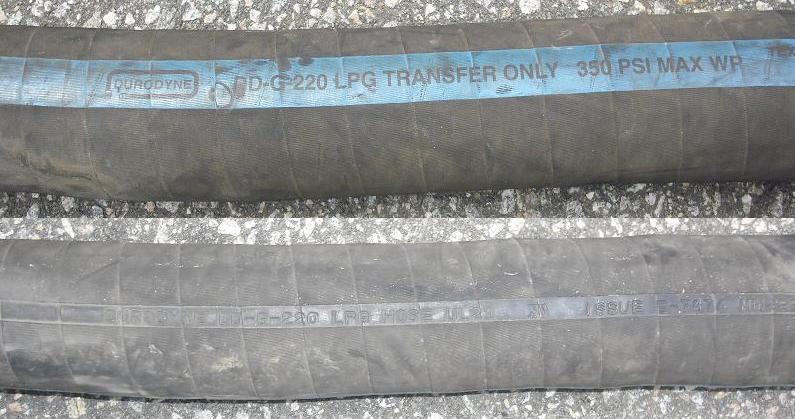
Each delivery hose assembly is permanently marked with a unique identification number and maximum working pressure (See 49 CFR § 180.416(b)). Many hoses are branded on the side of the hose with the designation “LPG TRANSFER ONLY” (See Figure 1), or “ANHYDROUS AMMONIA USE ONLY.” Over time and with improper use, these hoses are susceptible to failure due to the incompatibility of the product with the materials used in the construction of the hoses. Hoses and couplings may also fail due to improper maintenance of the hose assemblies used in the loading and unloading of LPG and NH3. 1 The accident summary report is available at http://www.ntsb.gov/investigations/reports.html.

Figure 1: Example of LPG-Use Only Hose Marking
Emergency Flow Control
Title 49 CFR § 173.315(n)(2) requires that bulk transport vehicles transporting certain liquefied compressed gases, including NH3, be outfitted with passive emergency shutdown control equipment. The passive shutdown system will automatically shut off the flow of product from the cargo tank motor vehicle—without the need for human intervention—within 20 seconds of an unintentional release caused by “a complete separation of a liquid delivery hose.” Two types of passive shutdown systems commonly used by industry include:
- A hose that operates in the event of a mechanical failure (the hose involved with the incident utilized Smart-Hose™ Technology); and
- A permanently mounted, computer-controlled leak detection/shutdown system.
Employee Training
Please ensure that all HM employees receive the appropriate function-specific training, including awareness of the dangers associated with loading and unloading these materials and proper handling of these materials during loading and unloading. Control of the release in the Swansea incident was the result of a quick response by the driver-trainee, who manually tripped the emergency shut-down device, as a complete separation of the hose did not occur, which would have tripped the Smart-Hose function. Hose manufacturers provide explicit instructions on the proper use and maintenance of the hose for various chemicals, and it is extremely important that the hose is used only for the application it was designed and manufactured to handle.
The Hazardous Materials Regulations (HMR) require, prior to loading and unloading, that a qualified person performs a visual inspection of the discharge system, including the delivery hose assembly and piping (See 49 CFR § 177.840). Additional hose maintenance requirements include regular tests and inspections, including maintaining documentation of such tests and inspections (See 49 CFR § 180.416). It is crucial that the regulations are followed in their entirety. You should refuse service to facilities where a driver discovers the facility is using hoses and systems that fail to comply with regulatory safety requirements. (See 49 CFR § 180.416). This will minimize the risk associated with the loading and unloading of LPG and NH3.
This safety advisory should be included as part of the HM training required by 49 CFR § 172.700 of the HMR, and provided to each HM employee responsible for the safe loading and unloading of LPG and NH3. If there are any questions regarding this safety advisory notice please contact the FMCSA Hazardous Materials Division at (202) 385-2400.
CLICK HERE to download the alert from FMCSA
