
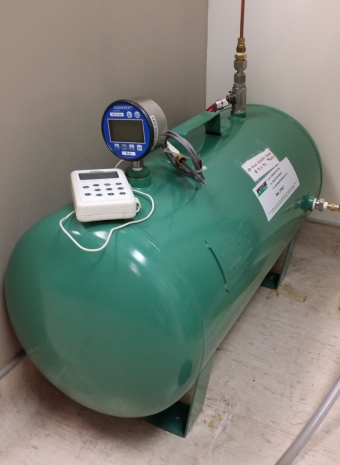
UPDATE 10/18/2016 – Hawaii Occupational Safety and Health Office reduced the number of violations cited from 15 to nine and lowering fines from $115,500 to $69,300. About a month after the blast, the Honolulu Fire Department said its investigation determined the explosion was likely caused by a digital pressure gauge in the tank that produced an electrical spark, which detonated the flammable gas in the tank. An independent investigation conducted by a team from the University of California Center for Laboratory Safety concluded the explosion was likely caused by static electricity. The report said the gauge was not inside the tank, and that detonation was caused by an electrostatic charge, accumulated by the gas storage tank or by Ekins-Coward herself, that was released when she touched a metal housing as she attempted to turn off the gauge.
A postdoctoral researcher was combining 70% hydrogen, 25% oxygen, and 5% carbon dioxide gases from high-pressure cylinders into a lower pressure tank when an explosion occurred that severed her right arm just above the elbow. The gas mixture was “food” for bacteria being used to produce biofuels and bioplastics. She was working for the Hawaii Natural Energy Institute under another researcher. In a 2013 paper by the supervising researcher, it shows a similar set-up in which gases are plumbed through a mixing device directly into the bioreactor (Int. J. Hydrogen Energy 2013, DOI: 10.1016/j.ijhydene.2013.04.153). The gas gauge identified in that paper was an “intrinsically safe” model designed for use with flammable gases. But after the postdoctoral researcher started in the lab last fall, she purchased a 49-L steel gas tank, a DIFFERENT gauge, one that was NOT rated as intrinsically safe, a pressure-relief valve, and fittings, and she put them together. She told fire department investigators, she would add the gases to the portable tank, which would then be connected to the bioreactor. In the week before the incident, a similar set-up with a 3.8-L tank resulted in a “small internal explosion” when she pressed the OFF button on the same type gauge. She also occasionally experienced STATIC SHOCKS when touching the 3.8-L tank, which was NOT grounded. She reported the shocks and possibly the small explosion to the supervising researcher, who told her not to worry about it. On the day of the incident, the 49-L tank exploded when she pressed the OFF button on the gauge.
The University of Hawaii hired the University of California Center for Laboratory Safety to independently investigate the incident. That report is expected to be completed by the end of this month. The Hawaii Occupational Safety & Health Division is also investigating the incident.
CLICK HERE for the FULL Honolulu Fire Department Report which contains scene photos and more valuable data.
CLICK HERE for the University of California Center for Laboratory Safety Report