The short and simple answer is YES. It is, without a doubt, a PRCS. This debate is much like the “Is an Evaporative Condenser a PRCS” discussion. This week, I was presenting at the 2020 Refrigerating Engineers & Technicians Association (RETA) virtual conference, and my presentation was “Evaluating Your Ammonia Refrigeration System to determine if certain equipment is a Permit-Required Confined Space.” I used the Evaporative Condenser as my example. As I have written about several times, these condensers are, without a doubt, a PRCS, and this week, I received a new challenge from the ammonia refrigeration industry… somehow, a spiral freezer operating at -40ºF is how not a PRCS.
So, as I did with the condenser, let’s break this evaluation down so that it can be demonstrated that most, if not all, spiral freezers are, in fact a PRCS:
First Step – is the spiral freezer a Confined Space (CS)?
Do these spiral freezers pose ALL three (3) of the following characteristics?
Is the spiral freezer large enough and so configured that an employee can bodily enter and perform assigned work?
AND
Does the spiral freezer have limited or restricted means for entry or exit?
AND
Is the spiral freezer designed for continuous employee occupancy?
IS THE SPIRAL FREEZER LARGE ENOUGH AND SO CONFIGURED THAT AN EMPLOYEE CAN BODILY ENTER AND PERFORM ASSIGNED WORK?
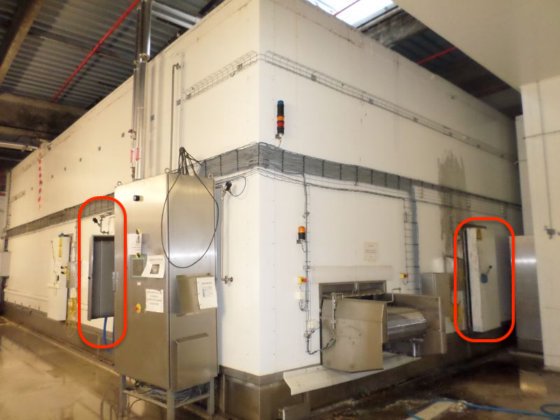
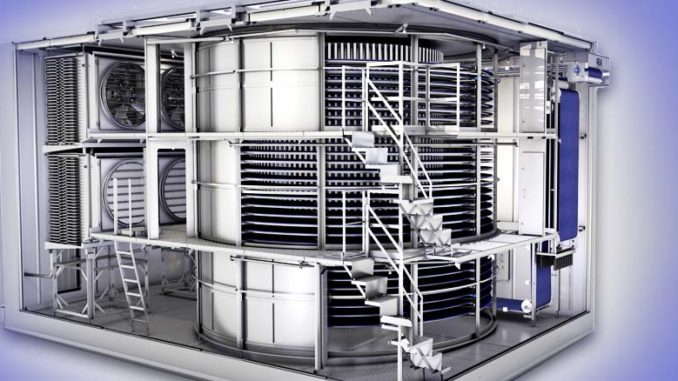
Here are two (2) stock photos of spiral freezers. One picture shows us the outside view, and the other is a 3D image showing the inside layout. And yes, most of the ones I have worked with will have similar-sized openings. The entryways, highlighted with red boxes below, are intended to provide access into the freezer shell/skin/housing for maintenance/servicing tasks. Once inside the shell/skin/housing, some units are pretty roomy and well-designed – providing reasonable access to equipment.
 |
 |
It is clear that the spiral freezer is large enough and configured so that an employee can bodily enter and perform assigned work.
DOES THE SPIRAL FREEZER HAVE LIMITED OR RESTRICTED MEANS FOR ENTRY OR EXIT?
As shown in the pics above, we can see that although these larger units will have multiple ways in/out, the size of these openings poses an issue. And yes, I have seen some with larger doors, but I have yet to see one with a full-size personnel door. Remember, the mere presence of a full-size door does NOT mean that entry/exit is not limited or restricted; we also have to examine these units’ internal configurations to ensure there is no impediment to entry/exit from the unit.
Most manufacturers have vastly improved their designs over the years with safety in mind; however, these FREEZERS are not normally occupied spaces, and thus, these stairs do not always meet the width requirements needed to comply with OSHA and IBC stair design requirements. We can see ladders and stairs in the 3D model image above, and ladders are most certainly considered a restriction in entry/exit. Although I have been able to navigate inside many of these spaces, I often can NOT do so standing straight up or without having to contort my body to get around corners. So, in my professional opinion, ALL of the units I have worked with pose a restricted or limited means for entry and exit due to either the size of the entry/exit portals or the internal configurations within the shell/skin/housing.
So it is clear that most spiral freezers HAVE LIMITED OR RESTRICTED MEANS FOR ENTRY OR EXIt.
IS THE SPIRAL FREEZER DESIGNED FOR CONTINUOUS EMPLOYEE OCCUPANCY?
This one, once again, was a sticking point for the group challenging my evaluation. They felt that since the manufacturer had provided “improved” means to enter/exit and had improved the layout/spacing within the units for maintenance tasks; this somehow implied the manufacturer intended for “continuous employee occupancy.” From a straightforward point of view, does anyone think that a space designed to operate around -40ºF is intended for CONTINUOUS EMPLOYEE OCCUPANCY?
We can not confuse the fact that manufacturers have provided and improved their “maintenance access” in many cases. But this in NO WAY implies that the manufacturer designed this space for CONTINUOUS EMPLOYEE OCCUPANCY. Try to get a letter from the manufacturer stating that they agree that we could set up a maintenance office inside the freezer and staff the office inside their freezer for 12 hours per shift and two shifts per day as designed. Go ahead… I’ll wait! LOL
So, I hope it is clear that the spiral freezer is NOT designed for CONTINUOUS EMPLOYEE OCCUPANCY.
Since we have a space that:
-
Is large enough and so configured that an employee can bodily enter and perform assigned work; AND
-
has limited or restricted means for entry or exit; AND
-
is NOT designed for continuous employee occupancy
We, in fact, have a Confined Space (CS).
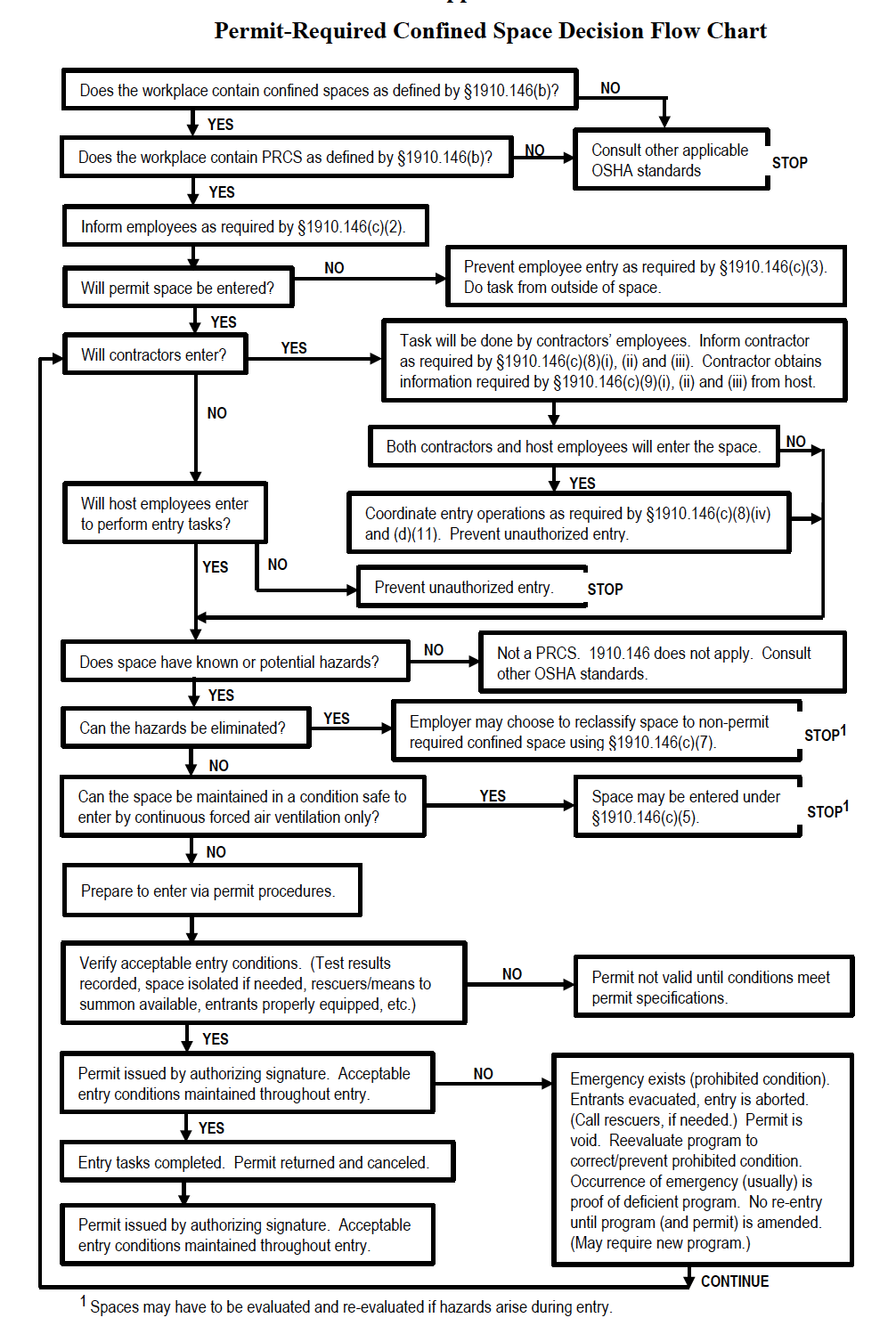
But does this CS contain a hazard(s) that would make it a Permit-Required Confined Space (PRCS)?
For a CS to rise to the level of being a PRCS, the space MUST contain at least one (1) of these hazard types:
- Contains or has a potential to contain a hazardous atmosphere; OR
- Contains a material that has the potential for engulfing an entrant; OR
- Has an internal configuration such that an entrant could be trapped or asphyxiated by inwardly converging walls or by a floor which slopes downward and tapers to a smaller cross-section; OR
- Contains any other recognized serious safety or health hazard
So let’s examine a spiral freezer to determine if at least one (1) of these types of hazards may be present within the space.
DOES A SPIRAL FREEZER CONTAIN OR HAVE THE POTENTIAL TO CONTAIN A HAZARDOUS ATMOSPHERE?
Most spiral freezers I deal with use anhydrous ammonia as the refrigerant; however, outside the USA, I have encountered some spiral and tunnel freezers that use a cryogenic such as Nitrogen as the refrigerant. To be clear, BOTH NH3 and N2 pose significant (i.e., lethal) atmospheric hazard potentials within the space when the refrigerant is within the coils/tubes within the space. N2 poses a potential oxygen-deficient atmosphere, and NH3 poses an acutely toxic and potentially IDLH-hazardous atmosphere.
A client fired me for intervening in workers inside a spiral freezer trying to locate a refrigerant leak. The unit was in its full operational mode (nothing locked out), AND the two employees had bypassed the safety switch/interlock on the door they used to enter the freezer. I am sorry, but as a safety professional, I will NEVER walk away from an imminent hazard, especially one that the facility clearly recognized as this freezer was, in fact, labeled a PRCS. We agreed to part ways as I have not come this far to work with an organization that decries “safety first” and then, with full management support, allows/sanctions these types of unsafe acts.
But entering a spiral freezer with an ACTIVE REFRIGERANT LEAK and the coil/tube/piping are charged with the refrigerant and doing so without the safety of an ENTRY PERMIT and all the layers of protection that go with this entry option are just INSANE. But it happens more often than we really want to know!
WARNING! By the way, entering these spaces to fix a leak also OPENS the door to this action having to meet 1910.120(q). Check out the definition of an “Emergency response or responding to emergencies,” and you will understand how entering to find and fix a release of anhydrous ammonia is, in fact, an emergency response.
There may be a refrigerant that does not pose a potential atmospheric hazard, but I am unaware of it. The two refrigerant classes that I work with are NH3 and cryogenics. These most certainly pose the potential to create an oxygen-deficient atmosphere or an acutely toxic and potentially IDLH hazardous atmosphere.
Like the evaporative condenser, we have the potential for a hazardous atmosphere within the space; thus we have a Permit-Required Confined Space.
But wait, there’s more…
DOES A SPIRAL FREEZER CONTAIN A MATERIAL THAT HAS THE POTENTIAL FOR ENGULFING AN ENTRANT?
I am going to be brief here and just say NO, as I have never seen an engulfment potential within these freezers. Not to say there is no way it could not happen, but in general, these spaces are NOT designed to hold an engulfment material.
DOES A SPIRAL FREEZER HAVE AN INTERNAL CONFIGURATION SUCH THAT AN ENTRANT COULD BE TRAPPED OR ASPHYXIATED BY INWARDLY CONVERGING WALLS OR BY A FLOOR WHICH SLOPES DOWNWARD AND TAPERS TO A SMALLER CROSS-SECTION?
I am going to be brief here and just say NO, as I have never seen a freezer with this type of configuration.
DOES A SPIRAL FREEZER CONTAIN ANY OTHER RECOGNIZED SERIOUS SAFETY OR HEALTH HAZARD?
This hazard class is one that we discussed at length in my previous articles, as it is the most misunderstood hazard. It is clear that OSHA meant for these recognized serious safety or health hazard to include physical hazards within the space. Such as fan blades, agitator blades, augers, sweep arms, etc. Even unguarded hazards, such as belts/pulleys, power transmission shafts, conveyors, open electrical, etc., would be considered serious safety and health hazards. A lot of times, the manufacturers will NOT properly guard these devices INSIDE the space, as the exterior walls of the freezer/space are intended to be the “guard” for these hazards; but once we have entered the freezer/space, we are now exposed to these hazards.
Inside a spiral freezer, we have many moving parts that are energized by power transmission devices, and the vast majority of this equipment poses a serious entrapment hazard for anyone inside the freezer.
The counter-argument I get on these freezers is that the manufacturer does not label them as PRCS, and they should know better than some crazy safety engineer. I even get accused of “fear-mongering” to generate business. So, for one such client, I had them set up a call with their freezer manufacturer to explain to me and the facility (using their own written PRCS program definitions) how their freezer is not a PRCS. It was probably not a shock to many true safety professionals, but the manufacturer did not even know what constituted a CS, much less what turned a CS into a PRCS. I then walked them through the evaluation process, and their engineering group admitted that their space met the same criteria that the facility’s PRCS program established. When the plant personnel asked them why they did not label their doors or mention these concerns in their owners/maintenance manual, they said that is not an area we are familiar with.
Take a look at this marketing video from a major international manufacturer. I am in NO WAY picking on this company or its products – merely offering an inside look (albeit via a model video) to demonstrate all the nooks and crannies within these freezers and all the moving parts, ladder access means, etc.
JBT Frigoscandia GYRoCOMPACT® 70 Spiral Freezer from JBT on Vimeo.
UPDATE 2/1/2021 – this update is due to the horrible tragedy in Gainesville, GA, on 1/28/2021. The authorities have officially identified that the equipment was an immersion freezer/spiral freezer combo. The company that designed and built this system is one of the finest chemical companies in the world and is one of the resident experts in cryogenic processes. The authorities have not said if this incident is related to the space being a PRCS or where the five on-scene fatalities were located. Still, I know the designer and installer company well and have worked with them since I was in the chemical and semiconductor industries, and I was delighted to see the following photo. It seems that this company fully agrees with my assessment and labeled their spiral freezer as a PRCS. But I must be honest; their design differs from the spiral freezer I used in my example above. The immersion freezer/spiral freezer combo involved in this accident seems to be of cutting-edge technology. The system catches the N2 gas off the immersion portion of the flash freezer and then uses that cold gas to improve the efficiency of the spiral freezer. But here is how they label their spiral freezer:
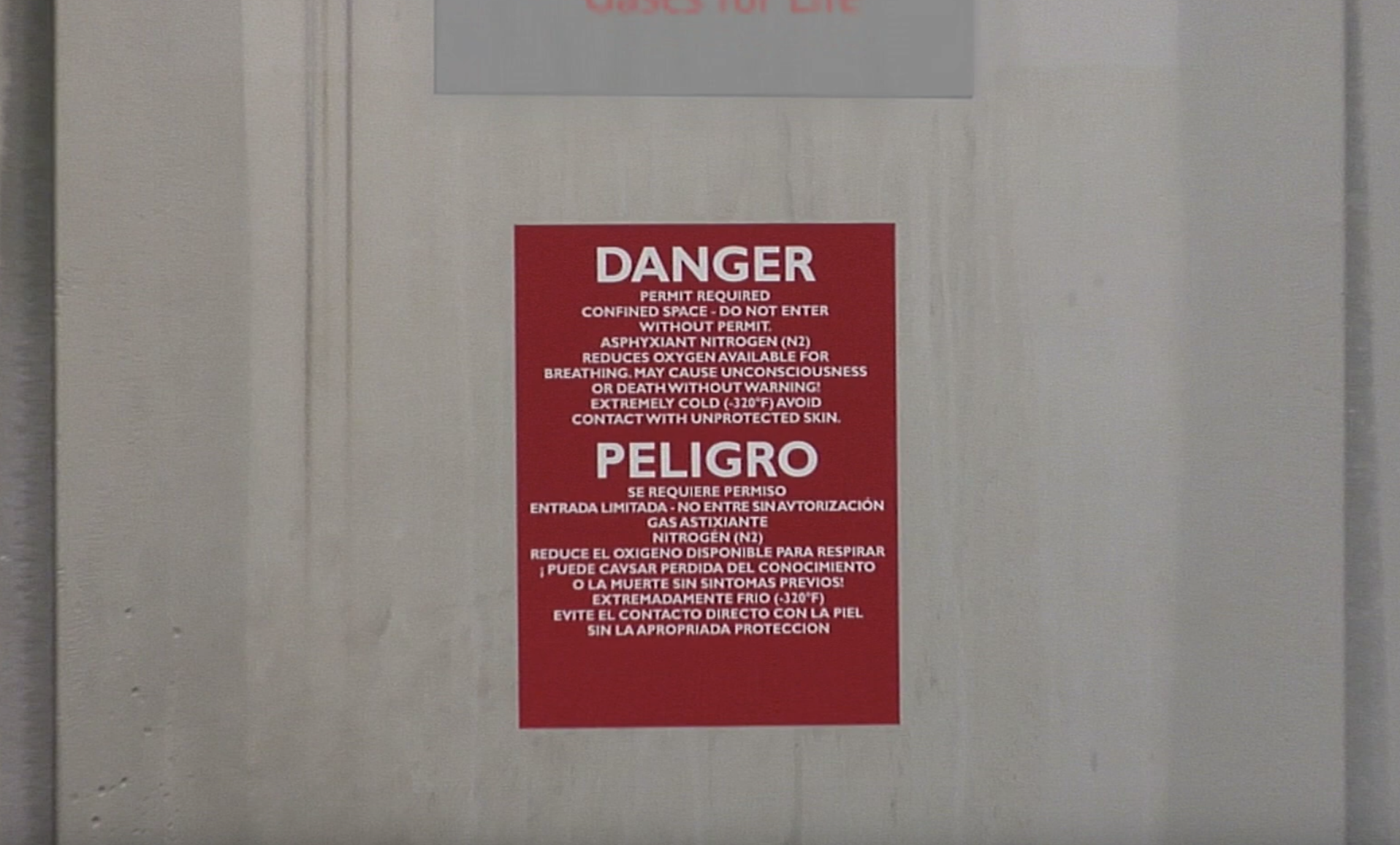
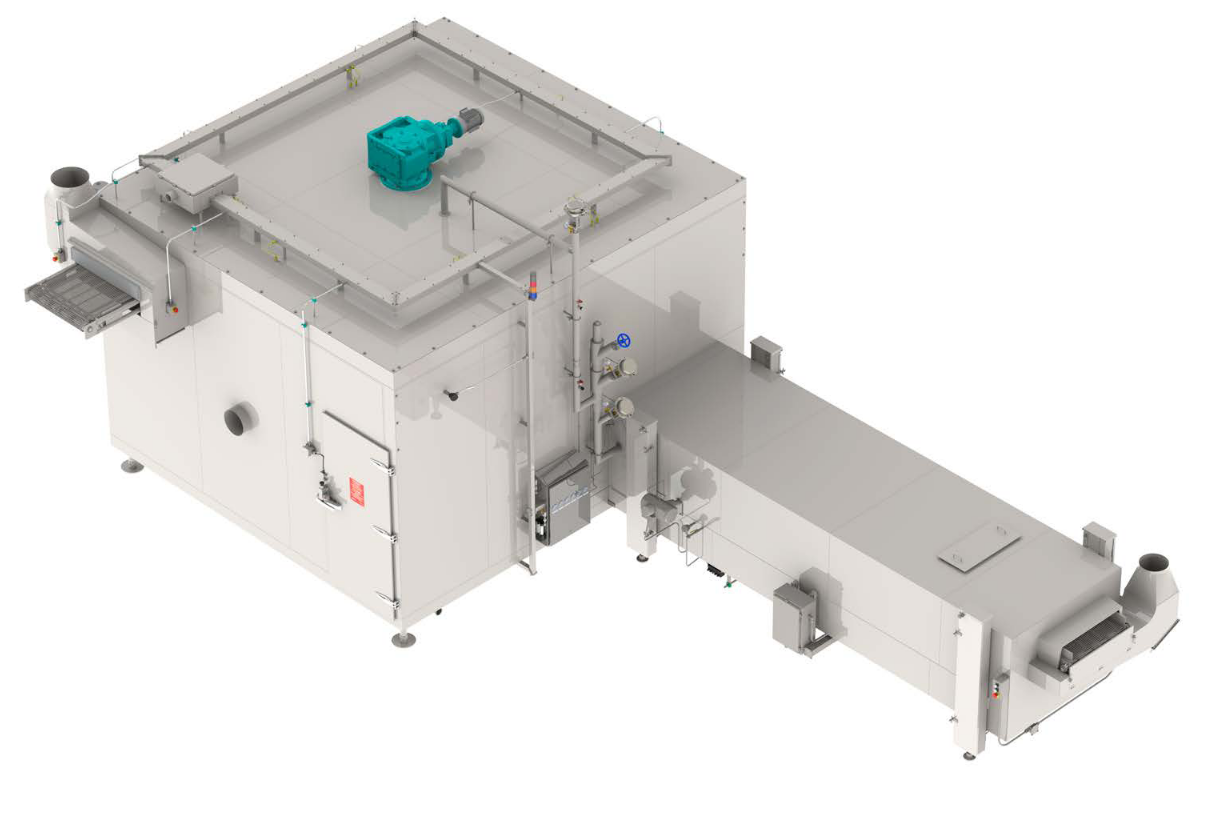
Here is a marketing image of the freezer involved: (look closely at the image below and you can see the red sign on the door into the freezer)