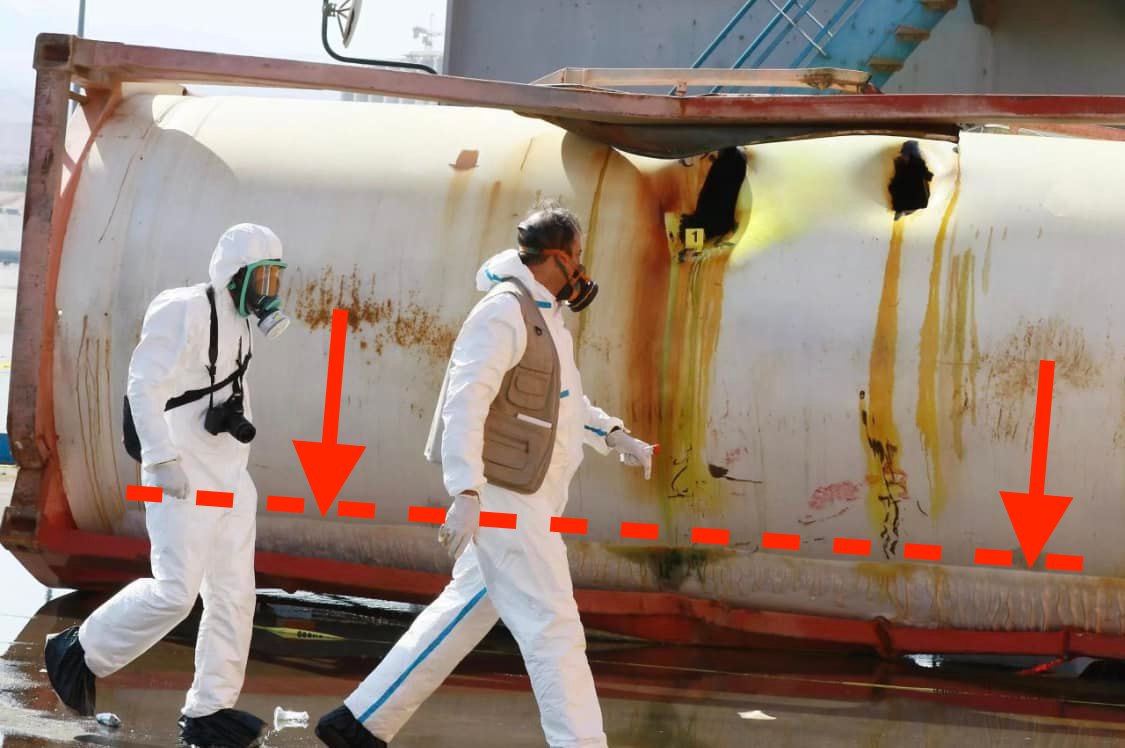
As we saw in Jordan last week, gases stored as liquids can “auto-refrigerate” in large-scale accelerated releases. In the aftermath pictures, we can see a clear frost line along the bottom of the ISO container, which is evidence of a refrigerated liquid level within the container. (See pic and explanation below)
Auto-refrigeration is a process where an unintentional and/or uncontrolled phase change from a liquid state to gas occurs resulting in a very rapid reduction in the temperature of the liquid.
When that ISO container was ruptured, the liquid chlorine inside the container went “atmospheric” immediately (as can be seen by the Chlorine gas rapidly escaping and expanding). This caused the liquid to begin boiling, just like water does at 212ºF – Cl2 boils at -29ºF. The only thing keeping the Cl2 from boiling inside the container during transport is the “vapor pressure” the Cl2 generated inside the container. Once that internal pressure is lost and the Cl2 liquid is at atmospheric pressure (remember this occurred at darn near exact sea-level) the liquid Cl2 takes full advantage of this atmospheric pressure and begins to go back to its natural state – a GAS! And as we saw in the video, it does this very quickly and efficiently!
This boiling actually drops the temperature of the liquid mass and can literally stop the catastrophic release. This is indicated by a “frost line” (read my other articles about “frost lines on pressure vessels). on the ISO contained (see pic below). The frost line is formed by the humidity in the air coming in contact with the extremely cold wall of the tank. Which by the way will have exceeded the MDMT of the container (See my other articles on Minimum Design Metal Temperature).

However, over time, the remaining liquid will begin to absorb the heat from its surroundings and once the mass has heated back to its BP, we will have ANOTHER event.
So the question is… is auto-refrigeration a safeguard that should be considered a safeguard that will aid in the prevention of ALL the LPG escaping the container?
HELL NO!
Had this container flipped one more time or rotated during the event and the liquid chlorine escaped, the entire contains would have been lost onto a hot dock surface and matters would have been worse. Since we have no way of controlling the failure mode of our WCS, we can not logically declare auto-refrigeration as a safegaurd.