
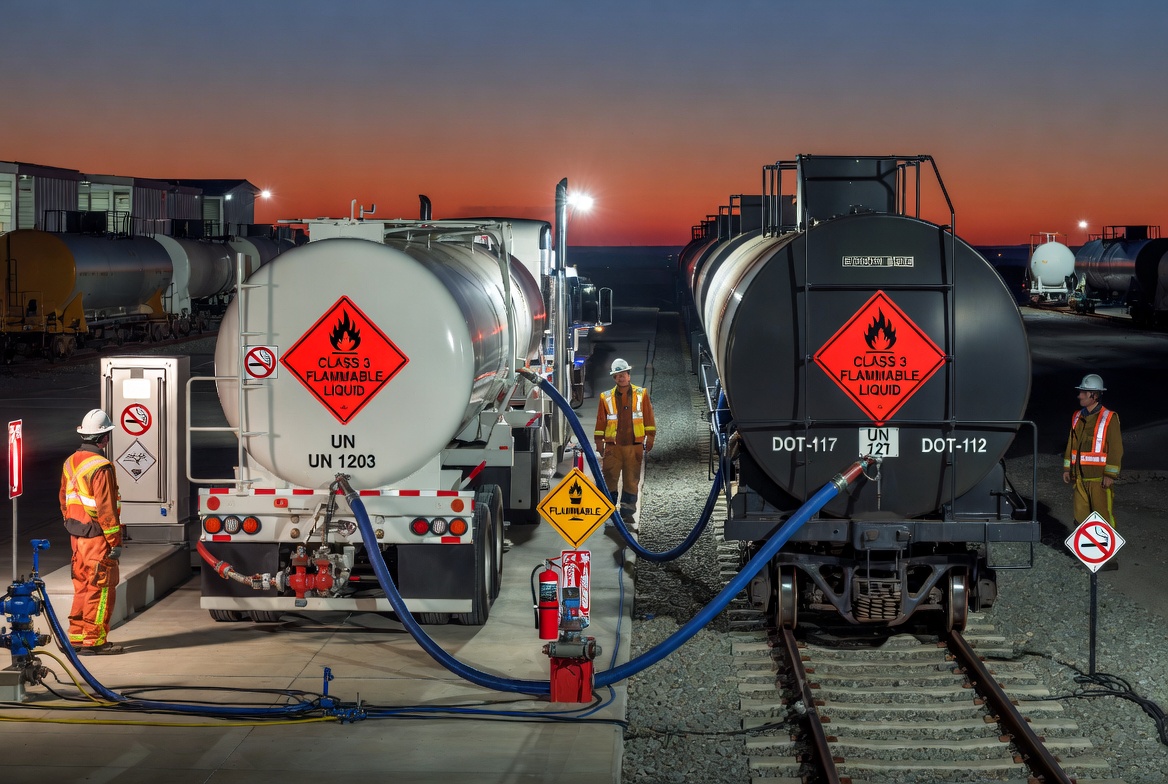
I have had a numerous discussions with companies regarding this new push for “trans-loading”. Trans-loading is defined as:
"Transloading means the transfer of a hazardous material by any person from one bulk packaging to another bulk packaging, from a bulk packaging to a non-bulk packaging, or from a non-bulk packaging to a bulk packaging for the purpose of continuing the movement of the hazardous material in commerce."
I am not sure what is driving this increase in interest in this activity, but all of the inquires were centered around a single question:
Is my trans-loading operation a PSM or RMP covered process?
And each time, the answer has been a clear YES. And I never hear from them again. In my recent travels, one such site that I was asked about was in operation. Now I could not see if they were practicing PSM in their activities; but I was able to verify an RMP had not been submitted for this process. The lawyers asking the questions, clearly did not expect my answer, and challenged it hard; but, that did not change the fact this would be BOTH a PSM and an RMP covered process.
Why?
Key Points from DOT/PHMSA Guidance
- It involves a “pure transfer” — not mixing, blending, diluting, or otherwise altering the hazardous material (those operations fall outside the definition).
- Transloading is considered part of “storage incidental to movement” (and thus transportation in commerce) when it meets the criteria, such as when original shipping documentation identifies it as a through-shipment to a final destination.
- It can occur at various locations, including private tracks or facilities, and is regulated under the HMR regardless of ownership.
OSHA’s PSM standard (29 CFR 1910.119) defines a process as:
“Any activity involving a highly hazardous chemical including use, storage, manufacturing, handling, or the movement of such chemicals, or a combination of these activities.”
Transloading is literally handling, movement, transfer of a PSM‑listed chemical. Therefore, if the site has ≥ the threshold quantity (e.g., 10,000 lb for flammables, or the listed TQ for toxics), the transloading operation is PSM‑covered.
OSHA has repeatedly clarified that once the facility controls the transfer, PSM applies.
OSHA has stated that commercial railroad tank cars and CTMVs are covered by the PSM standard to the extent that they are not covered by any other regulatory authority. For example, the DOT HMR covers rail cars. These DOT regulations cover rail car design, construction, maintenance (including repairs) and certain operations. In general, if the rail cars are considered “in transit” by DOT, OSHA would defer jurisdiction to DOT. Therefore, if the rail car is no longer “in-transit” because it is located on a private siding or track and the motive power is disconnected, the rail car is PSM covered. See 49 CFR § 171.1 for definition of private siding or track. Anicello LoI 02/15/1994, and Schneider LoI 07/11/1994
QA-74: After the rail car is connected to the downstream process, is the downstream equipment part of the PSM-covered process?
Response: Yes. The rail car containing a TQ of a HHC is a PSM-covered process. Therefore, all the interconnected downstream equipment that contains the HHC is part of the PSM-covered process. Source: https://www.osha.gov/sites/default/files/enforcement/directives/CPL_02-01-065.pdf
Is transloading a covered process under EPA RMP?
Yes — if the facility has ≥ TQ of an RMP‑listed substance and the transfer is part of the stationary process.
EPA RMP (40 CFR 68) defines a process as:
“Any activity involving a regulated substance including use, storage, manufacturing, handling, or on‑site movement, or any combination of these.”
EPA guidance explicitly states that loading and unloading operations are part of the process.
EPA’s “Transportation Exemption” is narrow — once the facility touches the chemical, the exemption usually ends.
