
Back in 2012, I wrote an article about ASME’s “Lethal Service” definition in the hopes of providing some direction in how we could establish which of our HHC/EHSs may rise to the level of “lethal service” as it applies to the design of our pressure vessels. The article stirred much debate among the SAFTENG die-hards, but it also led to more questions. The most asked question was… “what about the piping connected to a lethal service pressure vessel, what guidance do we have for the piping?” Well, we have an answer… ASME B31.3-2014, Process Piping. Much like ASME Section VIII has for pressure vessels, ASME B31.3-2014, Process Piping has a special class of piping for those hazardous materials that are extremely hazardous (my words not ASME’s). ASME defines their Category M Fluid Service in the following manner:
Category M Fluid Service: A fluid service in which the potential for personnel exposure is judged to be significant and in which a single exposure to a very small quantity of a toxic fluid, caused by leakage, can produce serious irreversible harm to persons on breathing or bodily contact, even when prompt restorative measures are taken.
I like to break down this definition in the following manner:
- A fluid service in which the potential for personnel exposure is judged to be significant and
- in which a single exposure to a very small quantity of a toxic fluid, caused by leakage, can produce serious irreversible harm to persons on breathing or bodily contact,
- even when prompt restorative measures are taken.
It is the Owner’s responsibility to determine what liquids and gasses constitute Category M Fluids and here lies the issue. Ask 50 facilities for their listing of Category M Fluids and I can guarantee you that you will NOT get 50 consistent answers! We would be lucky if we could get 10 out of the 50 to even admit they have Category M Fluids.
There are a number of methods to quantify the hazards associated with our hazardous materials and my favorites are:
- NFPA 704
- NIOSH’s IDLH (the method I used to establish “lethal service”)
- International Fire Code (IFC) “Highly Toxic” Hazardous Materials classification
I would certainly be comfortable using NIOSH IDLH’s to define Category M Fluids, but for some reason, there seems to be a desire by others to use the NFPA Health Hazard level of “4” to also define their Category M Fluids. The IFC probably provides as much guidance and examples of their “highly toxic” hazardous materials as any credible source.
But I just love it when someone else takes on these battles and when it is a reputable group, it just makes things easier. Unfortunately, OSHA nor EPA have not quantified this for us, but we do have a very reputable group who has defined/quantified those hazardous materials that rise to the level of Category M Fluids. We can turn to the LANL Engineering Standards Manual, STD-342-100, Chapter 17, Pressure Safety; Attachment ASME-3 Category M Fluids. Now PLEASE do NOT read this LANL Engineering Standard as “law”, as it is NOT enforceable by OSHA or EPA; however, it does provide us with a starting point in our assessment discussions. In the LANL document, you may notice that some of their Category M Fluids have NFPA Health Rating(s) less than “4” and unfortunately, they do not provide their rationale for their listings. But having looked it over, I do not see a lot of chemicals that I would disagree with.
It would be a wise decision to include your assessment against your HHC/EHS on the site so as to establish the fact that none of your PSM/RMP chemicals rise to the level of Category M Fluids. As declaring a hazardous material to be classified as Category M Fluid places added requirements on the design, fabrication, construction, and examination of the piping. This means that if your piping RAGAGEP is ASME B31.3-2014, Process Piping and some of your HHC/EHSs are indeed Category M Fluid(s) then the piping will have those added design, fabrication, construction, and examination requirements of the piping.
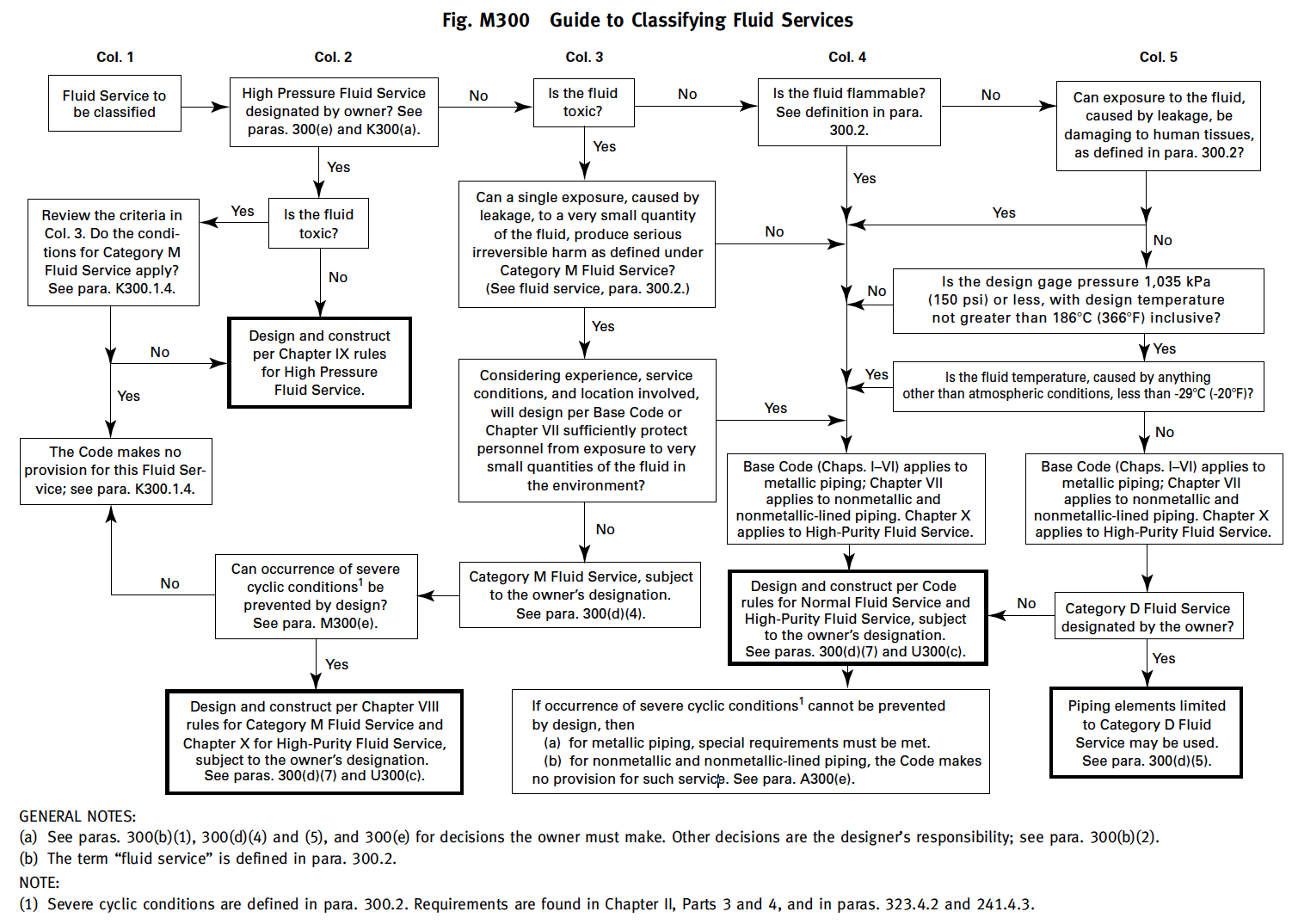
Lastly, ASME B31.3 does provide us with a flowchart to aid in our decision making, but this flowchart does not make any attempt at defining or quantifying any chemicals that would rise to the level of a Category M Fluid. But I did want to provide you with it in case it is helpful in your discussions.
I would also like to provide some of the IFC guidance regarding their “highly toxic” hazardous materials, which I like to mix and mingle as a “best practice”. The IFC makes no mention of “Category M fluids” and instead has classified “hazardous materials” as a “health hazard” and then we break these health hazards down into:
- Toxic
- Highly Toxic
The IFC defines these key terms as:
HEALTH HAZARD. A classification of a chemical for which there is statistically significant evidence that acute or chronic health effects are capable of occurring in exposed persons. The term “health hazard” includes chemicals that are toxic, highly toxic and corrosive.
HIGHLY TOXIC. A material which produces a lethal dose or lethal concentration which falls within any of the following categories:
-
- A chemical that has a median lethal dose (LD50) of 50 milligrams or less per kilogram of body weight when administered orally to albino rats weighing between 200 and 300 grams each.
- A chemical that has a median lethal dose (LD50) of 200 milligrams or less per kilogram of body weight when administered by continuous contact for 24 hours (or less if death occurs within 24 hours) with the bare skin of albino rabbits weighing between 2 and 3 kilograms each.
- A chemical that has a median lethal concentration (LC50) in air of 200 parts per million by volume or less of gas or vapor, or 2 milligrams per liter or less of mist, fume or dust, when administered by continuous inhalation for one hour (or less if death occurs within 1 hour) to albino rats weighing between 200 and 300 grams each.
Mixtures of these materials with ordinary materials, such as water, might not warrant classification as highly toxic. While this system is basically simple in application, any hazard evaluation that is required for the precise categorization of this type of material shall be performed by experienced,
technically competent persons.
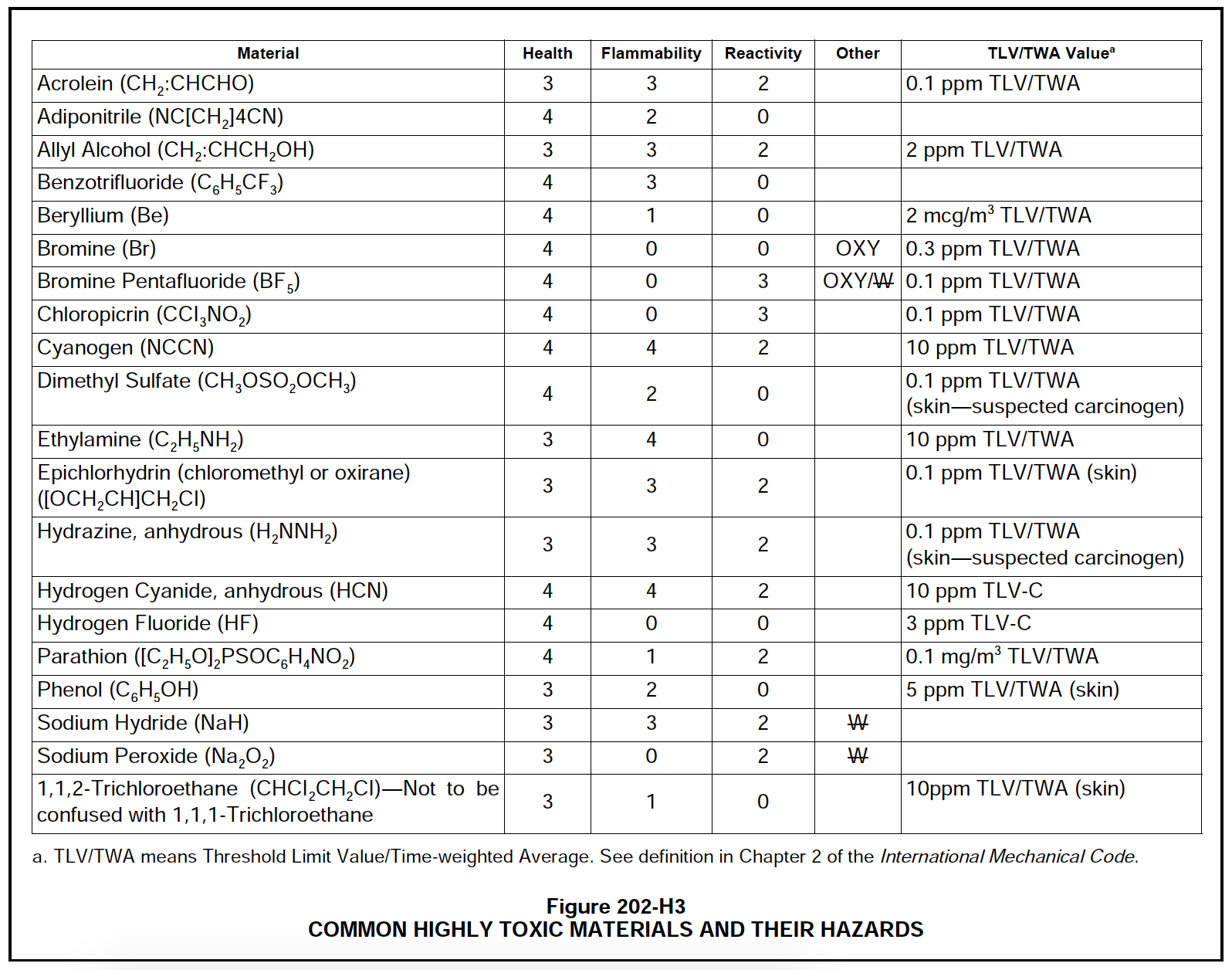
The great people at ICC have also provided us with a nice “recommendation” for what kinds of chemicals would fall under the “highly toxic” designation. This list is NOT a complete list, but provides us some insights as to what IFC would consider “highly toxic”…
The bottom line is that EACH OWNER has to ask the questions and apply the CAT M designation. This should be answered by a competent person/engineer at a corporate level for ALL the company’s Hazardous Materials within the company. And this exercise should NOT be viewed merely as a PSM/RMP question/designation, as the IFC uses quantities far less than OSHA/EPA PSM/RMP thresholds.