
For the life of me (pun intended) I can not find this fool who runs around and tells all these safety lies about OSHA compliance. I used to think it had to be Casper The Friendly Ghosts’ brother – but now I am at a loss in combating some of the most fundamental safety principles. But there is hope, my beloved Cincinnati OSHA office team (One of the 2 OSHA Technical Offices in the country) stepped up and issued citations last month to an employer who was not isolating their PRCSs properly and the office even made note that when reclassifying a PRCS – PROPER ISOLATION of the space is required. So let’s look at this critical aspect of preparing a PRCS for entry and what OSHA actually said in their most recent citations…
Are we able to see the theme from these four (4) citations?
(emphasis by me)
|
Citation 1 Item 3 Type of Violation: Serious; $10,728 29 CFR 1910.146(c)(7)(i): A space classified by the employer as a permit-required confined space may be reclassified as a non-permit confined space under the following procedures: 1910.146(c)(7)(i) If the permit space poses no actual or potential atmospheric hazards and if all hazards within the space are eliminated without entry into the space, the permit space may be reclassified as a non-permit confined space for as long as the non-atmospheric hazards remain eliminated. a) From October 8, 2020, to January 4, 2021, the employer had reclassified and entered the powder coat process line, a permit-required confined space, on 13 occasions without ensuring the space posed no actual or potential atmospheric hazards in order for maintenance employees to perform repairs and preventive maintenance. On the cure oven, the natural gas was not always gas locked out until November of 2020, the preheat oven and cure oven were not isolated from the natural gas lines as the ISOLATION PROCEDURE WAS NOT CORRECTLY PERFORMED BY ALL EMPLOYEES…
Citation 1 Item 4a Type of Violation: Serious; $10,728 29 CFR 1910.146(d)(3)(i): Develop and implement the means, procedures, and practices necessary for safe permit space entry operations, including, but not limited to, the following: Specifying acceptable entry conditions. a) From October 8, 2020, to January 4, 2021, the employer reclassified and entered the powder coat process line, a permit-required confined space, on 13 occasions without implementing the means, procedure, and practices specifying safe entry conditions in order for maintenance employees to perform repairs and preventive maintenance. The cure oven did not have the natural gas locked out until November of 2020, the PREHEAT OVEN AND CURE OVEN WERE NOT ISOLATED FROM THE NATURAL GAS USING A DOUBLE BLOCK AND BLEED…
Citation 1 Item 5a Type of Violation: Serious; $10,728 29 CFR 1910.146(g)(3): The training shall establish employee proficiency in the duties required by this section and shall introduce new or revised procedures, as necessary, for compliance with this section. a) On or about October 8, 2020, the employer did not provide training when a procedure was changed in that that employees were not trained on locking out the natural gas on the cure oven for the powder coat line, AN ENTRY SUPERVISOR AND EMPLOYEES WERE NOT TRAINED ON HOW TO ISOLATE THE NATURAL GAS LINES ON THE CURE OVEN AND PREHEAT THE OVEN…
Citation 1 Item 2 Type of Violation: Serious; $13,653 29 CFR 1910.147(c)(4)(ii): The procedures shall clearly and specifically outline the scope, purpose, authorization, rules, and techniques to be utilized for the control of hazardous energy, and the means to enforce compliance including, but not limited to, the following: B)Specific procedural steps for shutting down, isolating, blocking and securing machines or equipment to control hazardous energy; a) On or about 10/30/2020 the energy control procedure for the Powder Coat Cure Oven was inadequate in that it did not include specific procedural steps for safely shutting down and isolating the natural gas lines. THE PROCEDURE DID NOT IDENTIFY THE MEANS OF BLEEDING OFF THE EXCESS NATURAL GAS, THEREBY EXPOSING EMPLOYEES TO THE HAZARDS ASSOCIATED WITH NATURAL GAS… |
The GI standard could not be more clear…
1910.146(d)(3) Develop and implement the means, procedures, and practices necessary for safe permit space entry operations, including, but not limited to, the following:
…
1910.146(d)(3)(iii) Isolating the permit space
What does “isolating the permit space” mean – they were kind enough to define it for us:
“Isolation” means the process by which a permit space is removed from service and completely protected against the release of energy and material into the space by such means as: blanking or blinding; misaligning or removing sections of lines, pipes, or ducts; a double block and bleed system; lockout or tagout of all sources of energy; or blocking or disconnecting all mechanical linkages.
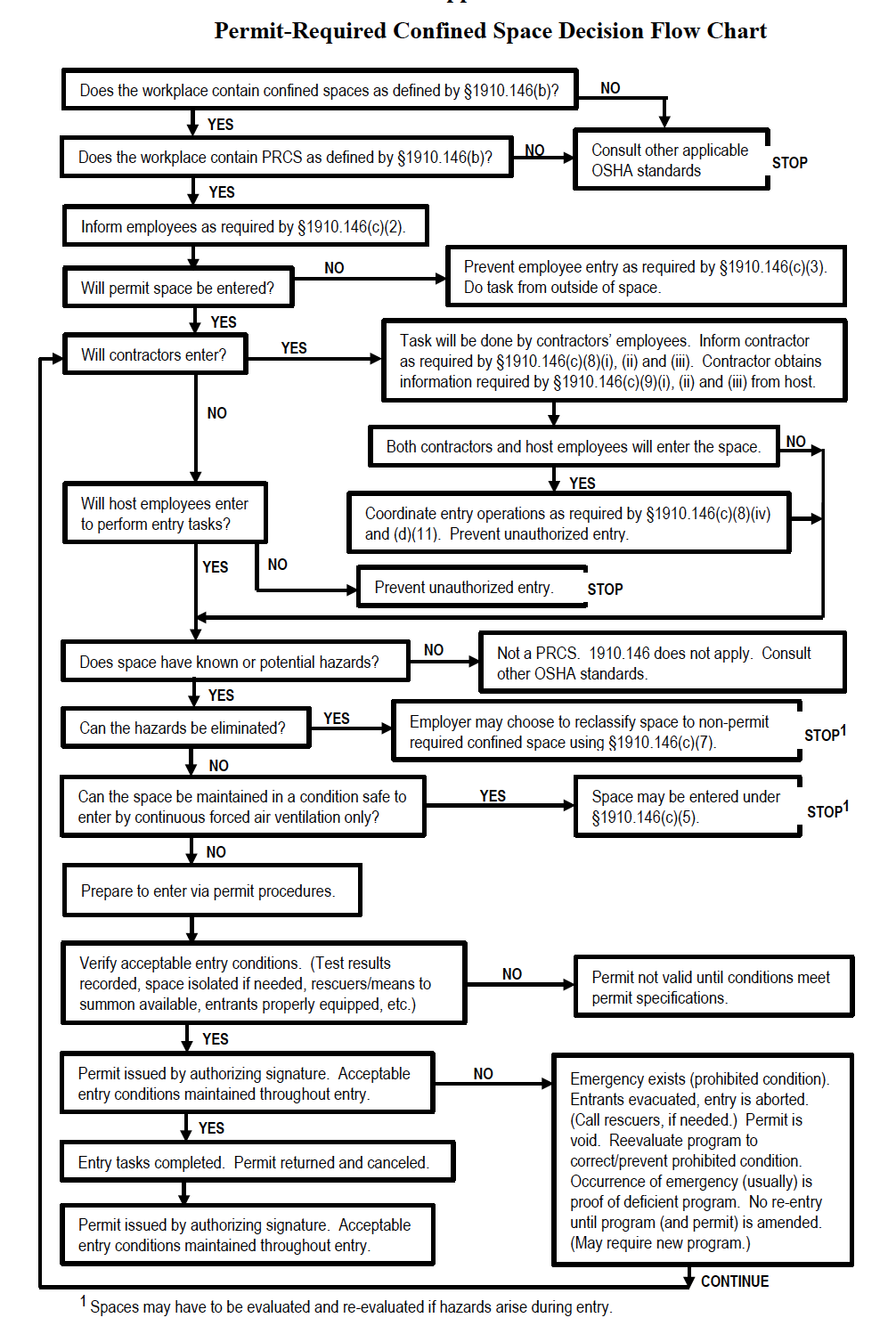
So what if I want to “reclassify” my PRCS to a non-PRCS for entry, what does OSHA require in terms of isolating the space?
1910.146(c)(7)(i) If the permit space poses no actual or potential atmospheric hazards and if all hazards within the space are eliminated without entry into the space, the permit space may be reclassified as a non-permit confined space for as long as the non-atmospheric hazards remain eliminated.
Now, this requirement may not be as clear as the one in .146(d)(3)(iii), but we can turn to an OSHA “cheat-sheet” and get a better understanding of HAZARD ELIMINATION entails for reclassifying a PRCS to a non-permit status. This is taken from OSHA 2008 LOTO CPL (emphasis by me)
|
Relationship between the Control of hazardous energy (LOTO) standard and the Permit-required confined spaces (PRCS), 29 CFR §1910.146, standard. The PRCS and the LOTO standards are generic and interrelated standards, and both standards may, depending upon the circumstances, apply to the isolation of hazardous energy for a PRCS. The application of the LOTO standard, with respect to PRCS, is governed by §1910.147(a)(3)(ii), which provides that, when other standards require LOTO, the procedural and training provisions of the LOTO standard shall be used and supplemented to effectively control hazardous energy. Therefore, for any particular PRCS, the question will be whether the 1910.146 standard requires LOTO to isolate hazardous energy. The answer to this question depends on the type(s) of hazardous energy that must be isolated, whether LOTO provides isolation (offering complete employee protection), and whether the §1910.146 requires the use of LOTO. Pursuant to the §1910.146 standard (including its final rule preamble), electro-mechanical types of hazards, associated with a PRCS, must be isolated in accordance with the LOTO standard (or guarded in accordance with Machine guarding, Subpart O, requirements). Failure to follow the procedural and training requirements of the LOTO standard should be cited as §1910.147 violations related to the isolation of electro-mechanical hazards. The PRCS standard does not, however, allow LOTO for flowable material isolation. This is because compliance with §1910.147 does not, in all cases, adequately isolate hazards created by materials such as steam, flammable gases, flammable and combustible liquids. In a permit-required confined space, hazards associated with flowable materials will be considered isolated only by the use of the following techniques: blanking or blinding; misaligning or removing sections of lines, pipes or duct; and use of a double block and bleed system. A double block and bleed isolation system, for example, usually utilizes the closure of two valves, the opening of a bleeder valve, and the application of LOTO devices (offering complete employee protection); whereas an employer can comply with §§ 1910.147(d)(3) and 1910.147(d)(4) of the LOTO standard by simply closing and LOTO of a single valve (which could create atmospheric hazards due to the leakage of a single valve). |
So the ONLY entry option that does not mention isolation is (c)(5) and this is because this entry option is ONLY allowed when the space has ONLY an atmospheric hazard that can be controlled by forced-air ventilation. In other words, it is like a “telecommunications vault” that has nothing attached to it that needs “isolating”. There are no hoses/tubing, piping, or ductwork attached to the vault that could convey a hazardous substance to the space.
So let’s be honest… if you have a 50-year-old plant isolating your PRCS properly may be a challenge. But if the space was created/installed/constructed since 1995/96 and there is no way that blanking or blinding, misaligning or removing sections of lines, pipes or duct, and/or use of a double block and bleed system can be used to properly isolate the space then we really have no excuse. Does it cost money to configure an installation that we know will require entry into the vessel so that it can be isolated using 1 of these 3 means? Absolutely it does, but it also saves a tremendous amount of time when the time comes that the space has to be entered. But the days of crying and saying we have no way to isolate our space using one of these three means and therefore just not doing it are over. Most would agree, 20 years of notice is ample!!!

