
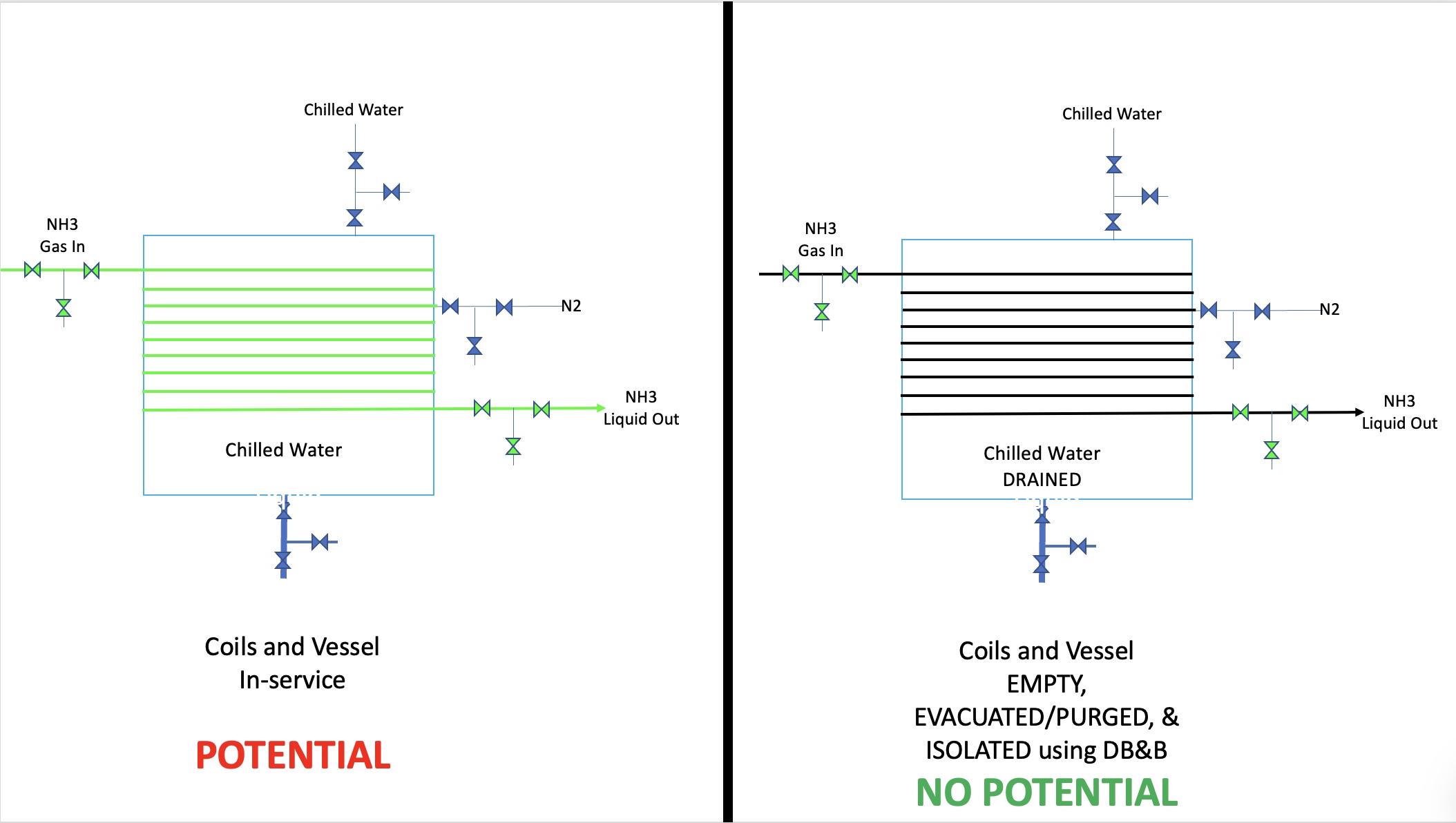
Isolating piping passing through a PRCS (OSHA LOI)

Well, it’s not often that I disagree with the OSHA technical team that writes LOIs, but this one is a MAJOR MISTAKE. I have debated this topic for 30 years and now my argument just got squashed by the agency. In their 2025 LOI, OSHA stated:

If the employer's evaluation of the space determines that the piping does not terminate in the space and that no potential exists for rupture or leakage of materials into the space, then isolation of the piping is not required.

NFPA 350 makes a similar comment:

8.6.5 Pipes and lines that run through but do not terminate within a confined space do not need to be disconnected or isolated as indicated in 8.6.3 provided that the Entry Supervisor determines that the materials in these lines are not impacted by the work being done in the space and do not create a hazard to workers in the space.

Scenario: Our client operates a large university campus which utilizes a complex steam, chilled and hot water system that connects to several buildings. The systems contain in-ground utility vaults, and contain chilled and hot water piping, valves, and connections that pass through the vaults, but do not terminate in or serve the vaults. The purpose of these vaults is to manipulate valves to isolate or sectionalize the chilled water and hot water systems. Dozens of these vaults are designated as permit-required confined spaces. The hot water and chilled water pipes can be isolated and drained prior to entry into these spaces. This can be accomplished by shutting nearby valves and draining the necessary parts of the system. However, due to the age and complexity of the utility system, draining hot and cold-water pipes from certain confined spaces requires draining millions of gallons of hot or cold water from significant portions of the university. Further, refilling the systems can be complex and take days. During this process dormitories could become uninhabitable under state law and research could be disrupted. The application of OSHA’s standard at 1910.146(d)(3)(iii) requires employers to “isolate” the space and verify that conditions in the permit space are acceptable for entry throughout the duration of the entry.

Question: Does 1910.146(d)(3)(iii) require the employer to isolate and drain all flowable utilities that contain valves and other connections within the space, such as flanges, prior to entering the space, where the employer is not working on that piping and there is no known breach or hazard posed by the piping? Is such isolation required where the employer’s hazard assessment has indicated that there is no engulfment or atmospheric hazard from the quantity of liquid or gas in the lines that could potentially enter the space? Additionally, does 1910.146(d)(3)(iii) require the employer to isolate and drain all flowable utilities prior to entering the space to manipulate flowable utility isolation valves?

Response: The OSHA permit required confined space standard is a performance-oriented standard and requires an evaluation be made per 29 CFR 1910.146(c)(1) to determine if any “confined spaces” are “permit-required confined spaces”, as defined by the standard. If the spaces in question meet the definition of a permit required confined space, and entry is authorized, 29 CFR 1910.146(d)(3)(iii) requires employers to isolate the permit space prior to entry. Piping that contains flowable materials such as water or steam must be isolated when the employer’s evaluation determines that due to the condition of the piping, valves or flanges, manipulation and/or work performed related to the valve or flange, work done adjacent to the piping, valves and flanges, or for other reasons there exists a potential for the piping inside the space to rupture or leak into the space and potentially result in engulfment, burns, or other serious safety or health hazard to an entrant. If the employer’s evaluation of the space determines that the piping does not terminate in the space and that no potential exists for rupture or leakage of materials into the space, then isolation of the piping is not required.

Question: OSHA’s letter of interpretation dated October 27, 1995 states that “…crawl spaces of the traditional multi-family or commercial building generally contain utility service lines (i.e., water, natural gas, fuel oil, sewage, steam, and electric power) which pass through them. If these utility services do not terminate at end use equipment in the crawl space, the inherent hazards of the material flowing through the service lines do not have to be considered in the permit space determination unless there is reason to believe there is a reasonable probability of a rupture or leak where the contents of the piping would cause a serious safety or health hazard.”

Does the presence of flowable utility piping valves, flanges, and/or other connections within the permit space that pass through the space and do not terminate in the space, present a “reasonable probability of a rupture or leak where the contents of the piping would cause a serious safety or health hazard”? What are examples of ‘reasonable probability of a rupture or leak’ in a utility service line?

Response: As stated in the answer to question #1, employers are required to conduct an evaluation of spaces to determine if they meet the definition of a permit required confined space under 29 CFR 1910.146(b), including whether the area contains a “recognized serious safety or health hazard.” Whether there exists a “reasonable probability of a rupture or leak where the contents of the piping would cause a serious safety or health hazard” is a determination to be made by the employer. Factors to consider include, but are not limited to, age and condition of the piping; whether routine inspection and maintenance of piping, valves, flanges, and/or other connections have been made by the employer and at what periodicity; whether the work to be done will involve the piping, valves, flanges, or other connections; whether the work to be conducted will be within close proximity such that piping systems could be damaged; history of failures of piping, valve, flange, or other connections; and whether the maximum volume and flow of the flowable material in question would cause a serious safety or health hazard such as, but not limited to, engulfment of an entrant.

Source: https://www.osha.gov/laws-regs/standardinterpretations/2025-01-03

Scroll to Top