
Earlier today I posted a recent OSHA citation where a facility was cited for not having procedures regarding the means to isolate and verify ZES for pneumatic energy sources (i.e. plant air). For some reason, on nearly all of my LOTO projects I find that air sources are a bastardized source of energy when it comes to a means to isolate it and verify it is at a Zero Energy State (ZES). A typical air set up is a drop line off a header, which may or may not have a 1/4 turn ball valve at the end of the drop. At the end of the drop, there is usually a hose connected which conveys the air source to the machine/equipment. Hose or hard pipe, it really does not matter for the purposes of this article. Here is an example from one of my procedures over the years:
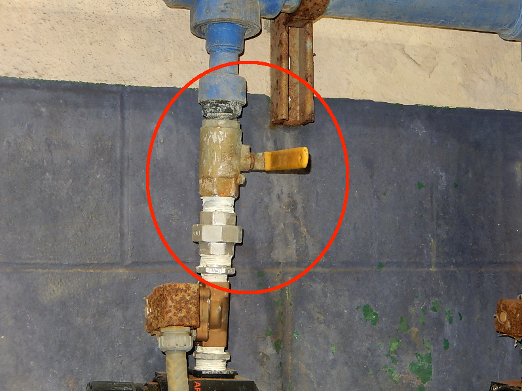
9 times out of ten, facilities will say something like “CLOSE and Lockout valve #XXX”. And this is NOWHERE near a Safe State! As we can see in the picture, the valve is CLOSED and I can apply my LO Lock to the valve, but the equipment below the valve is still ENERGIZED at its FULL pressure. The procedure MUST include a means to “release the stored energy” AND a means by which we can verify the air pressure is at its ZES. This is where a bleed/vent and gauge come in handy!
But we can make this really easy for just a few dollars more; behold a DUMP VALVE with a built-in gauge:
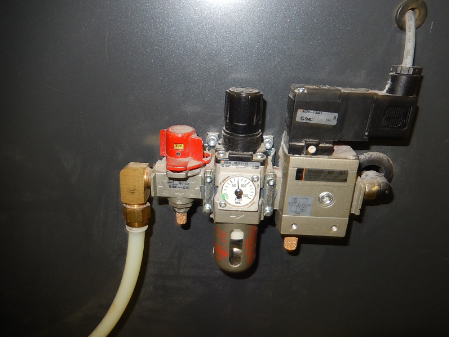
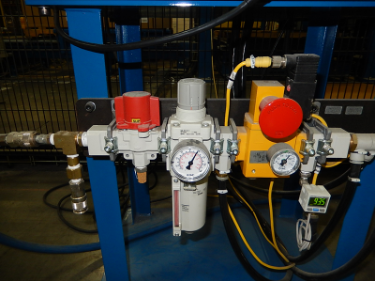
These devices used to be a very special and costly addition to a plant, but today, dump valves can be bought for as little as $50; even the ones with built-in gauges are less than $100. The amount of time these dump valves will save us, and the fact that we can be assured that the air is at a ZES and can NOT re-accumulate if the isolation valve fails is PRICELESS!
Be careful with salespeople who will claim a dump valve needs no pressure gauge, as the user can “hear” the air discharging from the valve. Don’t be fooled by this – of course, we can hear the air “dumping out,” but how many of us can hear ALL THE AIR dumping out? A gauge is an ABSOLUTE MUST, in my opinion. As shown above, these dump valves come with a gauge built-in as it is part of the pressure regulator.
Another item we need to be aware of is some of these arrangements come with “check-valves” built-in. These are in place so that the pump/equipment will stay primed/charged for production reasons. In the first picture, I highly suspected there was a check valve in the elbow after the ball valve, as there was a directional arrow on the elbow. So, when the facility came back to me about my concerns regarding no means to release the stored energy, their solution was to merely break the connection at the provided fitting just below the isolation valve. When I voiced my concern about the chance there may be a check valve in the fitting at the hose, they went and checked by closing the ball valve and disconnecting the fitting below it. They then pushed the start button for the pump, and it cycled 2-3 times (i.e., there was indeed a check valve that prevented the air from flowing back to the disconnected fitting)
I am not endorsing any brand or supplier – merely hoping that more facilities will see the value in these dump valve arrangements and incorporate them into their machine/equipment designs. A quarter-turn ball valve is an effective isolation device, but it comes with several ADDITIONAL steps (some requiring tools to be readily available).
Here is a video I shared in my social media groups last year of a dump valve being used, but the gauge is BROKEN, and luckily, it is BROKEN showing pressure. But you can get an idea of how these dump valves work.