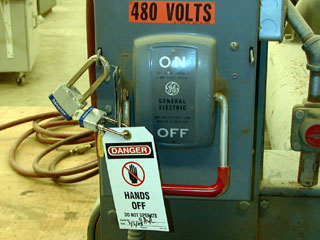
Here we sit, ending the year 2013, 20+ years after OSHA promulgated its Control of Hazardous Energy (e.g., Lockout/Tagout) standard. Yet, we still see so much confusion regarding this safety-critical standard. We get so much resistance on some of the most basic requirements of LOTO that I thought it would be helpful to dispel two of the most common errors/misunderstandings we encounter…
OSHA does NOT, nor have they ever, require a “tagout” tag be placed with each “lockout” lock. In fact, OSHA gives us the option of using locks or tags; however, they certainly prefer locks by placing several high hurdles one must clear before using tags instead of locks. Let’s look at what 1910.147 says about using locks and tags…
(emphasis by me)
1910.147(c)(2)(i) If an energy isolating device is NOT capable of being locked out, the employer’s energy control program under paragraph (c)(1) of this section SHALL UTILIZE A TAGOUT SYSTEM.
1910.147(c)(2)(ii) If an energy isolating device is capable of being locked out, the employer’s energy control program under paragraph (c)(1) of this section SHALL UTILIZE LOCKOUT, unless the employer can demonstrate that the utilization of a tagout system will provide FULL EMPLOYEE PROTECTION as set forth in paragraph (c)(3) of this section.
Here is paragraph (c)(3):
1910.147(c)(3)(i) When a tagout device is used on an energy isolating device which is capable of being locked out, the tagout device shall be attached at the same location that the lockout device would have been attached, AND the employer shall demonstrate that the tagout program will provide a level of safety equivalent to that obtained by using a lockout program.
(SAFTENG NOTE: (c)(3)(i) is where the “Tag-Plus” requirements stem from)
1910.147(c)(3)(ii) In demonstrating that a level of safety is achieved in the tagout program which is equivalent to the level of safety obtained by using a lockout program, the employer shall demonstrate full compliance with all tagout-related provisions of this standard together with such ADDITIONAL ELEMENTS as are necessary to provide the equivalent safety available from the use of a lockout device. Additional means to be considered as part of the demonstration of full employee protection shall include the implementation of ADDITIONAL SAFETY MEASURES such as the removal of an isolating circuit element, blocking of a controlling switch, opening of an extra disconnecting device, or the removal of a valve handle to reduce the likelihood of inadvertent energization.
So as we can see, OSHA clearly is giving the employer the option of using locks OR tags and in NO WAY requires BOTH a lock and a tag on an energy-isolating device.
This takes me to the next issue we see with using the lock/tag combo… identification of lockout locks.
OSHA REQUIRES us to identify our lockout locks by COLOR, SHAPE, or SIZE. These are the ONLY approved methods of identifying lockout locks! It is NOT permissible to use any color, shape, or size lock as a lockout lock and then apply a “Tagout Tag” as the means to identify the lock as a “lockout lock.” ALL lockout locks MUST BE identified by either their COLOR, SHAPE, or SIZE. Now it is PERMISSIBLE to use a tagout tag on a PROPERLY IDENTIFIED lockout lock (i.e., color, shape, size) to identify who placed the lock on the isolation device. But this is the SOLE REASON for using the tag in this situation; in NO WAY should the tag be utilized to identify just any lock as a “lockout lock.” Let’s see what 1910.147 says about this…
1910.147(c)(5)(ii)(B) Standardized. Lockout and tagout devices shall be standardized within the facility in at least one of the following criteria: Color; shape; or size; and additionally, in the case of tagout devices, print and format shall be standardized.
…
1910.147(c)(5)(ii)(D) Identifiable. Lockout devices and tagout devices shall indicate the identity of the employee applying the device(s).
Here is a perfect example of what we commonly see…
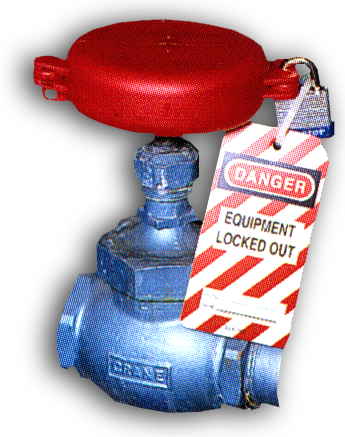
You will note that the “lockout lock” used is the very common silver Master brand lock, with the blue trim on the bottom of the lock. This very lock color (silver) may be the most popular lock in the United States of America, and to think that this lock “color” is used solely for lockout and NO OTHER use on the property is a LONGSHOT at best. So the facility decides that by hanging a “tagout tag” on this common lock, somehow now identifies the silver master lock with the blue band as their “lockout lock”… WRONG!
For the facility to be in compliance with 1910.147, it would have to have this silver master lock, with blue trim, listed in its LOTO written program as a lockout lock AND THEN ensure that this silver master locks with blue trim are used ONLY for lockout and NO OTHER uses (e.g., not on sprinkler systems, personal lockers, fence gates, etc.).
Think I am crazy…
1910.147(c)(5)(ii) Lockout devices and tagout devices shall be singularly identified; shall be the only devices(s) used for controlling energy; shall not be used for other purposes; and shall meet the following requirements: …
Here is another POOR EXAMPLE of LOTO. This came from an article on a popular safety site discussing the Top 5 LOTO citations… ironically the photo shows a violation; at least, at first glance, it does!
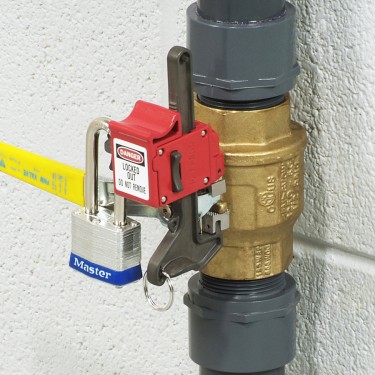
In this photo, you will again see the ever-popular silver Master brand lock with blue trim and a lockout device designed for quarter-turn valves. Notice the sticker on the isolation device and the lock hanging on the device. What do we see as possible issues with this arrangement?
As stated above, we hope the facility has called out in their LOTO written program that silver master locks with blue trim are LOTO locks and that these locks are used for NOTHING BUT LOTO. But who applied this lockout device to the energy-isolating device/valve? In the picture, we see nothing to inform us as to which authorized employee applied this lockout device. Granted, there may be some system in place, such as a LOTO Permit, that may tell us who applied this lockout; however, these permit systems will use lockout locks with some identification method so that we can trace the lock number, letter, etc. back to a LOTO Permit which will then provide us the name of the authorized employee who applied the lockout device. AND PLEASE DO NOT think that the “sticker” on the lockout device “identifies” this as a lockout! Danger Stickers were NOT an ” approved method” for identifying lockout devices (e.g., color, shape, or size).
Now I will admit that BOTH photos above should make it obvious that the equipment is “locked out”; however, 1910.147 are the most basic requirement, and 1910.147 is NOT fully met in both photos.
Summary: Using a tagout device on a lockout lock is not necessarily wrong; however, using that tagout device as your means to “identify” the lockout lock as such is WRONG and is NOT compliant, regardless of how many marketing photos you have seen over your career.
Ending with a photo to show how “confusion” in a LOTO program can look in the field. Do you see the issue in this photo? Note: One of the silver master locks is being used for LOTO, and one is being used for another safety compliance reason. Another HUGE issue is shown in this photo that is used online to represent “safety training” in how LOTO is supposed to look… God help us! CLICK HERE to see the actual webpage with this photo.